reporails@reporails
reporails/arcade/tree/main/doom
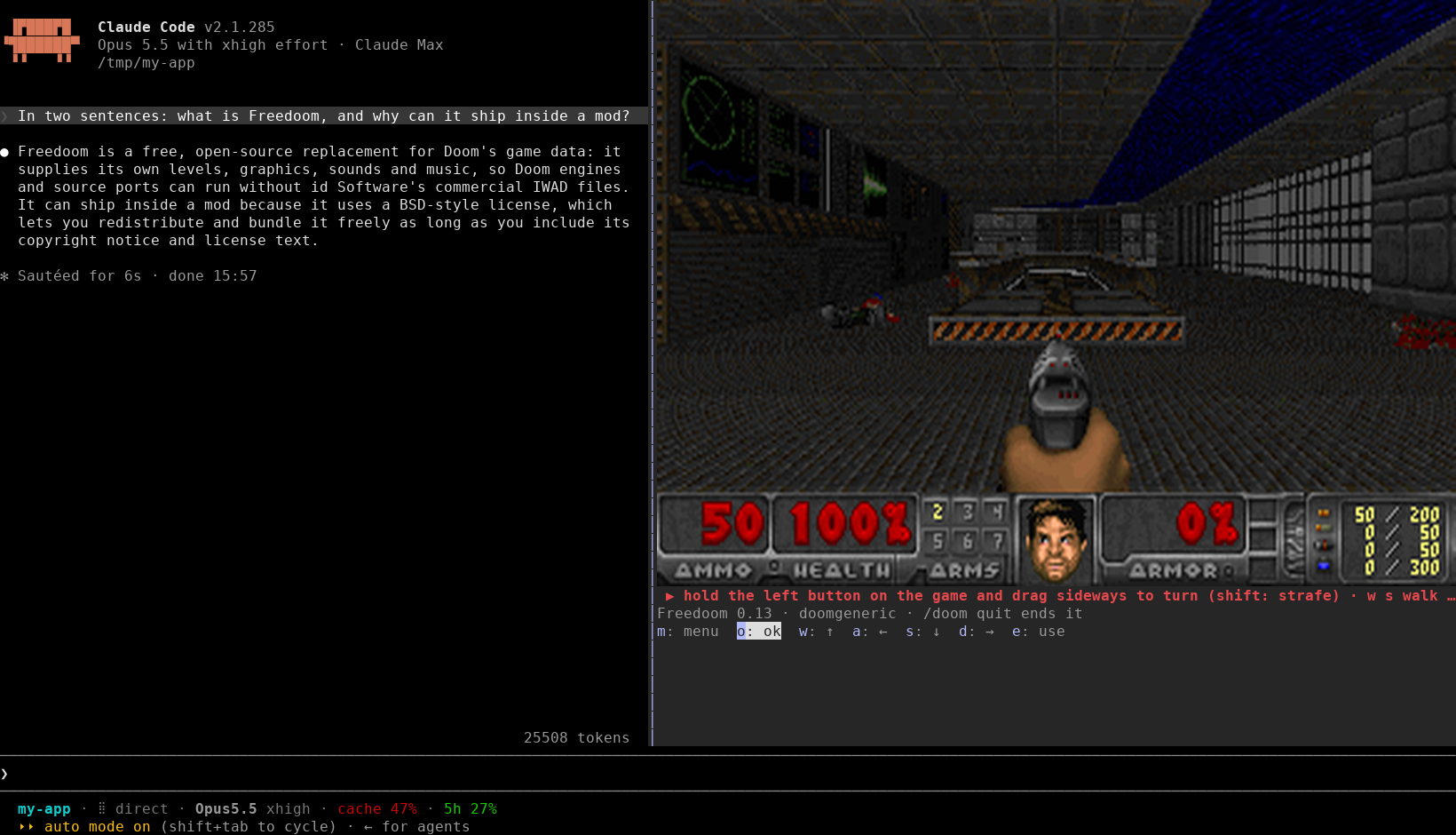
Doom in a Claude Code pane: Freedoom on the doomgeneric engine, a real picture in kitty and Ghostty and block characters elsewhere, played with the keys and the mouse while Claude works. Prebuilt engines for Linux, macOS and Windows.
reporails/arcade/tree/main/doom
Doom in a Claude Code pane. A mod, shipped as a plugin: /doom opens a pane and plays Freedoom on the doomgeneric engine while Claude works. In kitty or Ghostty the screen is a real picture at Doom's own 320×200; in any other terminal it is drawn in quadrant block characters, four pixels a cell. It reads nothing the model sees and adds nothing to it. Unlike the other arcade games it does hook the prompt box, and only while you play: game keys that land there go to Doom instead (type / to have it back). It runs the engine as a child process and talks to it on this machine only, over a Unix socket or 127.0.0.1.

It carries a prebuilt engine for Linux, macOS and Windows, each on x86_64 and arm64, so no compiler is needed. Only the Linux x86_64 engine has been run so far (see What has been verified).
In a Claude Code session:
/plugin marketplace add reporails/arcade
/plugin install doom@reporails-arcade
Then start Claude Code in the fullscreen layout and run /doom:
CLAUDE_CODE_NO_FLICKER=1 claude
On 2.1.285 or 2.1.286, where mods are early access, add CLAUDE_CODE_ENABLE_FUNCTION_HOOKS=1; from 2.1.287 mods load by default. It has been played on 2.1.285 only. From a checkout: claude --plugin-dir ./doom.
| Platform | Engine | Picture |
|---|---|---|
| Linux x86_64 / arm64 | engine/bin/linux-*/doom-claude, static (musl): any distribution | kitty or Ghostty: the picture; elsewhere blocks |
| macOS Apple silicon / Intel | engine/bin/macos-*/doom-claude | kitty or Ghostty: the picture; Terminal.app and iTerm2: blocks |
| Windows x86_64 / arm64 | engine/bin/windows-*/doom-claude.exe | blocks (no Windows terminal speaks kitty's picture protocol that the mod detects) |
| Anything else with a C compiler | built on first /doom with make | as above |
Under WSL, Claude Code is a Linux program and uses the Linux engine.
Run it in kitty or Ghostty for the full picture; the mod finds them by TERM / TERM_PROGRAM, and falls back to blocks if Claude Code refuses the picture anyway (as it does inside tmux). In any other terminal the screen's size follows the terminal's height: the dock is as tall as the space above the prompt, the screen is 3/8 as many rows as columns (Doom's 4:3), and the pane narrows to the screen's width so the transcript keeps the rest. On a 126×38 terminal that is about 72×27 to 85×32 cells, 144×54 to 170×64 pixels. More rows (a smaller font, or a taller window) give a sharper picture.
CLAUDE_CODE_NO_FLICKER=1 turns on the fullscreen layout: the pane docks on the right and takes clicks. Without it the pane sits above the prompt and Doom is played with the button keys alone.
| Input | What it does |
|---|---|
| /doom | Opens the pane and starts Doom. If Doom is running, brings the pane back. |
| /doom quit | Ends Doom and closes the pane. |
| Esc | Gives the keyboard back to Claude Code's prompt (Claude Code keeps Escape for that; no mod can take it). Game keys you go on pressing still reach Doom: while you play, the mod takes them out of the prompt and hands them to the game. |
| Ctrl+X then X | Closes the pane, which ends Doom. |
/doom is an immediate command, so it works while Claude is mid-turn.
The mouse turns and the keys walk: a terminal tells when a mouse button goes down and when it comes up, which it never does for a key, so turning, which needs to stop exactly, is the mouse's job.
| Mouse, on the game | Doom |
|---|---|
| Hold the left button and drag left or right | Turn, exactly as fast as a and d (half speed for the first sixth of a second, as Doom turns a held key), however far you drag; an up or down drag does nothing |
| …with shift held | Strafe instead of turn |
| Let go | Stop turning, at once |
| Hold the right button | Fire, for as long as it is held |
The drag is measured from where the button went down, and keeps working past the edge of the game once the button is down. The red strip under the game takes the same drags and says what the stick is doing ("◉ turn right"). Walk with w and s while you drag: the keys and the mouse work at once. A click on the game or the strip also gives Doom the keyboard:
| Key | Doom |
|---|---|
| Space | Fire |
| e | Use (doors, switches) |
| 1 to 7 | Weapons |
| m or backspace | Menu |
| Return | Pick in a menu; yes to Doom's questions (quit, new game, nightmare) |
| Arrows, w a s d | Move and turn, held the way a terminal allows (below) |
| , . | Strafe |
| Tab | Map |
| p | Pause |
| y n | Yes (sends Return), no |
| Esc | Hands the keyboard back to the prompt; game keys still reach Doom while you play (below) |
Without a click, the buttons under the strip answer their letters: m menu, o ok, w a s d, e use; and Return presses ok, which holds the pane's focus ring. Every other game key (space, the digits, , .) lands in Claude Code's prompt, and so does every key after Esc. So while you play (the game had input in the last 10 seconds), the prompt is Doom's (a prompt.edit hook): a game key that lands there goes to Doom, any other key is dropped, and nothing stays in the prompt. Type / to have it back at once (for /doom quit, or delete it and write to Claude), or leave the game alone for 10 seconds. A draft you had typed before is never touched. The arrows never reach Doom without a click: in the prompt they recall earlier prompts. m, then Return three times, starts a new game on the default skill. The engine makes Enter Doom's confirm key, so Return answers yes; n answers no. The mouse needs the fullscreen layout (CLAUDE_CODE_NO_FLICKER=1).
During the title demo any key opens the menu (Doom's own rule), and m (Escape) closes it again when it is open.
A terminal sends no key-up, only a press and then its auto-repeat (half a second later on GNOME, then every 30 ms), and it repeats only the newest key: once a is pressed while w is held, w goes quiet whether it is still held or not. So, as doom-cli does, a key counts as held until its next repeat is due: a press of a movement or turn key holds it until the first repeat could come (the terminal's repeat delay, which the engine learns from the repeats it sends, plus 60 ms), each repeat for 160 ms more, so a held key never stops and a key let go stops a sixth of a second after its last repeat. A turn key in play turns through Doom's mouse instead: slowly until the terminal repeats it, then as fast as Doom's arrow keys (half speed for their first sixth of a second, as Doom ramps a held key), so a tap turns about 10°, as a quick tap does in Doom with a real keyboard, and a held key never stops (doom-cli's own source suggests this: "just turn more slowly outside of state repeat"). In a menu, the title demo or a pause the turn keys stay keys, so menu sliders still take them. Fire and use hold 120 ms, so a tap is one shot. Movement keys take turns: pressing w a s d, an arrow, , or . lets go of every other movement key at once, so a turn key only turns and walking stops the moment you turn. Walking and turning together is a walking key plus a sideways drag of the mouse. Fire, use and weapons are held on their own and let go of nothing: space while walking fires and keeps walking until the walking key's hold runs out.
doom/
├── .claude-plugin/plugin.json
├── hooks/
│   ├── hooks.json            points at register.ts
│   ├── register.ts           the hooks: the command, the pane, the frame pull, the keys
│   ├── pad.ts                the surface module: the strip that takes the keyboard
│   └── lib.ts                pure functions: key map, screen size, URLs, engine arguments
├── engine/
│   ├── doomgeneric/          the doomgeneric engine, unchanged (GPL-2.0)
│   ├── doomgeneric_claude.c  its platform layer: HTTP on a Unix socket or 127.0.0.1 instead of a window
│   ├── bin/<os>-<arch>/      prebuilt engines: linux, macos, windows × x86_64, arm64
│   ├── build-all.sh          builds bin/ for every platform with zig cc
│   └── Makefile              builds ./doom-claude for this machine; the mod runs it when no prebuilt engine fits
├── wad/freedoom1.wad         Freedoom Phase 1, 0.13.0 (BSD; wad/COPYING.freedoom)
├── data/                     made at first run: Doom's config, saves, engine.log (the engine's last run)
├── tests/doom.test.ts        runs with `claude plugin test`
└── README.md
How it fits together:
/doom works out the machine (%OS% and %PROCESSOR_ARCHITECTURE% on Windows, uname -sm elsewhere), picks engine/bin/<os>-<arch>/doom-claude, falls back to one built here with make (never on Windows), and starts it with $.process.spawn. The engine runs for as long as the mod reads its output: Claude Code ends it when the mod unloads. The mod waits for the line doom-claude listening the engine prints once it listens; whatever the engine writes is kept, and written to data/engine.log when it ends, the last line shown in the pane if it ends badly.XDG_RUNTIME_DIR), else the user's temporary directory (TMPDIR, as on macOS), else data/: the first whose path fits a socket (about 100 bytes). On Windows, or when no path fits, the engine listens on 127.0.0.1 on a free port it prints (doom-claude listening port=N), and takes only requests carrying the X-Doom-Token header with a random 64-digit token the mod hands it in its environment (DOOM_CLAUDE_TOKEN); anything else is refused with 403. DOOM_CLAUDE_TRANSPORT=tcp makes Linux and macOS use 127.0.0.1 too, which is how that path was tried on Linux./image?since=…. When there is a newer frame the engine writes it as raw 320×200 RGB to a file in the same private directory as its socket (written beside it and renamed over it, so it is never read half-written) and answers with its number. The hooks module swaps the keyed Image to { file, format: 'rgb', width: 320, height: 200, generation }. Claude Code hands kitty the file's path and kitty reads the pixels itself, so no pixel passes through Claude Code. Ten refused swaps in a row (the Image showing its alt text) switch the screen to blocks./frame?c=…&r=… with $.http.fetch. The engine answers with the screen already encoded as Raster cells, and the hooks module blits that text onto the mounted Raster with $.ui.blit. A frame not newer than the last one painted (the engine counts a frame only when the picture changed) is answered with an empty 204.Raster paints at most 1024 colour pairs and snaps the rest to the nearest, which speckles the picture, and 32 by 32 is 1024. A cell takes its left neighbour's colours when they fit nearly as well, because Claude Code's paint gets slower the more often the colour changes along a row (measured: 12–14 frames a second with a 64-colour palette and no reuse, 20–35 with this, on the same loaded machine). No cell is a blank, because Claude Code leaves blanks at the end of a row undrawn.Check the author's README for the marketplace and plugin name first. Commands may change as the repository evolves.
claude plugin marketplace add reporails/arcade
claude plugin install doom
Doom in a Claude Code pane. A mod, shipped as a plugin: /doom opens a pane and plays Freedoom on the doomgeneric engine while Claude works. In kitty or Ghostty the screen is a real picture at Doom's own 320×200; in any other terminal it is drawn in quadrant block characters, four pixels a cell. It reads nothing the model sees and adds nothing to it. Unlike the other arcade games it does hook the prompt box, and only while you play: game keys that land there go to Doom instead (type / to have it back). It runs the engine as a child process and talks to it on this machine only, over a Unix socket or 127.0.0.1.
It carries a prebuilt engine for Linux, macOS and Windows, each on x86_64 and arm64, so no compiler is needed. Only the Linux x86_64 engine has been run so far (see What has been verified).
In a Claude Code session:
/plugin marketplace add reporails/arcade
/plugin install doom@reporails-arcade
Then start Claude Code in the fullscreen layout and run /doom:
CLAUDE_CODE_NO_FLICKER=1 claude
On 2.1.285 or 2.1.286, where mods are early access, add CLAUDE_CODE_ENABLE_FUNCTION_HOOKS=1; from 2.1.287 mods load by default. It has been played on 2.1.285 only. From a checkout: claude --plugin-dir ./doom.
| Platform | Engine | Picture |
|---|---|---|
| Linux x86_64 / arm64 | engine/bin/linux-*/doom-claude, static (musl): any distribution | kitty or Ghostty: the picture; elsewhere blocks |
| macOS Apple silicon / Intel | engine/bin/macos-*/doom-claude | kitty or Ghostty: the picture; Terminal.app and iTerm2: blocks |
| Windows x86_64 / arm64 | engine/bin/windows-*/doom-claude.exe | blocks (no Windows terminal speaks kitty's picture protocol that the mod detects) |
| Anything else with a C compiler | built on first /doom with make | as above |
Under WSL, Claude Code is a Linux program and uses the Linux engine.
Run it in kitty or Ghostty for the full picture; the mod finds them by TERM / TERM_PROGRAM, and falls back to blocks if Claude Code refuses the picture anyway (as it does inside tmux). In any other terminal the screen's size follows the terminal's height: the dock is as tall as the space above the prompt, the screen is 3/8 as many rows as columns (Doom's 4:3), and the pane narrows to the screen's width so the transcript keeps the rest. On a 126×38 terminal that is about 72×27 to 85×32 cells, 144×54 to 170×64 pixels. More rows (a smaller font, or a taller window) give a sharper picture.
CLAUDE_CODE_NO_FLICKER=1 turns on the fullscreen layout: the pane docks on the right and takes clicks. Without it the pane sits above the prompt and Doom is played with the button keys alone.
| Input | What it does |
|---|---|
| /doom | Opens the pane and starts Doom. If Doom is running, brings the pane back. |
| /doom quit | Ends Doom and closes the pane. |
| Esc | Gives the keyboard back to Claude Code's prompt (Claude Code keeps Escape for that; no mod can take it). Game keys you go on pressing still reach Doom: while you play, the mod takes them out of the prompt and hands them to the game. |
| Ctrl+X then X | Closes the pane, which ends Doom. |
/doom is an immediate command, so it works while Claude is mid-turn.
The mouse turns and the keys walk: a terminal tells when a mouse button goes down and when it comes up, which it never does for a key, so turning, which needs to stop exactly, is the mouse's job.
| Mouse, on the game | Doom |
|---|---|
| Hold the left button and drag left or right | Turn, exactly as fast as a and d (half speed for the first sixth of a second, as Doom turns a held key), however far you drag; an up or down drag does nothing |
| …with shift held | Strafe instead of turn |
| Let go | Stop turning, at once |
| Hold the right button | Fire, for as long as it is held |
The drag is measured from where the button went down, and keeps working past the edge of the game once the button is down. The red strip under the game takes the same drags and says what the stick is doing ("◉ turn right"). Walk with w and s while you drag: the keys and the mouse work at once. A click on the game or the strip also gives Doom the keyboard:
| Key | Doom |
|---|---|
| Space | Fire |
| e | Use (doors, switches) |
| 1 to 7 | Weapons |
| m or backspace | Menu |
| Return | Pick in a menu; yes to Doom's questions (quit, new game, nightmare) |
| Arrows, w a s d | Move and turn, held the way a terminal allows (below) |
| , . | Strafe |
| Tab | Map |
| p | Pause |
| y n | Yes (sends Return), no |
| Esc | Hands the keyboard back to the prompt; game keys still reach Doom while you play (below) |
Without a click, the buttons under the strip answer their letters: m menu, o ok, w a s d, e use; and Return presses ok, which holds the pane's focus ring. Every other game key (space, the digits, , .) lands in Claude Code's prompt, and so does every key after Esc. So while you play (the game had input in the last 10 seconds), the prompt is Doom's (a prompt.edit hook): a game key that lands there goes to Doom, any other key is dropped, and nothing stays in the prompt. Type / to have it back at once (for /doom quit, or delete it and write to Claude), or leave the game alone for 10 seconds. A draft you had typed before is never touched. The arrows never reach Doom without a click: in the prompt they recall earlier prompts. m, then Return three times, starts a new game on the default skill. The engine makes Enter Doom's confirm key, so Return answers yes; n answers no. The mouse needs the fullscreen layout (CLAUDE_CODE_NO_FLICKER=1).
During the title demo any key opens the menu (Doom's own rule), and m (Escape) closes it again when it is open.
A terminal sends no key-up, only a press and then its auto-repeat (half a second later on GNOME, then every 30 ms), and it repeats only the newest key: once a is pressed while w is held, w goes quiet whether it is still held or not. So, as doom-cli does, a key counts as held until its next repeat is due: a press of a movement or turn key holds it until the first repeat could come (the terminal's repeat delay, which the engine learns from the repeats it sends, plus 60 ms), each repeat for 160 ms more, so a held key never stops and a key let go stops a sixth of a second after its last repeat. A turn key in play turns through Doom's mouse instead: slowly until the terminal repeats it, then as fast as Doom's arrow keys (half speed for their first sixth of a second, as Doom ramps a held key), so a tap turns about 10°, as a quick tap does in Doom with a real keyboard, and a held key never stops (doom-cli's own source suggests this: "just turn more slowly outside of state repeat"). In a menu, the title demo or a pause the turn keys stay keys, so menu sliders still take them. Fire and use hold 120 ms, so a tap is one shot. Movement keys take turns: pressing w a s d, an arrow, , or . lets go of every other movement key at once, so a turn key only turns and walking stops the moment you turn. Walking and turning together is a walking key plus a sideways drag of the mouse. Fire, use and weapons are held on their own and let go of nothing: space while walking fires and keeps walking until the walking key's hold runs out.
doom/
├── .claude-plugin/plugin.json
├── hooks/
│   ├── hooks.json            points at register.ts
│   ├── register.ts           the hooks: the command, the pane, the frame pull, the keys
│   ├── pad.ts                the surface module: the strip that takes the keyboard
│   └── lib.ts                pure functions: key map, screen size, URLs, engine arguments
├── engine/
│   ├── doomgeneric/          the doomgeneric engine, unchanged (GPL-2.0)
│   ├── doomgeneric_claude.c  its platform layer: HTTP on a Unix socket or 127.0.0.1 instead of a window
│   ├── bin/<os>-<arch>/      prebuilt engines: linux, macos, windows × x86_64, arm64
│   ├── build-all.sh          builds bin/ for every platform with zig cc
│   └── Makefile              builds ./doom-claude for this machine; the mod runs it when no prebuilt engine fits
├── wad/freedoom1.wad         Freedoom Phase 1, 0.13.0 (BSD; wad/COPYING.freedoom)
├── data/                     made at first run: Doom's config, saves, engine.log (the engine's last run)
├── tests/doom.test.ts        runs with `claude plugin test`
└── README.md
How it fits together:
/doom works out the machine (%OS% and %PROCESSOR_ARCHITECTURE% on Windows, uname -sm elsewhere), picks engine/bin/<os>-<arch>/doom-claude, falls back to one built here with make (never on Windows), and starts it with $.process.spawn. The engine runs for as long as the mod reads its output: Claude Code ends it when the mod unloads. The mod waits for the line doom-claude listening the engine prints once it listens; whatever the engine writes is kept, and written to data/engine.log when it ends, the last line shown in the pane if it ends badly.XDG_RUNTIME_DIR), else the user's temporary directory (TMPDIR, as on macOS), else data/: the first whose path fits a socket (about 100 bytes). On Windows, or when no path fits, the engine listens on 127.0.0.1 on a free port it prints (doom-claude listening port=N), and takes only requests carrying the X-Doom-Token header with a random 64-digit token the mod hands it in its environment (DOOM_CLAUDE_TOKEN); anything else is refused with 403. DOOM_CLAUDE_TRANSPORT=tcp makes Linux and macOS use 127.0.0.1 too, which is how that path was tried on Linux./image?since=…. When there is a newer frame the engine writes it as raw 320×200 RGB to a file in the same private directory as its socket (written beside it and renamed over it, so it is never read half-written) and answers with its number. The hooks module swaps the keyed Image to { file, format: 'rgb', width: 320, height: 200, generation }. Claude Code hands kitty the file's path and kitty reads the pixels itself, so no pixel passes through Claude Code. Ten refused swaps in a row (the Image showing its alt text) switch the screen to blocks./frame?c=…&r=… with $.http.fetch. The engine answers with the screen already encoded as Raster cells, and the hooks module blits that text onto the mounted Raster with $.ui.blit. A frame not newer than the last one painted (the engine counts a frame only when the picture changed) is answered with an empty 204.Raster paints at most 1024 colour pairs and snaps the rest to the nearest, which speckles the picture, and 32 by 32 is 1024. A cell takes its left neighbour's colours when they fit nearly as well, because Claude Code's paint gets slower the more often the colour changes along a row (measured: 12–14 frames a second with a 64-colour palette and no reuse, 20–35 with this, on the same loaded machine). No cell is a blank, because Claude Code leaves blanks at the end of a row undrawn.Client) is the only thing that gets the pointer, and it cannot draw a Raster or an Image. So a second instance of pad.ts lies over the screen in a position: "absolute" Box the screen's size, drawing nothing, so the picture shows through while it takes the pointer and the keys.pad.ts posts what it takes to the hooks module: the keys go to /key, the stick to /stick?t=…&f=0&b=… (it only turns, so its forward move is always 0). A surface module may post once a frame, and a later post replaces one not yet delivered, so each post carries the last 24 keys, numbered per instance (the hooks module keeps the ones it has not seen), and the stick as it is now. The engine posts the stick to Doom as one mouse event a tic, its sideways move turning (or strafing) and its forward move walking, its buttons held until the next /stick; a held stick is sent again every 300 ms, and one not heard of for 1.5 s is let go. The buttons send their key directly./doom quit and the session's end each send /quit, and end the engine's output stream should it not answer. The engine also exits on its own after 30 seconds with no request, so nothing is left running if Claude Code dies. A fatal error inside Doom prints and exits (the engine passes -nogui), rather than opening a dialog box nobody would see.The engine also answers /stats (frames drawn and served, keys taken, the longest wait between frames served, holds that ended while the key was still down, the keys down, the stick, the player's facing in degrees and the repeat delay learnt; ?reset=1 starts the counts again), which is how the figures below were measured.
Frame delivery, re-measured with all six engines rebuilt (Claude Code 2.1.285, the title demo, load 5–6 on 8 cores, other sessions running):
Since a turn key turns slowly until it repeats (the linux-x86_64 engine only so far):
d in a level turned 10.5° (61.5° before). Held 1.5 s with GNOME's timing it never stopped for longer than 28 ms: 9.0° at 0.5 s, 55.8° at 1 s, 136.6° at 1.5 s. On the title demo d still opened the menu, and with a menu open it turned the player 0°.Since keys hold until their next repeat is due, as doom-cli's do:
/stats about every 10 ms. With GNOME's timing (first repeat at 500 ms, then every 30 ms): held 1.5 s, it never stopped turning for longer than 26 ms and let go 160 ms after the last repeat; a tap turned 61.5°. With the old 220 ms turn hold the same held key stopped for 308 ms, and a tap turned 19.3°.a pressed lets w go; space while walking keeps both down), and claude plugin test passes 19 of 19.d (GNOME's repeat timing) turned 5.3° and 7.1° at 100 ms, 51.0° and 52.8° at 500 ms, 114.3° and 112.5° at 1 s: the same within a tic. A held w stayed down in 71 of 71 samples while the drag turned the view.Since the engine became a spawned child with prebuilt binaries:
claude plugin validate passes on 2.1.285, and claude plugin test passes 17 of 17: the platform and engine choice, where the engine listens, the listening line, the spawned engine's frames, the token on every request over 127.0.0.1, an engine that ends (the pane says so, data/engine.log keeps its output), one that cannot start (the pane shows its last line), the make fallback, and Windows with no engine.build-all.sh): static ELF for Linux, Mach-O for macOS, PE32+ console programs for Windows./stats and /image answer, the frame file is 192,000 bytes, /quit removes the socket and the file) and 127.0.0.1 (403 without the token or with a wrong one, 200 with it, an 80×30 frame is 38,400 bytes of base64; no port without a token: exit 2). A missing WAD exits at once (255, in 17 ms) with its message, and no dialog.linux-x86_64 engine: over the Unix socket the game drew in the pane, the engine ran as a child of claude (no fork), the m button reached it, Esc ended it (exit 0, socket and frame file gone, data/engine.log written). With DOOM_CLAUDE_TRANSPORT=tcp: the engine listened on 127.0.0.1 only, refused a request without the token, and served the pane's fetches. Killing claude with SIGKILL: the engine was gone a second later, its files removed.Before that change, on the daemon build:
claude plugin validate passes on 2.1.285./stats: w held then a held keeps w down (carried) the whole time a is held and lets both go 160 ms after; w held then a tapped keeps w down for 560 ms after the tap; s after w lets w go at once; w alone held has no gap.claude plugin test passes, 13 of 13, on 2.1.285 with the early-access switch. The tests cover the key map, the screen size, the key numbering across replaced posts, the engine's command line, the frame pull and blit, keys from the strip and the buttons, the engine going away, /doom quit, fitting the docked pane to the screen (and keeping that width), the picture in kitty (the engine's file, swapped generation by generation), the fall back to blocks when the picture is refused, the stick (its curve, and its drag, release and fire on the game and on the strip), and a surface with no terminal.script): Claude Code sent kitty the frame file by path (a=T,U=1,f=24,s=320,v=200,t=f,c=90,r=33 with /run/user/1000/claude-doom-….rgb). During the demo 33 frames a second were served and 34 picture swaps a second reached kitty (Doom runs at 35), the longest wait between frames 58 ms, and Claude Code used 7% of a core.TERM=xterm-kitty, Claude Code drew no picture and the mod fell back to blocks, as designed.TMUX unset and COLORTERM=truecolor, which is how the sessions above were run.m. Holds are timed: a movement or turn key holds from a press until the terminal's first repeat is due (its repeat delay, learnt, at most 600 ms, plus 60 ms), anything else 120 ms, and each repeat extends the hold by 160 ms, so a key let go stops within about a sixth of a second; a turn key turns slowly until its repeats come, so a tap turns about 10° and a held turn takes half a second to reach full speed.Image is untried.Three licences, by folder:
hooks/ and tests/: MIT, as the rest of this repository (../LICENSE).engine/: GPL-2.0-or-later. The engine is doomgeneric (engine/doomgeneric/LICENSE), and its platform layer engine/doomgeneric_claude.c and the prebuilt binaries under engine/bin/ are built with it, so they carry the same licence. The mod only runs the engine as a separate program.wad/freedoom1.wad: Freedoom, BSD-3-Clause (wad/COPYING.freedoom)."Doom" is id Software's name for its game. This mod plays Freedoom, a free game made for Doom engines, and contains nothing of id's.

IoT device lifecycle, telemetry anomaly detection, fleet management, and witness chain verification for Cognitum Seed hardware

Build, format, optimize, and review interactive Power BI reports, with a report pane that follows the pbir CLI and shows what Claude reads and changes.

Shows unread AMP messages above the prompt, in the status line and as a toast, and can wake an idle Claude Code session to read them. Needs Claude Code 2.1.287 or later.