
galElmalah@galElmalah
galElmalah/claude-mods/tree/main/claude-mermaid
Mermaid diagrams in Claude Code: every ```mermaid block Claude writes is drawn as box art, in colour, right where the fence was in the transcript. Needs function hooks (early access) and an interactive terminal.
galElmalah/claude-mods/tree/main/claude-mermaid
Mermaid diagrams in Claude Code. Every ```mermaid block Claude writes
is drawn as box art, in colour, right where the fence was in the transcript.
Nothing costs a token: the plugin draws locally, and nothing else appears on
screen — no pane, no buttons.
❯ how does a prompt become a reply?

⏺ A prompt flows through understanding and a decision point before a reply.

  ┌────────┐     ┌────────────┐     ◇────────────◇     ┌───────┐
  │        │     │            │     │            │     │       │
  │ Prompt ├────►│ Understand ├────►│ Use Tools? ├─Yes►│ Reply │
  │        │     │            │     │            │     │       │
  └────────┘     └────────────┘     ◇────────────◇     └───────┘
Flowcharts, state, sequence, class and ER diagrams and xy charts are drawn;
other kinds (gantt, pie, mindmap, …) keep their fence. A top-down flowchart
or state diagram is laid out left to right when that fits and loses nothing
(rows are dear in a terminal: 5 rows instead of 30), and a state diagram's
[*] start and end, which the renderer draws as empty boxes, are left out.
A mod: a plugin built on Claude Code function hooks, TypeScript that runs inside Claude Code's own process. Early access, so it needs the environment variable below and the API can change between releases.
CLAUDE_CODE_ENABLE_FUNCTION_HOOKS=1./mermaid ascii on for one that does not). Nothing draws in
claude -p.Turn function hooks on, in ~/.claude/settings.json:
{ "env": { "CLAUDE_CODE_ENABLE_FUNCTION_HOOKS": "1" } }
Or for one session: CLAUDE_CODE_ENABLE_FUNCTION_HOOKS=1 claude.
Load the plugin from a clone (the repo's own .claude/settings.json
sets the variable for sessions started inside it):
git clone https://github.com/galElmalah/claude-mods
cd claude-mods
claude --plugin-dir claude-mermaid
Or install it from the repo's marketplace, gal-mods:
claude plugin marketplace add galElmalah/claude-mods
claude plugin install mermaid-draw@gal-mods
Ask Claude for a diagram. It is drawn in the reply.
Upgrading from claude-mermaid@claude-mods? Follow the
migration instructions.
| command | what it does |
| --- | --- |
| /mermaid | shows the current settings |
| /mermaid ascii on\|off | plain +--| art instead of box-drawing glyphs (default off) |
| /mermaid color on\|off | borders cyan, arrows yellow, lines dim (default on) |
| /mermaid lr on\|off | lay top-down flowcharts and state diagrams out left to right when nothing is lost (default on) |
| /mermaid reset | the defaults again |
A setting redraws the diagrams already on screen. Settings are kept in the plugin's store across sessions.
hooks/register.ts is the hooks module. It hooks ui.render of
AssistantMessage: with colour on, on the terminal, it returns a tree of its
own (Markdown for the prose, one Text per diagram line, the colours as
props on its spans), since a rewritten props.text may carry no escape
sequence from Claude Code 2.1.287 on; otherwise it swaps each closed mermaid
fence for a text fence of plain art. It also hooks command.run for
/mermaid.hooks/diagrams.ts is the pure part: finding fences, rendering, choosing
the sideways layout (kept only when every word of the top-down render
survives, since the renderer can overwrite the label of an edge that runs
back the other way), fitting to a width, serializing. bun test covers it.hooks/vendor/mermaid-ascii.js is beautiful-mermaid's
ASCII renderer bundled by scripts/build-vendor.mjs (hooks modules run
with no Node and cannot import packages). The renderer only emits ANSI, so
it is run in truecolor against a theme of sentinel colours and the escapes
are decoded back into roles (border, line, arrow, text), then coloured for
the terminal's own 16-colour palette so light and dark themes both read.Map maximum size exceeded, which would burn the hook's whole
budget. The vendored copy caps the search and falls back to a straight
segment, so the same graph draws in ~60 ms. Rendered art is cached per
source and glyph set; a hook settles in a few ms after the first draw.npm install # esbuild, beautiful-mermaid, aimock, bun types
npm run build:vendor # rebuilds hooks/vendor/mermaid-ascii.js
npm test # unit tests of hooks/diagrams.ts
npm run test:plugin # render-hook tests in Claude Code's plugin test kit
npm run test:e2e # the plugin inside a real Claude Code (below)
npm run typecheck # against ../.claude/types (run /plugin-types first)
npm run validate # what the engine sees the module hook and call
Typechecking needs the declarations of your Claude Code build: open a
session in the repository root with function hooks on and run /plugin-types,
which writes the git-ignored .claude/types/.
The plugin test kit and Bun use different runtimes. test:plugin copies the
hooks and kit tests into a temporary plugin folder so Claude's runner does
not try to load the Bun tests. npm run test:all runs both suites and the
end-to-end tests with their respective runners.
tests/e2e drives a real interactive Claude Code in a tmux pane, its
replies scripted by aimock (an
Anthropic-API mock on a local port, ANTHROPIC_BASE_URL pointed at it), the
plugin loaded from the checkout with --plugin-dir. Each test sends a
prompt, waits for the screen to show a thing, and asserts on the captured
text, with -e where colour matters. It covers every drawn kind, colours,
two diagrams in one reply, an undrawn kind, the dense graph that used to
hang, a fence inside a list item, the sideways layout, every /mermaid form, and a terminal too
narrow for the art. Needs tmux and claude on PATH, and the checkout to
be a folder Claude Code trusts; skipped otherwise. About 10 s.
Edits to hooks/ hot-reload into a running --plugin-dir session. Start
Claude with --debug-file /tmp/mermaid.log to see what the engine refused.
… and a line
saying by how much; make the terminal wider.Markdown element's cap) is drawn plain too.MIT.
Check the author's README for the marketplace and plugin name first. Commands may change as the repository evolves.
claude plugin marketplace add galElmalah/claude-mods
claude plugin install mermaid-draw@gal-mods
Mermaid diagrams in Claude Code. Every ```mermaid block Claude writes
is drawn as box art, in colour, right where the fence was in the transcript.
Nothing costs a token: the plugin draws locally, and nothing else appears on
screen — no pane, no buttons.
❯ how does a prompt become a reply?

⏺ A prompt flows through understanding and a decision point before a reply.

  ┌────────┐     ┌────────────┐     ◇────────────◇     ┌───────┐
  │        │     │            │     │            │     │       │
  │ Prompt ├────►│ Understand ├────►│ Use Tools? ├─Yes►│ Reply │
  │        │     │            │     │            │     │       │
  └────────┘     └────────────┘     ◇────────────◇     └───────┘
Flowcharts, state, sequence, class and ER diagrams and xy charts are drawn;
other kinds (gantt, pie, mindmap, …) keep their fence. A top-down flowchart
or state diagram is laid out left to right when that fits and loses nothing
(rows are dear in a terminal: 5 rows instead of 30), and a state diagram's
[*] start and end, which the renderer draws as empty boxes, are left out.
A mod: a plugin built on Claude Code function hooks, TypeScript that runs inside Claude Code's own process. Early access, so it needs the environment variable below and the API can change between releases.
CLAUDE_CODE_ENABLE_FUNCTION_HOOKS=1./mermaid ascii on for one that does not). Nothing draws in
claude -p.Turn function hooks on, in ~/.claude/settings.json:
{ "env": { "CLAUDE_CODE_ENABLE_FUNCTION_HOOKS": "1" } }
Or for one session: CLAUDE_CODE_ENABLE_FUNCTION_HOOKS=1 claude.
Load the plugin from a clone (the repo's own .claude/settings.json
sets the variable for sessions started inside it):
git clone https://github.com/galElmalah/claude-mods
cd claude-mods
claude --plugin-dir claude-mermaid
Or install it from the repo's marketplace, gal-mods:
claude plugin marketplace add galElmalah/claude-mods
claude plugin install mermaid-draw@gal-mods
Ask Claude for a diagram. It is drawn in the reply.
Upgrading from claude-mermaid@claude-mods? Follow the
migration instructions.
| command | what it does |
| --- | --- |
| /mermaid | shows the current settings |
| /mermaid ascii on\|off | plain +--| art instead of box-drawing glyphs (default off) |
| /mermaid color on\|off | borders cyan, arrows yellow, lines dim (default on) |
| /mermaid lr on\|off | lay top-down flowcharts and state diagrams out left to right when nothing is lost (default on) |
| /mermaid reset | the defaults again |
A setting redraws the diagrams already on screen. Settings are kept in the plugin's store across sessions.
hooks/register.ts is the hooks module. It hooks ui.render of
AssistantMessage: with colour on, on the terminal, it returns a tree of its
own (Markdown for the prose, one Text per diagram line, the colours as
props on its spans), since a rewritten props.text may carry no escape
sequence from Claude Code 2.1.287 on; otherwise it swaps each closed mermaid
fence for a text fence of plain art. It also hooks command.run for
/mermaid.hooks/diagrams.ts is the pure part: finding fences, rendering, choosing
the sideways layout (kept only when every word of the top-down render
survives, since the renderer can overwrite the label of an edge that runs
back the other way), fitting to a width, serializing. bun test covers it.hooks/vendor/mermaid-ascii.js is beautiful-mermaid's
ASCII renderer bundled by scripts/build-vendor.mjs (hooks modules run
with no Node and cannot import packages). The renderer only emits ANSI, so
it is run in truecolor against a theme of sentinel colours and the escapes
are decoded back into roles (border, line, arrow, text), then coloured for
the terminal's own 16-colour palette so light and dark themes both read.Map maximum size exceeded, which would burn the hook's whole
budget. The vendored copy caps the search and falls back to a straight
segment, so the same graph draws in ~60 ms. Rendered art is cached per
source and glyph set; a hook settles in a few ms after the first draw.npm install # esbuild, beautiful-mermaid, aimock, bun types
npm run build:vendor # rebuilds hooks/vendor/mermaid-ascii.js
npm test # unit tests of hooks/diagrams.ts
npm run test:plugin # render-hook tests in Claude Code's plugin test kit
npm run test:e2e # the plugin inside a real Claude Code (below)
npm run typecheck # against ../.claude/types (run /plugin-types first)
npm run validate # what the engine sees the module hook and call
Typechecking needs the declarations of your Claude Code build: open a
session in the repository root with function hooks on and run /plugin-types,
which writes the git-ignored .claude/types/.
The plugin test kit and Bun use different runtimes. test:plugin copies the
hooks and kit tests into a temporary plugin folder so Claude's runner does
not try to load the Bun tests. npm run test:all runs both suites and the
end-to-end tests with their respective runners.
tests/e2e drives a real interactive Claude Code in a tmux pane, its
replies scripted by aimock (an
Anthropic-API mock on a local port, ANTHROPIC_BASE_URL pointed at it), the
plugin loaded from the checkout with --plugin-dir. Each test sends a
prompt, waits for the screen to show a thing, and asserts on the captured
text, with -e where colour matters. It covers every drawn kind, colours,
two diagrams in one reply, an undrawn kind, the dense graph that used to
hang, a fence inside a list item, the sideways layout, every /mermaid form, and a terminal too
narrow for the art. Needs tmux and claude on PATH, and the checkout to
be a folder Claude Code trusts; skipped otherwise. About 10 s.
Edits to hooks/ hot-reload into a running --plugin-dir session. Start
Claude with --debug-file /tmp/mermaid.log to see what the engine refused.
… and a line
saying by how much; make the terminal wider.Markdown element's cap) is drawn plain too.MIT.

Firstmate Calm for Claude Code: the sailboat working animation and conversation-only transcript presentation, sharing the per-home config/calm preference with the Pi Calm extension. Its hooks module may load through CLAUDE_CODE_ENABLE_FUNCTION_HOOKS or Claude Code's tengu_plugin_hooks_modules rollout flag, but the mod activates only when CLAUDE_CODE_ENABLE_FUNCTION_HOOKS is exactly 1 and is otherwise a complete no-op.

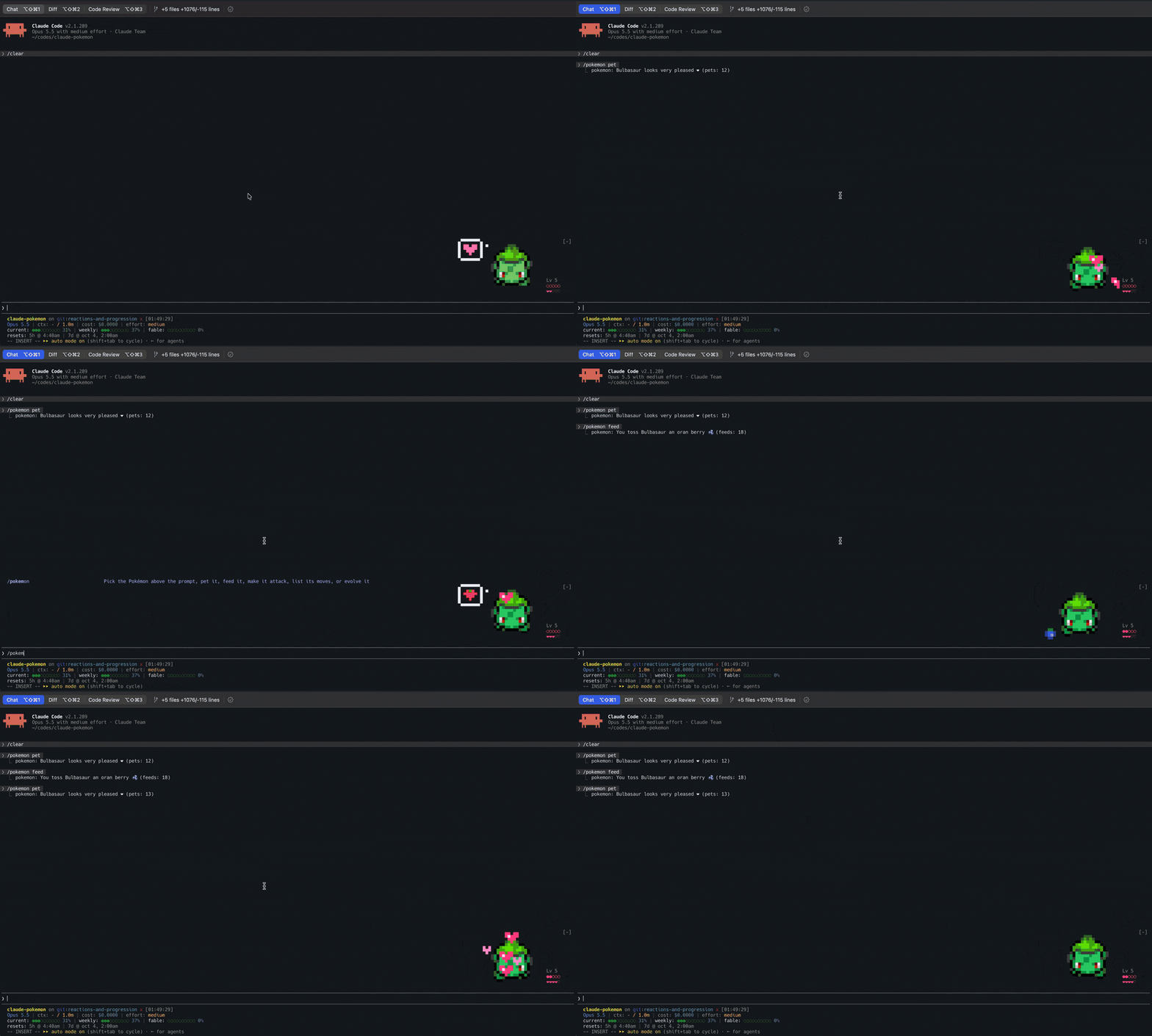
A pixel Pokémon that lives above your Claude Code prompt and reacts to everything Claude does.

Switchable themes for the Claude Code terminal UI: padded prompt/reply boxes, coloured markdown, and a matching status line, switchable via /ui-theme.