korro_ai@korro_ai
KorroAi/seuil

Seuil is an open-source Claude Code mod that monitors conversation size after each turn and auto-compacts past a configurable threshold (default 300k tokens) to reduce token cost, with a live statusline and /seuil commands; a pixel-art Campfire theme is included. The author reports ~30% savings across 144 replayed sessions, plus a read-only local simulator script.
KorroAi/seuil
The post describes Seuil: after each turn it measures the real conversation size and, past 300k tokens (adjustable via /seuil 250, disabled via /seuil off), compacts between turns, keeping decisions, work state and file paths. A statusline shows progress (Seuil · 182k / 300k). A benchmark script replays local sessions read-only to estimate savings, which the author reports as ~30% overall (27% with a pessimistic 50k-token loss assumption), concentrated in long sessions. An optional Windows Terminal pixel-art 'Campfire' theme is bundled. Install: /plugin install seuil --marketplace KorroAi/seuil; repo at github.com/KorroAi/seuil.
Check the author's README for the marketplace and plugin name first. Commands may change as the repository evolves.
claude plugin marketplace add KorroAi/seuil
claude plugin install seuil@seuil
Automatic compaction for Claude Code: between two turns, once the conversation passes a threshold.
Every model call re-reads the whole conversation, so a long session pays mostly for re-reading.<br> Seuil keeps the conversation short without you thinking about it. Seuil is French for threshold.




<sub>Seuil in 15 seconds. The compaction shown (366 k → 47 k) comes from a real session, the 30 % from the paper. <a href="https://github.com/KorroAi/seuil/raw/main/docs/media/seuil-demo.mp4">Watch it in HD (1080p)</a>.</sub>
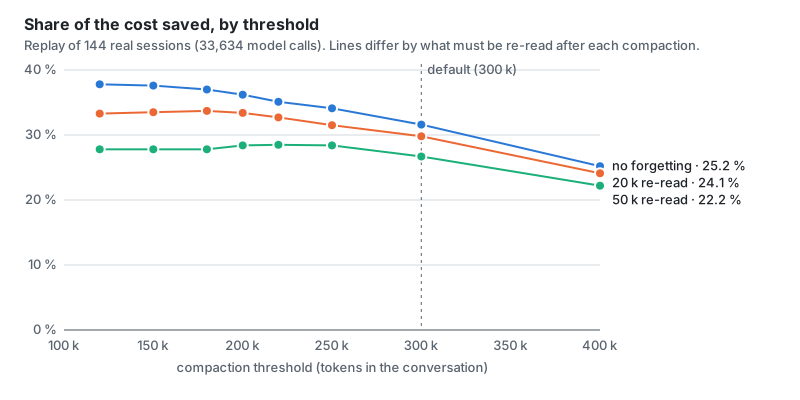
</div>On 144 real sessions (30 days, 33,634 model calls), replayed with automatic compaction at 300 k tokens:
Trimming tool outputs instead, the obvious idea, would save 0.1 % without loss and 5 % at most.
The method, the tables and the limits are in the paper.
bench/simulate.mjs runs the same replay on your own sessions.
At the prompt of a Claude Code terminal session:
/plugin install seuil --marketplace KorroAi/seuil
Answer y to add the marketplace, then pick a scope (user scope = every session). From a shell:
claude plugin install seuil --marketplace KorroAi/seuil
In the desktop app: click + next to the prompt box, then Plugins, Add marketplace with KorroAi/seuil,
then Add plugin.
Seuil uses the Claude Code mod API (function hooks), which is in early access. Checked on Claude Code 2.1.325.
At the end of each turn it reads the real size of the conversation from Claude Code.
Above the threshold (300 k tokens by default) it starts Claude Code's own compaction, with instructions that ask the summary to keep the goal, every decision and correction you gave (quoted), the exact state of the work, the files with their paths, what remains to do, and the pitfalls met.
It never compacts in the middle of a turn or inside a subagent.
It does not start again right after a compaction that left the conversation close to the threshold: then it waits until the conversation has grown back by half.
On a model whose context window is smaller than the setting, the threshold drops to 75 % of the window.
You always see where you are, live, even during a long turn. In the terminal, at the end of the hint line under the prompt:
? for shortcuts · Seuil · 182 k / 300 k · last compaction 341 k → 64 k
In the desktop app and remote sessions, as the plugin's status line. Each compaction also leaves a line in the transcript.
In a headless session (claude -p, an SDK host) it goes through /compact, since direct compaction is not
available there yet.
| Command | Effect |
|---|---|
| /seuil | status, last compaction, total taken out since install |
| /seuil 250 | sets the threshold to 250 k (minimum 100 k) |
| /seuil now | compacts as soon as the turn ends |
| /seuil off, /seuil on | switches automatic compaction off or on |
The model also gets a diagnostic tool that reports the real state read from the engine.
node bench/simulate.mjs        # the last 30 days
node bench/simulate.mjs 60     # the last 60 days
It reads ~/.claude/projects without changing anything and sends nothing anywhere. Projects are numbered, never
named, so the output can be shared. Node 18 or newer, no dependency.
A night landscape in pixel art, drawn by a shader behind the text: starry sky, shooting stars, mountains, forest, and a camp with a fire and a cat that sits, blinks and falls asleep. It stays dark and in the back, fades out under text, and never passes under the line you type in. It is the background of the demo above.

node theme/install.mjs               # adds a "Seuil · Campfire" profile to the new-tab menu
node theme/install.mjs --everywhere  # applies it to every Windows Terminal profile
node theme/install.mjs --remove      # removes everything it added
A copy of Windows Terminal's settings is kept before the first change (settings.json.before-seuil-theme).
The theme uses Windows Terminal's experimental pixel shader settings; it was checked on Windows Terminal 1.24.
Other terminals (VS Code, macOS, Linux) have no pixel shaders: the theme is Windows Terminal only, the mod works
everywhere Claude Code runs.
Everything is code: paint.mjs paints the camp, campfire.hlsl
draws the rest and animates it.
claude --plugin-dir .          # run Claude Code with this folder as a mod
claude plugin test .           # 15 tests
claude plugin validate .
What changed between versions: CHANGELOG.md.
Is this your project? Add this badge to your README or website. It links back to this page.


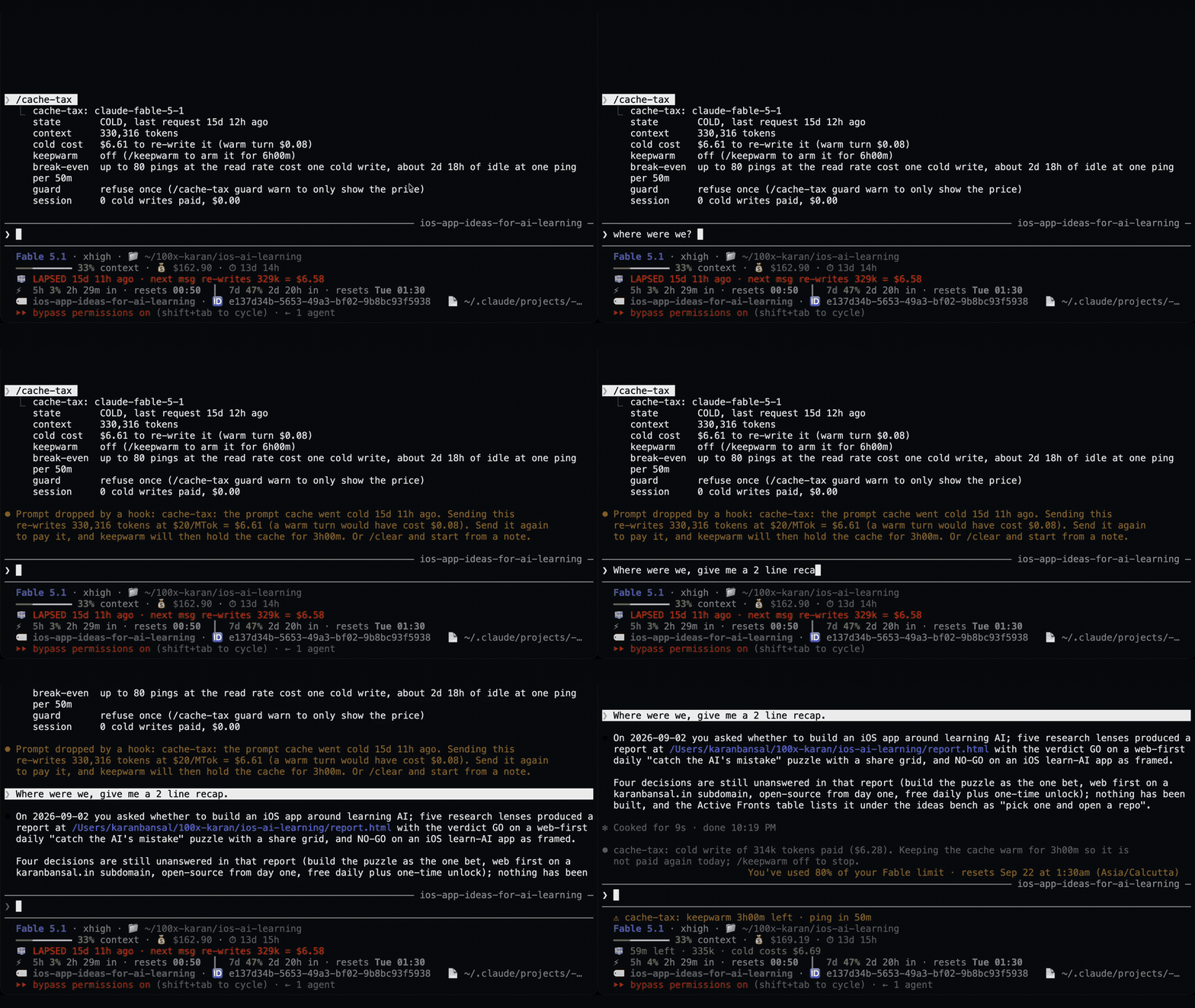
Claude Code mod that keeps the prompt cache warm during breaks by sending small refresh forks shortly before expiry, reducing the cost of the next prompt.
CodeCraft is a free, open-source Claude Code mod that redraws the interface as a Minecraft-style HUD. Hearts represent the context window, hunger represents usage limits, armor represents work safety, and it adds a hotbar of items, villager subagents, and 60 achievements.


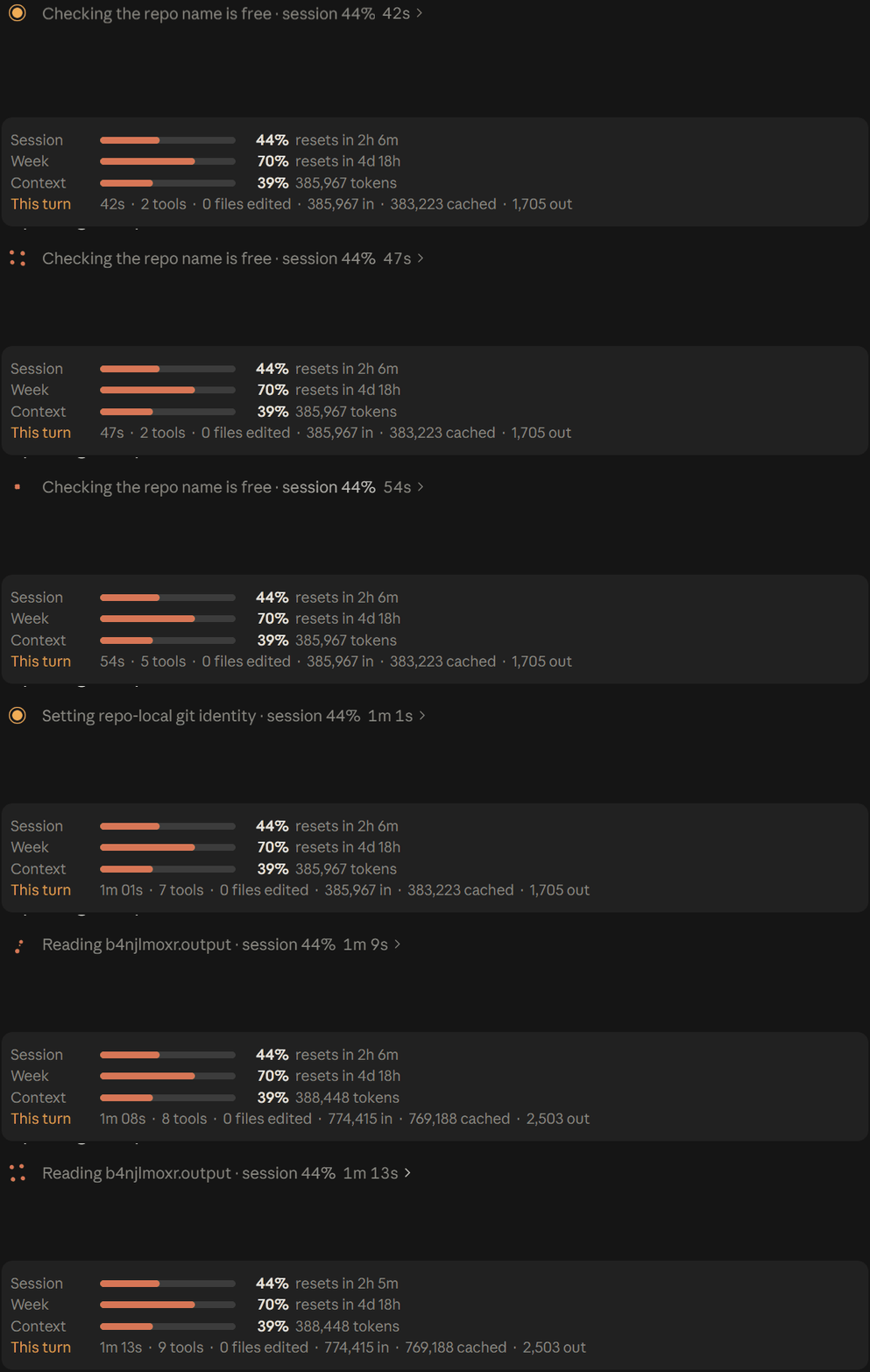
A Claude Code plugin that shows 5-hour and 7-day plan-limit bars with reset countdown, burn rate and time-to-empty estimates, session cost, cache hit ratio and a tokens-per-turn sparkline.

A Claude Code mod from the claude-pro-kit marketplace that shows a countdown until the prompt cache expires in the status line, and once it has expired, reports exactly how many tokens the next message will re-send uncached.

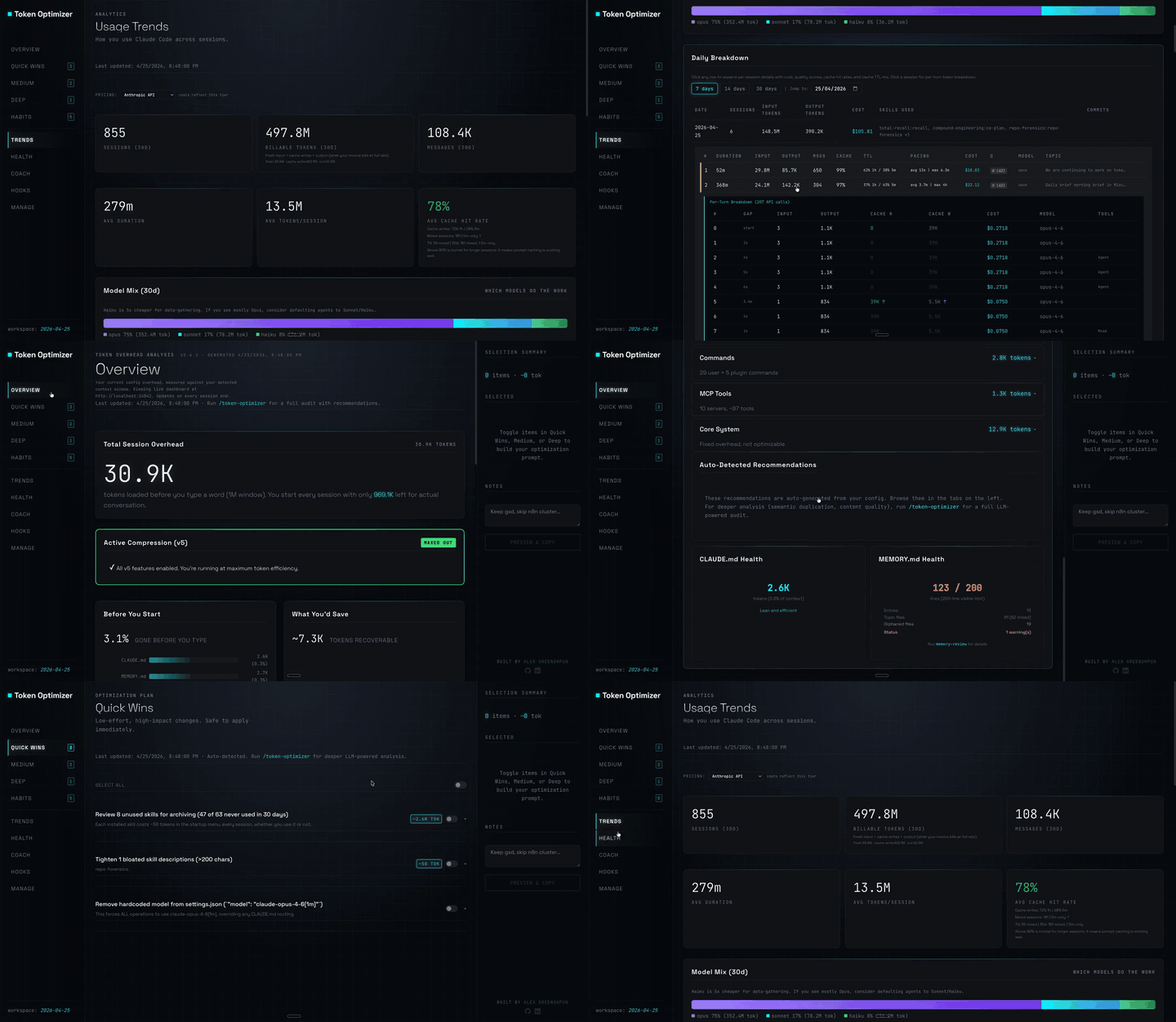
Claude Code plugin that compresses tool output, checkpoints before compaction, scores context quality, and reports token/cost savings on a local dashboard; ships hooks and a localhost daemon.
A Claude Code mod that keeps the one-hour prompt cache warm during breaks and stops a cold send once with its estimated rewrite cost. Warming uses model requests and costs tokens. Requires Claude Code 2.1.287+.