sebi75@sebi75
sebi75/agent-canvas
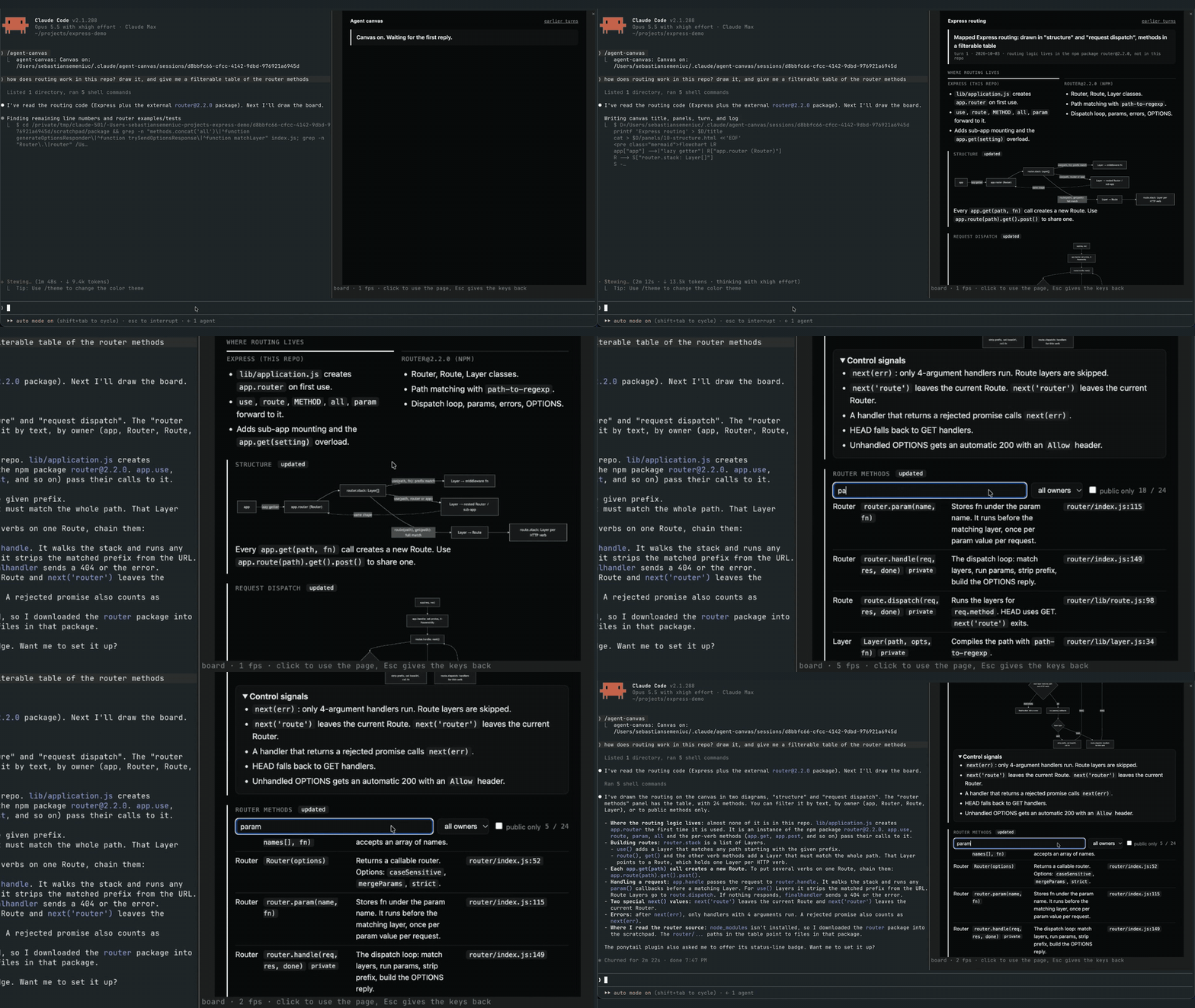
A live, clickable board for each Claude Code session, drawn by headless Chrome in a pane beside the transcript.
sebi75/agent-canvas
agent-canvas is a Claude Code mod that gives every session a live board in a pane beside the transcript. The agent keeps it current each reply by rewriting turn.html, editing panels/<name>.html and appending to log.txt under ~/.claude/agent-canvas/sessions/<session id>/. A hook blocks the Stop event if the agent ends a turn without writing turn.html. The bridge (bridge/bridge.mjs) builds board.html, runs headless Chrome over a pipe with no open port, and emits PNG frames the mod draws with the Image element and swaps via $.ui.blit. A Client region forwards clicks, keys and pane size to Chrome, and the wheel scrolls. Requires Claude Code 2.1.287+, an image-capable terminal (Ghostty, kitty or WezTerm), Chrome/Chromium and Node.js 18+. Install via /plugin marketplace add sebi75/agent-canvas. Known limits: text on the page cannot be selected, and the Desktop app and VS Code extension lack the Image element.
Check the author's README for the marketplace and plugin name first. Commands may change as the repository evolves.
claude plugin marketplace add sebi75/agent-canvas
claude plugin install agent-canvas
A live board for each Claude Code session, in a pane beside the transcript. The agent keeps it current every reply, with diagrams, tables, charts and the state of the work. The board is a real web page drawn by headless Chrome, so you can click, type, hover and scroll in it. Nothing opens in a browser tab, and the board belongs to the session that made it.
It is a Claude Code mod: a plugin whose hooks run inside Claude Code.
turn.html (this reply's news), edits the panels that changed (panels/<name>.html, kept across turns) and appends a line to log.txt. The files live in ~/.claude/agent-canvas/sessions/<session id>/.turn.html after its last tool call, the mod blocks the Stop event and tells it why.bridge/bridge.mjs builds board.html from those files, runs headless Chrome on it over a pipe (no open port), and writes each frame as a PNG. Panels written this turn come first, marked "updated". Every turn keeps a snapshot, linked from "earlier turns".Image element and swaps each new one in with $.ui.blit. A Client region laid over the picture sends clicks, keys and the pane size back to Chrome, and the mouse wheel scrolls the page.From a Claude Code session:
/plugin marketplace add sebi75/agent-canvas
/plugin install agent-canvas@agent-canvas
Or clone the repository and load the folder in every session by adding CLAUDE_CODE_PLUGIN_DIRS with the clone's path to the env block of ~/.claude/settings.json.
| command | what it does |
|---|---|
| /agent-canvas | turns the board on and opens its pane; when it shows another page, goes back to the board |
| /agent-canvas off | turns the board off and closes the pane |
| /agent-canvas <url or path> | shows that page instead, for example a local dev server |
Click the page to type into it. Esc gives the keyboard back to Claude Code. The board stays on across a plugin reload, and AGENT_CANVAS_OPEN=1 turns it on when a session starts.
Claude Code turns images off when the terminal reports itself as "libghostty", which Herdr does. Its own switch turns them back on: set CLAUDE_CODE_FORCE_TERMINAL_IMAGES=1 in the shell that starts claude inside Herdr, for example in ~/.zshrc when HERDR_ENV is set.
Use Herdr 0.9 or later. On Herdr 0.9.3 an animated page measured about 42 frames per second on screen, against about 53 in plain Ghostty. Herdr 0.7 drew about 3; there, set AGENT_CANVAS_FPS=4 so frames do not queue up.
| variable | default |
|---|---|
| AGENT_CANVAS_FPS | 60 |
| AGENT_CANVAS_SCALE | 2 device pixels per CSS pixel |
| AGENT_CANVAS_CHROME | the first Chrome or Chromium found |
| AGENT_CANVAS_OPEN | unset; 1 turns the board on at session start |
Image element. The pane says so there.agent-canvas started as herdr-canvas, which rendered the same kind of board to a static image in a Herdr pane next to the agent. Claude Code mods made it possible to put a live, clickable page inside Claude Code itself.
node test/board.test.mjs
MIT

Documentation generation, drift detection, and API docs automation plugin that also acts as a function-hook guard refusing doc writes or worker dispatch containing secrets.

A status bar for the Claude desktop app. It draws above your prompt and shows session quality, context fill, cache countdown, and your 5-hour and weekly limits, with Clawd acting out what the session is doing.

A Claude Code plugin mod providing a /databricks-pane that presents Databricks workspace, Unity Catalog, compute, jobs, pipelines, apps and dashboards as a tree following the databricks CLI, with live highlights, profile switching, and CLI argument copy.