Digital-Threads@Digital-Threads
Digital-Threads/aimux/tree/master/mod
Digital-Threads/aimux/tree/master/mod




并排运行多个 Claude Code / Codex / Gemini 订阅:共享一个大脑——skills、agents、memory、settings,登录信息彼此隔离,并在一个视图中查看每个订阅实时的 5h/7d 限额。

你有多个 Claude Code 订阅(个人、工作、客户),分别位于不同的 ~/.claude-* 目录。你得手动维护符号链接、重复设置,还要用 bash 函数在它们之间切换。
aimux 对待 AI CLI 配置的方式,就像 tmux 对待终端一样:一个共享大脑,多个相互隔离的工作阶段。
npm install -g @digital-threads/aimux
~/.claude 和额外目录(例如 ~/.claude-work)npm install -g aimux
aimux init # auto-detects all ~/.claude* dirs
aimux status # verify profiles, auth, symlinks
aimux run w # launch work profile (prefix matching)
~/.claude(一个订阅)npm install -g aimux
aimux init # creates config with main profile
aimux profile add work # add a new profile
aimux auth login work # OAuth for the new account
aimux profile update w -m 'opus[1m]'
aimux run w
aimux profile add myapi --api
# Configure API endpoint (leave blank to use default):
#   Base URL:                          https://api.your-provider.com/v1
#   Auth token:                        [hidden]
#   Default model [claude-sonnet-5-5]:
#   Opus model    [claude-opus-5-5]:
#   Sonnet model  [claude-sonnet-5-5]:
#   Haiku model   [claude-haiku-4-5]:
# ✓ Credentials saved to ~/.aimux/profiles/myapi/.env (chmod 600)
aimux run myapi
请参阅按 profile 设置环境变量,了解声明式替代方案(.env 文件或 env: 区块);高级使用者和 CI 会采用这种方式。
# Install Claude CLI first, then:
claude auth login       # creates ~/.claude
npm install -g @digital-threads/aimux
aimux init
aimux profile add work
aimux auth login work
aimux run               # interactive picker (↑↓ + Enter)
aimux run w             # prefix match → work
aimux run o -m claude-sonnet-5-5  # one-time model override
aimux run w --resume    # flags pass through to Claude CLI
aimux run --auto        # launch whichever subscription has the most headroom left
aimux status            # dashboard
aimux usage             # token usage by profile for the last 7 days
aimux usage --all       # all known transcript usage

# Set a default model per profile. Prefer a family alias: `opus[1m]` always means the
# newest Opus, so a new release is picked up without touching aimux. A full id such
# as `claude-opus-5-5` pins that exact version until you change it. Quote names with
# brackets, or the shell will try to expand them.
aimux profile update w -m 'opus[1m]'
aimux profile update w -m claude-opus-5-5   # pin one version
aimux profile update w --unset-model        # let the CLI choose its own default

# Set a fallback model, tried automatically when the primary is overloaded/unavailable
aimux profile update w --fallback-model claude-sonnet-5-5
aimux profile update w --unset-fallback-model   # remove it
aimux use)aimux run 会启动一次性工作阶段。如果你更想激活某个 profile,让普通的
claude / codex 使用它——就像 nvm use 或 pyenv shell 一样——先启用一次
shell integration:
# add to ~/.zshrc or ~/.bashrc (fish: ~/.config/fish/config.fish)
eval "$(aimux shell-init)"
然后:
aimux use work     # activate 'work' in this shell (persistent until you switch)
claude             # runs under 'work', on its model — no `aimux run` needed
codex              # same; the CLI adapter sets CODEX_HOME for you
aimux use api      # switch profiles — stale ANTHROPIC_*/tokens are cleaned up
aimux use          # no name → interactive picker
每个 shell 都彼此独立,因此不同终端可以同时持有不同的 active profile。切换只会将
环境变量导出到当前 shell,绝不会改变全局状态。aimux run 仍可用于一次性启动,而且
无论当前 shell 激活了哪个 profile,它总是运行你指定的 profile。
aimux split)aimux split # one tmux pane per logged-in claude subscription, in this directory
aimux split work client # just these two
每个窗格都会运行完整的 aimux run <profile>,窗格边框会标出对应 profile;如果某个
运行失败,窗格会保留并显示错误。关闭窗口就会像关闭普通终端一样结束这些窗格——对话
已经保存,之后可用 aimux run <profile> --resume 接着其中一个继续。在 tmux 中,它会
开启新窗口而不是嵌套 tmux;那个窗口由你决定保留或关闭。需要 tmux(sudo apt install tmux,
或 brew install tmux)。
对话记录是共享的,因此工作阶段可以在另一个订阅下继续,只有登录帐号会改变。当一个
通过 aimux run 启动的 claude 工作阶段因为当前窗口用尽而停止时,aimux 会提供选项,
让它在剩余空间最多的地方继续:
⚠ work hit its 5-hour limit (resets 23:10).
Continue this session on personal (5h 10%, 7d 16%)? [Y/n]
按 Enter 后,同一个工作阶段会在那里恢复,并保留启动时使用的 flags。aimux 会从该
工作阶段自己的对话记录中读取达到限制的情况,因此普通退出不会产生额外消耗;只有在
确实达到限制时才会检查其他订阅。aimux split 窗格中也能使用。
通过 aimux run 启动的 claude 工作阶段,或位于 aimux split 窗格中的工作阶段,会在
提示符上方的横条中显示所有订阅,当前使用的订阅排在最前:

/exit 已经出现在提示符中:按 Enter,aimux
会把对话转移到该订阅,不再询问。/aimux 会打印完整表格,并显示每个窗口的重置时间。这是一个 Claude Code mod(Claude Code 2.1.287 或更高版本),只会加载到 aimux 启动的
工作阶段中;设置 AIMUX_NO_MOD=1 可将其关闭。脚本也可以通过 aimux status --json
取得相同的数字。
| Command | Description |
|---------|-------------|
| aimux init | 自动检测 Claude 目录、创建配置、迁移 profiles |
| aimux init --source <path> | 使用明确的 source directory 初始化 |
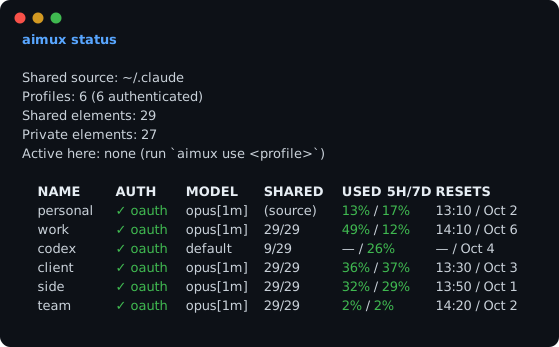
| aimux status | TUI 仪表板——profiles、身份验证、实时 5h/7d 限额用量和重置时间(claude + codex)、设置任一选项时的 auto-mode 规则、符号链接健康度。--watch [s] 会持续显示并重新读取限额;--json 将其打印给脚本;--max-age <s> 会复用最近的读取结果 |
| aimux status --no-limits | 不执行速率限制探测的相同仪表板(离线/更快) |
| aimux usage | 按 profile 显示 token 用量(Claude 对话记录 + codex rollouts),包括在 aimux 外启动的工作阶段 |
| aimux usage --profile work --since 24h | 显示一个 profile 在最近时间窗口内的用量 |
| aimux run [profile] | 使用正确的环境和模型启动 AI CLI |
| aimux run | 交互式选择器——历史记录会预先选择最近使用的 profile |
| aimux run w | 前缀匹配——如果没有歧义则启动 work |
| aimux run work -m claude-sonnet-5-5 | 使用模型覆盖启动 |
| aimux run --auto | 探测每个订阅的实时限额,并启动剩余空间最大的那个(保持在同一个 CLI 内) |
| aimux split [profiles...] | 并排打开多个订阅,每个使用一个 tmux 窗格(默认:所有已登录的 claude 订阅) |
| aimux use [profile] | 将当前 shell 切换到某个 profile(持久生效)——之后普通的 claude/codex 会使用它。需要在 rc 中执行 eval "$(aimux shell-init)" |
| aimux shell-init | 打印启用 aimux use 的 shell 函数(添加到 ~/.zshrc/~/.bashrc/fish 配置) |
| aimux agents | 多 profile agent 视图——在一个 TUI 中查看和管理所有 profile 的 claude 后台工作阶段 |
| aimux profile add <name> | 创建带符号链接的新 profile |
| aimux profile add <name> --api | 创建第三方 API profile(交互式 endpoint + token 提示) |
| aimux profile add <name> --cli codex | 为另一个 AI CLI(例如 Codex)创建 profile |
| aimux handoff <sessionId> --to <profile> | 通过摘要 handoff 在另一个 profile/CLI 下继续工作阶段 |
| aimux profile update <name> | 更新模型/cli 设置 |
| aimux profile update <name> --fallback-model <model> | 设置主要模型过载或不可用时使用的 fallback model |
| aimux profile update <name> --unset-model | 移除默认模型,让 CLI 使用自己的(最新)默认值 |
| aimux profile update <name> --unset-fallback-model | 移除 fallback model |
| aimux profile update <name> -e KEY=VALUE | 在 profile 的 .env 文件中设置环境变量 |
| aimux profile update <name> --unset-env KEY | 从 profile 的 .env 文件中移除环境变量 |
| aimux profile list | 列出所有 profile(与 aimux status 相同的表格;--no-limits 会跳过探测) |
| aimux profile remove <name> | 移除 profile 并清理 |
| aimux profile clone <src> <name> | 使用私有文件克隆 profile |
| aimux rebuild [profile] | 同步符号链接,并显示本地共享文件冲突 |
| aimux doctor | 健康检查——损坏的符号链接、缺少的共享项、冲突 |
| aimux auth login <profile> | 为某个 profile 启动 OAuth 流程 |
| aimux auth status | 显示各 profile 的身份验证文件状态 |
| aimux setup-shell | 自动安装 shell 补全(bash/zsh/fish) |
| aimux migrate isolate | 一次性迁移:将每个 profile 的 jobs/、daemon/、projects/ 符号链接转换成真正的私有目录,让每个 profile 拥有自己的 supervisor 和工作阶段。安全——不会删除数据。添加 --dry-run 可预览。 |
所有 profile 命令都支持前缀匹配:aimux run w → work,aimux profile update o → own。
~/.claude/          ← source of truth (your main profile)
  agents/
  skills/
  commands/
  memory/
  settings.json
  .credentials.json  ← private, stays here

~/.aimux/
  config.yaml        ← aimux config
  profiles/
    work/
      agents/ → ~/.claude/agents      ← symlink (shared)
      skills/ → ~/.claude/skills      ← symlink (shared)
      memory/ → ~/.
请先查看作者 README 确认 marketplace 和插件名称;命令可能随仓库结构改变。
claude plugin marketplace add Digital-Threads/aimux
claude plugin install aimux
Run multiple Claude Code / Codex / Gemini subscriptions side by side: one shared brain — skills, agents, memory, settings — separate logins, and every subscription's live 5h/7d limits in a single view.
You have multiple Claude Code subscriptions (personal, work, client) each in separate ~/.claude-* directories. You maintain symlinks manually, duplicate settings, and juggle bash functions to switch between them.
aimux treats your AI CLI configs like tmux treats terminals: one shared brain, multiple isolated sessions.
npm install -g @digital-threads/aimux
~/.claude + extra directories (~/.claude-work, etc.)npm install -g aimux
aimux init # auto-detects all ~/.claude* dirs
aimux status # verify profiles, auth, symlinks
aimux run w # launch work profile (prefix matching)
~/.claude (one subscription)npm install -g aimux
aimux init # creates config with main profile
aimux profile add work # add a new profile
aimux auth login work # OAuth for the new account
aimux profile update w -m 'opus[1m]'
aimux run w
aimux profile add myapi --api
# Configure API endpoint (leave blank to use default):
#   Base URL:                          https://api.your-provider.com/v1
#   Auth token:                        [hidden]
#   Default model [claude-sonnet-5-5]:
#   Opus model    [claude-opus-5-5]:
#   Sonnet model  [claude-sonnet-5-5]:
#   Haiku model   [claude-haiku-4-5]:
# ✓ Credentials saved to ~/.aimux/profiles/myapi/.env (chmod 600)
aimux run myapi
See Per-profile environment variables for the declarative alternative (.env file / env: block) used by power users and CI.
# Install Claude CLI first, then:
claude auth login       # creates ~/.claude
npm install -g @digital-threads/aimux
aimux init
aimux profile add work
aimux auth login work
aimux run               # interactive picker (↑↓ + Enter)
aimux run w             # prefix match → work
aimux run o -m claude-sonnet-5-5  # one-time model override
aimux run w --resume    # flags pass through to Claude CLI
aimux run --auto        # launch whichever subscription has the most headroom left
aimux status            # dashboard
aimux usage             # token usage by profile for the last 7 days
aimux usage --all       # all known transcript usage

# Set a default model per profile. Prefer a family alias: `opus[1m]` always means the
# newest Opus, so a new release is picked up without touching aimux. A full id such
# as `claude-opus-5-5` pins that exact version until you change it. Quote names with
# brackets, or the shell will try to expand them.
aimux profile update w -m 'opus[1m]'
aimux profile update w -m claude-opus-5-5   # pin one version
aimux profile update w --unset-model        # let the CLI choose its own default

# Set a fallback model, tried automatically when the primary is overloaded/unavailable
aimux profile update w --fallback-model claude-sonnet-5-5
aimux profile update w --unset-fallback-model   # remove it
aimux use)aimux run launches a one-off session. If you'd rather activate a profile so
plain claude / codex use it — like nvm use or pyenv shell — enable the
shell integration once:
# add to ~/.zshrc or ~/.bashrc (fish: ~/.config/fish/config.fish)
eval "$(aimux shell-init)"
Then:
aimux use work     # activate 'work' in this shell (persistent until you switch)
claude             # runs under 'work', on its model — no `aimux run` needed
codex              # same; the CLI adapter sets CODEX_HOME for you
aimux use api      # switch profiles — stale ANTHROPIC_*/tokens are cleaned up
aimux use          # no name → interactive picker
Each shell is independent, so different terminals can hold different active
profiles at once. The switch only exports env vars into the current shell — it
never changes global state. aimux run still works for one-off launches, and it
always runs the profile you name, whichever one the shell has active.
aimux split)aimux split # one tmux pane per logged-in claude subscription, in this directory
aimux split work client # just these two
Each pane runs a full aimux run <profile>, labelled with its profile on the pane
border; a pane whose run fails stays open with its error. Closing the window ends the
panes, as in any terminal — the conversations are saved, and aimux run <profile> --resume picks one up again. Inside tmux it opens a new window instead of nesting
tmux, and that window is yours to keep or close. Needs tmux (sudo apt install tmux,
or brew install tmux).
Transcripts are shared, so a session can carry on under another subscription — only
the login changes. When a claude session started with aimux run stops because its
window is spent, aimux offers to continue it where there is the most room left:
⚠ work hit its 5-hour limit (resets 23:10).
Continue this session on personal (5h 10%, 7d 16%)? [Y/n]
Press Enter and the same session resumes there, with the flags you started it with.
aimux reads the hit from the session's own transcript, so an ordinary exit costs
nothing; the other subscriptions are only checked when a limit was actually reached. It
works inside aimux split panes too.
A claude session started with aimux run — or in an aimux split pane — shows every
subscription in a band above the prompt, the one it runs on first:
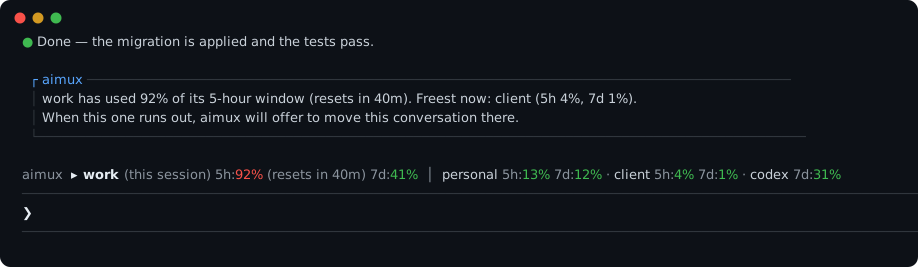
/exit is already in the prompt:
press Enter and aimux carries the conversation over to that subscription without
asking again./aimux prints the whole table, each window with its reset time.It is a Claude Code mod (Claude Code 2.1.287 or newer), loaded only into the sessions
aimux starts; AIMUX_NO_MOD=1 turns it off. The same figures are available to scripts
as aimux status --json.
| Command | Description |
|---------|-------------|
| aimux init | Auto-detect Claude dirs, create config, migrate profiles |
| aimux init --source <path> | Initialize with explicit source directory |
| aimux status | TUI dashboard — profiles, auth, live 5h/7d limit usage and reset times (claude + codex), auto-mode rules when any are set, symlink health. --watch [s] keeps it on screen and re-reads the limits; --json prints them for scripts; --max-age <s> reuses a reading that recent |
| aimux status --no-limits | Same dashboard without the rate-limit probe (offline / faster) |
| aimux usage | Show token usage by profile (Claude transcripts + codex rollouts), including sessions started outside aimux |
| aimux usage --profile work --since 24h | Show usage for one profile over a recent window |
| aimux run [profile] | Launch AI CLI with correct env and model |
| aimux run | Interactive picker — history pre-selects last used profile |
| aimux run w | Prefix matching — launches work if unambiguous |
| aimux run work -m claude-sonnet-5-5 | Launch with model override |
| aimux run --auto | Probe every subscription's live limits and launch the one with the most headroom (stays within the same CLI) |
| aimux split [profiles...] | Open several subscriptions side by side, one tmux pane each (default: every logged-in claude subscription) |
| aimux use [profile] | Switch the current shell to a profile (persistent) — plain claude/codex then use it. Requires eval "$(aimux shell-init)" in your rc |
| aimux shell-init | Print the shell function that enables aimux use (add to ~/.zshrc/~/.bashrc/fish config) |
| aimux agents | Multi-profile agent view — see and manage claude background sessions across all profiles in one TUI |
| aimux profile add <name> | Create new profile with symlinks |
| aimux profile add <name> --api | Create a 3rd-party API profile (interactive endpoint + token prompt) |
| aimux profile add <name> --cli codex | Create a profile for another AI CLI (e.g. Codex) |
| aimux handoff <sessionId> --to <profile> | Continue a session under another profile/CLI via summary handoff |
| aimux profile update <name> | Update model/cli settings |
| aimux profile update <name> --fallback-model <model> | Set a fallback model, used when the primary is overloaded/unavailable |
| aimux profile update <name> --unset-model | Remove the default model, so the CLI uses its own (newest) default |
| aimux profile update <name> --unset-fallback-model | Remove the fallback model |
| aimux profile update <name> -e KEY=VALUE | Set an env var in the profile .env file |
| aimux profile update <name> --unset-env KEY | Remove an env var from the profile .env file |
| aimux profile list | List all profiles (same table as aimux status; --no-limits skips the probe) |
| aimux profile remove <name> | Remove profile and clean up |
| aimux profile clone <src> <name> | Clone profile with private files |
| aimux rebuild [profile] | Sync symlinks and surface local shared-file conflicts |
| aimux doctor | Health check — broken symlinks, missing shared entries, conflicts |
| aimux auth login <profile> | Launch OAuth flow for a profile |
| aimux auth status | Show auth file status per profile |
| aimux setup-shell | Auto-install shell completions (bash/zsh/fish) |
| aimux migrate isolate | One-time migration: convert per-profile jobs/, daemon/, projects/ symlinks into real private dirs so each profile gets its own supervisor and sessions. Safe — no data is deleted. Add --dry-run to preview. |
All profile commands support prefix matching: aimux run w → work, aimux profile update o → own.
~/.claude/          ← source of truth (your main profile)
  agents/
  skills/
  commands/
  memory/
  settings.json
  .credentials.json  ← private, stays here

~/.aimux/
  config.yaml        ← aimux config
  profiles/
    work/
      agents/ → ~/.claude/agents      ← symlink (shared)
      skills/ → ~/.claude/skills      ← symlink (shared)
      memory/ → ~/.claude/memory      ← symlink (shared)
      plugins/                        ← real dir (shared content, per-profile metadata)
        marketplaces/ → ~/.claude/plugins/marketplaces   ← symlink (shared)
        cache/        → ~/.claude/plugins/cache           ← symlink (shared)
        known_marketplaces.json       ← real file (paths point inside this profile)
        installed_plugins.json        ← real file (paths point inside this profile)
      .credentials.json               ← real file (private)
      .claude.json                    ← real file (private)
    own/
      ...same pattern...
When you run aimux run work, it sets CLAUDE_CONFIG_DIR=~/.aimux/profiles/work and launches the CLI. Claude sees a complete config directory — shared content via symlinks, private auth locally.
Plugins are shared too, but Claude validates that a marketplace's installLocation
lives inside the active config directory. So each profile gets a real plugins/
directory: the heavy content (marketplaces/, cache/) is symlinked to the shared
~/.claude/plugins, while known_marketplaces.json and installed_plugins.json are
real, path-rewritten copies. ~/.claude stays the source of truth — install or update
plugins from your main profile (or with CLAUDE_CONFIG_DIR=~/.claude claude plugin …)
and every profile picks them up on its next run. A plugin installed from inside a
profile is merged back into the shared source automatically.
aimux isn't claude-only. A profile's cli field selects which AI CLI it runs, so you
can keep claude, Codex, and Gemini subscriptions side by side — same shared brain,
isolated auth — and even hand a live conversation from one to the other when a limit hits.
aimux profile add codework --cli codex   # a Codex profile
aimux profile add gem --cli gemini       # a Gemini profile (~/.gemini)
aimux auth login codework                # runs `codex login` under an isolated CODEX_HOME
aimux run codework                        # launches Codex with the right model flag
aimux agents                              # claude + codex sessions in one view (CLI-badged)
CLAUDE_CONFIG_DIR /
CODEX_HOME / GEMINI_CLI_HOME), so subscriptions never collide.shared_sources maps each CLI to its source
(claude → ~/.claude, codex → ~/.codex); the legacy shared_source stays as the
claude alias.private; Codex shares a
knowledge allowlist (skills, rules, memories) and keeps auth.json /
config.toml / sessions/ private; Gemini shares GEMINI.md / skills / commands
/ extensions / memories and keeps auth + settings.json + history private.GEMINI_CLI_HOME at the profile's parent and the profile dir IS gemini's .gemini.
Gemini resumes by per-project index (-r latest), not by session id, so cross-Gemini
native resume isn't wired into the session list yet.Hit a subscription limit mid-session? Continue it under another CLI:
aimux handoff <sessionId> --to codework
The two CLIs' transcripts are mutually unreadable, so this is a summary handoff, not
a native resume: aimux reads the source transcript, summarizes it with the target
profile (self-contained — the target CLI does the summarizing), then launches the target
seeded with that summary. Same-CLI continuation (claude↔claude, codex↔codex) still uses
native resume (aimux run <profile> --resume <id>). Note: the conversation context
carries over, not the model — the target continues with its own model.
Many providers expose an Anthropic-compatible endpoint, so they run on the claude CLI
itself — just a different base URL + token. A provider profile is therefore a claude
profile: it shares the full claude brain (skills, plugins, settings, memory, transcripts)
and you can even --resume a claude session under it natively (same CLI, same model swap).
One command, prompts only for the token:
aimux profile add ds --provider deepseek   # fills base URL + model mapping
aimux run ds
Built-in presets: deepseek, kimi, glm, qwen, minimax, mimo. Base URLs are verified;
model names drift — update with aimux profile update <name> -e ANTHROPIC_MODEL=….
For anything else (local models via Ollama/LM Studio, a proxy, Bedrock/Vertex), use the
generic aimux profile add <name> --api and point ANTHROPIC_BASE_URL at it (see below).
Costs shown by aimux usage are list-price estimates (Claude, codex/gpt-5, and the
Anthropic-compatible providers) and will drift as prices change.
Some Claude Code modes (3rd-party proxies, self-hosted gateways, Bedrock, Vertex) are activated by environment variables rather than OAuth. aimux injects per-profile env into the spawned claude process (and into aimux auth login <profile>) from two sources, merged in this order:
<profile>/.env — a dotenv file inside the profile directory. Best for secrets. Written with chmod 600 when aimux creates it; aimux run warns if it becomes group/other-readable.env: block under the profile in config.yaml — best for non-secret toggles you want versioned. Overrides .env on key conflict.The fastest way to set up an API profile is the interactive prompt:
aimux profile add myapi --api      # prompts for Base URL, hidden token, models
aimux profile update myapi -e ANTHROPIC_MODEL=claude-opus-5-5   # edit later
…which writes something like:
# ~/.aimux/profiles/myapi/.env — do not commit
ANTHROPIC_BASE_URL=https://api.your-provider.com/v1
ANTHROPIC_AUTH_TOKEN=sk-your-token...
ANTHROPIC_MODEL=claude-sonnet-5-5
ANTHROPIC_DEFAULT_OPUS_MODEL=claude-opus-5-5
ANTHROPIC_DEFAULT_SONNET_MODEL=claude-sonnet-5-5
ANTHROPIC_DEFAULT_HAIKU_MODEL=claude-haiku-4-5
The .env parser supports KEY=value, export KEY=value, comments, and single/double-quoted values (with \n/\t escapes inside double quotes). It does not do ${VAR} interpolation or multi-line values — it's a secrets loader, not a full dotenv-expand. .env is always private (never symlinked to the shared source).
# ~/.aimux/config.yaml
version: 1
shared_source: /home/user/.claude

profiles:
  main:
    cli: claude
    path: /home/user/.claude
    is_source: true
  work:
    cli: claude
    model: opus[1m]            # follows the newest Opus
    path: /home/user/.aimux/profiles/work
  myapi:
    cli: claude
    model: claude-sonnet-5-5
    path: /home/user/.aimux/profiles/myapi   # secrets live in this dir's .env
    # Optional non-secret env injected into the spawned CLI (overrides .env).
    # env:
    #   ANTHROPIC_DEFAULT_OPUS_MODEL: claude-opus-5-5

private:
  - .credentials.json
  - .env                  # API credentials — never symlinked, never committed
  - .claude.json
  - policy-limits.json
  - mcp-needs-auth-cache.json
  - remote-settings.json
  - settings.local.json
  - stats-cache.json
  - statsig
  - telemetry
  - state                 # MCP protocol verdicts, per install
  - session-env           # per-session environment
  - backups               # copies of the private .claude.json
  - remote                # Remote Control daemon + its binaries
  - security              # Agent SDK venv and logs
  - shell-snapshots
  - cache                 # fetched model catalog, per account
The defaults above are always applied — listing extra entries adds to them. Claude
Code keeps growing new runtime directories, so if aimux doctor reports a conflict
on one, add it here and run aimux rebuild.
MIT

Ruflo 记忆系统的基底层插件:AgentDB 控制器桥接(15 个 agentdb_* MCP 工具)、RuVector ONNX 嵌入(10 个 embeddings_* 工具,包括 RaBitQ 32x 量化)和 WASM HNSW 模式路由器(3 个 ruvllm_hnsw_* 工具)。作为 mod(ADR-445):可选的安全召回会进入提示,写入守卫会把机密排除在记忆之外,还提供 /agentdb 和控制台显示的状态文件。

构建、格式化、优化和审查交互式 Power BI 报表,并提供一个遵循 pbir CLI 的报表面板,显示 Claude 读取和修改的内容。

在提示列上方、状态行和 toast 中显示未读 AMP 消息,并可唤醒空闲的 Claude Code 工作階段来读取。需要 Claude Code 2.1.287 或更高版本。