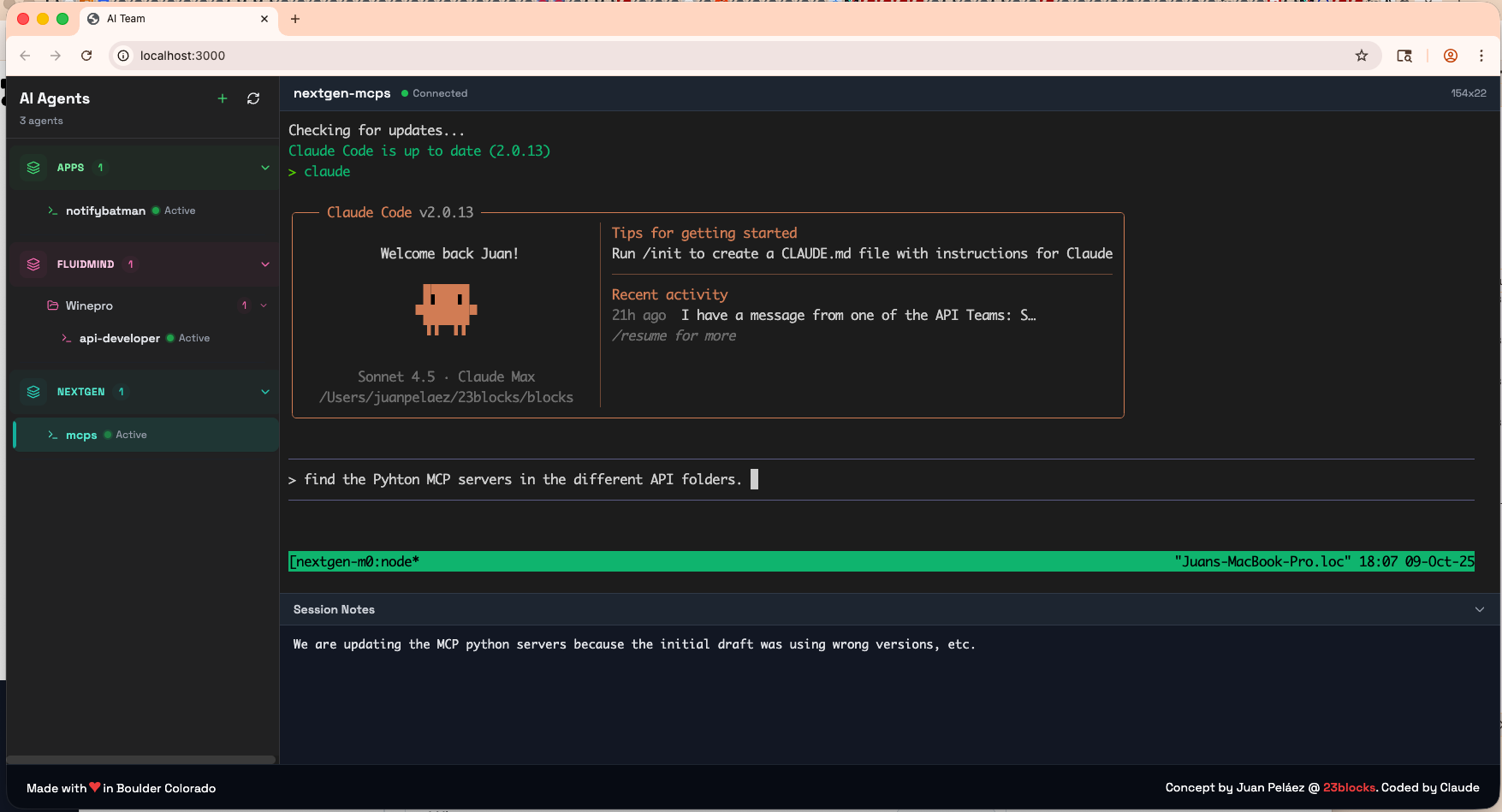
AsyrafHussin@AsyrafHussin
AsyrafHussin/claude-code-statusline/tree/main/mod/statusline-band
A panel above the prompt with rate limits and their pace, context, cost and tokens, git status and switches, actions, and a Spotify card, with Clawd and Beatbot
AsyrafHussin/claude-code-statusline/tree/main/mod/statusline-band
A panel above the Claude Code prompt, with Clawd, the Claude Code mascot, standing beside it, and a Spotify card under it with Beatbot, a Spotify mascot.
▲ out ~7h appears when the pace would use a limit up before it resets. Then context usage as a bar.push (commit and push), find bugs, run tests and summarize. quick commit has Haiku write a message from the diff and shows it: commit, commit and push, or type your own; it then commits itself, without a turn of the main model. Click one, or focus the band with ctrl+x tab, move to it and press Enter.commit auto · push ask, kept per repo. On ask, Claude's git add or commit, or push, waits for your OK. On auto Claude also does it on its own: it commits each finished change, and pushes right after. It runs without a prompt, but only in its plain form, naming its repo with -C: git -C '/abs/path' add <files>, git -C '/abs/path' commit -m '…' and git -C '/abs/path' push [remote] [branch], joined by &&. Any other shape asks whatever the switch says: a step without -C (the Bash tool keeps its own folder between calls), a force push, a heredoc, $(…), a cd, a pipe, a wrapper such as env or xargs, or an alias that commits or pushes. Nothing is allowed in plan mode. Steps that only read (status, log, diff, show, with flags that only shape their output) may ride along. When a step asks, a line under the dialog says what it takes with it. The system prompt tells Claude the plain form and where each switch stands. Click commit or push to flip it.spotify beside the git switches (spotify off, then on, kept across sessions). While it is off, nothing asks Spotify anything. When it is on and Spotify runs, a card framed in Spotify green under the band shows the state and the track, ◀◀ ❚❚ ▶▶, progress with the time, shuffle, repeat and volume − +, and the track heard before it (kept across sessions). With lyrics on (beside spotify, on by default), the card also shows the line being sung, bright, and the next one dim, in time with the song; they come from LRCLIB (lrclib.net), and a track it has no synced lyrics for shows none. search (or /spotify-search) opens a pane that searches Spotify and plays the track you pick, keeping the terminal in front, once spotifyClientId and the client secret are set. Beatbot, a little Spotify mascot drawn in pixels, dances under Clawd while a track plays, and falls asleep with Z's once a track has been paused 10 minutes. It asks Spotify through AppleScript every 5 seconds and never launches it. The playing playlist is not shown: Spotify gives it only through its Web API, which needs a sign-in.minimize on the bottom edge of either card shrinks it to one line from the band's left edge. The main card keeps the repo and branch, model, limits and context as percents, the first git fact and the session cost; the Spotify card keeps the controls, the track and the time. expand brings it back. Each card remembers its choice across sessions.30d, or run /usage-history, for a pane with each day's cost and tokens. Toasts fire when a limit passes 80% and 95%, and when its pace would run it out before the reset.Needs Claude Code v2.1.287 or later.
/plugin marketplace add AsyrafHussin/claude-code-statusline
/plugin install statusline-band@claude-code-statusline
Each is a row in /config, or run /plugin configure statusline-band@claude-code-statusline.
| Setting | Default | What it does |
|---------|---------|--------------|
| initials | empty | Up to two letters on Clawd's shirt |
| cardColor | #0a0a0a | Background of the band; empty ("") for none, so it takes the terminal's own |
| padRows | 1 | Empty rows above and below the stats, 0 to 2 |
| historyDays | 30 | Days the rolling cost and the history pane cover, 7 to 62 |
| noAttribution | false | Leave Co-Authored-By, Claude-Session and the Claude Code footer out of commits and pull requests |
| gitStrict | true | On: with a git switch on auto, only plain commands naming their repo with -C run without a prompt. Off: any git command runs without a prompt while the repo's switch is on auto |
| spotify | true | While Spotify runs, show what it plays under the band, with Beatbot dancing, a progress bar and controls (macOS) |
| plan | empty | Your Claude plan as shown, such as Max 20x; empty reads it from Claude Code's own ~/.claude.json (updated when Claude Code starts or signs in) |
| spotifyClientId | empty | Client ID of your own app at developer.spotify.com/dashboard, for searching Spotify |
| spotifyClientSecret | empty | Client secret of that app. /config leaves secret settings out, so keep it in the macOS Keychain instead: security add-generic-password -U -s statusline-band-spotify -a client-secret -w (it asks for the secret, hidden) |
It runs these programs, never through a shell. The arguments are fixed except the folder (each git command runs in the repo's folder, git -C <folder>), for quick commit the commit message you approved, and for a searched track its Spotify URI (checked to be spotify:track: and letters and digits only).
git, read-only, to show the branch and its changes (each in the repo's folder, git -C <folder>). It runs:
rev-parse --show-toplevel for the repo's root, once per folderstatus --porcelain=v2 --branch --show-stash for the branch, its upstream, commits ahead and behind, uncommitted files and stashesdiff --shortstat HEAD and diff --shortstat @{upstream}...HEAD for the lines uncommitted and unpushedlog -1 --format=%ct for the time of the last commitThese run every 30 seconds and after each tool call.
git, when a git step of Claude's asks, to say under the dialog what it takes with it: the same read-only commands, and config --get alias.<name> to see what a git alias in the command stands for.
git, when you press quick commit: status --porcelain, diff HEAD and log -5 --format=%s to write the message; then, once you approve it, add -A, commit -q -m <message> and, if you chose it, push. These are the only git commands it runs that change anything.
osascript, for Spotify: every 5 seconds, only while the spotify switch is on and Spotify runs, to read the track; on a press of a control (play, pause, skip, shuffle, repeat, volume); and when you pick a searched track, to play it and bring the app you were in back to the front.
security find-generic-password -s statusline-band-spotify -w, for search: when you open or use the search and the setting is empty, to read the Spotify client secret from your macOS Keychain; once it is found, it is kept until the mod reloads.
date, to read the local date and time (+%Y-%m-%d, and +%Y-%m-%d|%I:%M %p|%H|%M|%S). It also formats a rate limit's reset moment in your timezone (date -r <epoch>).
~/.claude.json: only your account's plan type and rate-limit tier, once per load, to show the plan.statusline-band-spotify, the Spotify client secret, when you search.All of it stays in the plugin's own store on your machine, nothing else:
spotify and lyrics switches, on or offgit push itself, to the branch's upstream, with the git credentials you already have.spotify and lyrics are on. Once per new track, its name, artist, album and length go to lrclib.net, a free open lyrics service, to get its synced lyrics. No account or key is involved. Turn lyrics off and nothing is sent.tool.call: only notes the time and refreshes the panel after the call. It lets every call run unchanged and never blocks or rewrites one.prompt.submit: starts Clawd's running animation. The prompt passes through unchanged.turn.complete: stops the animation and adds the turn's token counts to the totals.session.start: starts the panel's timers and registers /usage-history and, with spotify on, /spotify-search.command.run: answers only its own /usage-history and /spotify-search commands, by opening their panes.attribution.text: with noAttribution on, answers an empty commit trailer and PR footer.prompt.compose: adds one section to the system prompt: the git plain form, where each switch stands, and (with noAttribution) no credit lines.$.prompt.submit with its fixed prompt; nothing is sent without a press. quick commit instead sends the diff (up to 24k characters) and the last five commit subjects to Haiku through Claude Code's own model call, then runs git add -A, git commit -m and, if you choose it, git push itself.classic.UserPromptSubmit, classic.PostToolUse: read the permission mode and effort; they change nothing.classic.PreToolUseCheck the author's README for the marketplace and plugin name first. Commands may change as the repository evolves.
claude plugin marketplace add AsyrafHussin/claude-code-statusline
claude plugin install statusline-band
A panel above the Claude Code prompt, with Clawd, the Claude Code mascot, standing beside it, and a Spotify card under it with Beatbot, a Spotify mascot.
▲ out ~7h appears when the pace would use a limit up before it resets. Then context usage as a bar.push (commit and push), find bugs, run tests and summarize. quick commit has Haiku write a message from the diff and shows it: commit, commit and push, or type your own; it then commits itself, without a turn of the main model. Click one, or focus the band with ctrl+x tab, move to it and press Enter.commit auto · push ask, kept per repo. On ask, Claude's git add or commit, or push, waits for your OK. On auto Claude also does it on its own: it commits each finished change, and pushes right after. It runs without a prompt, but only in its plain form, naming its repo with -C: git -C '/abs/path' add <files>, git -C '/abs/path' commit -m '…' and git -C '/abs/path' push [remote] [branch], joined by &&. Any other shape asks whatever the switch says: a step without -C (the Bash tool keeps its own folder between calls), a force push, a heredoc, $(…), a cd, a pipe, a wrapper such as env or xargs, or an alias that commits or pushes. Nothing is allowed in plan mode. Steps that only read (status, log, diff, show, with flags that only shape their output) may ride along. When a step asks, a line under the dialog says what it takes with it. The system prompt tells Claude the plain form and where each switch stands. Click commit or push to flip it.spotify beside the git switches (spotify off, then on, kept across sessions). While it is off, nothing asks Spotify anything. When it is on and Spotify runs, a card framed in Spotify green under the band shows the state and the track, ◀◀ ❚❚ ▶▶, progress with the time, shuffle, repeat and volume − +, and the track heard before it (kept across sessions). With lyrics on (beside spotify, on by default), the card also shows the line being sung, bright, and the next one dim, in time with the song; they come from LRCLIB (lrclib.net), and a track it has no synced lyrics for shows none. search (or /spotify-search) opens a pane that searches Spotify and plays the track you pick, keeping the terminal in front, once spotifyClientId and the client secret are set. Beatbot, a little Spotify mascot drawn in pixels, dances under Clawd while a track plays, and falls asleep with Z's once a track has been paused 10 minutes. It asks Spotify through AppleScript every 5 seconds and never launches it. The playing playlist is not shown: Spotify gives it only through its Web API, which needs a sign-in.minimize on the bottom edge of either card shrinks it to one line from the band's left edge. The main card keeps the repo and branch, model, limits and context as percents, the first git fact and the session cost; the Spotify card keeps the controls, the track and the time. expand brings it back. Each card remembers its choice across sessions.30d, or run /usage-history, for a pane with each day's cost and tokens. Toasts fire when a limit passes 80% and 95%, and when its pace would run it out before the reset.Needs Claude Code v2.1.287 or later.
/plugin marketplace add AsyrafHussin/claude-code-statusline
/plugin install statusline-band@claude-code-statusline
Each is a row in /config, or run /plugin configure statusline-band@claude-code-statusline.
| Setting | Default | What it does |
|---------|---------|--------------|
| initials | empty | Up to two letters on Clawd's shirt |
| cardColor | #0a0a0a | Background of the band; empty ("") for none, so it takes the terminal's own |
| padRows | 1 | Empty rows above and below the stats, 0 to 2 |
| historyDays | 30 | Days the rolling cost and the history pane cover, 7 to 62 |
| noAttribution | false | Leave Co-Authored-By, Claude-Session and the Claude Code footer out of commits and pull requests |
| gitStrict | true | On: with a git switch on auto, only plain commands naming their repo with -C run without a prompt. Off: any git command runs without a prompt while the repo's switch is on auto |
| spotify | true | While Spotify runs, show what it plays under the band, with Beatbot dancing, a progress bar and controls (macOS) |
| plan | empty | Your Claude plan as shown, such as Max 20x; empty reads it from Claude Code's own ~/.claude.json (updated when Claude Code starts or signs in) |
| spotifyClientId | empty | Client ID of your own app at developer.spotify.com/dashboard, for searching Spotify |
| spotifyClientSecret | empty | Client secret of that app. /config leaves secret settings out, so keep it in the macOS Keychain instead: security add-generic-password -U -s statusline-band-spotify -a client-secret -w (it asks for the secret, hidden) |
It runs these programs, never through a shell. The arguments are fixed except the folder (each git command runs in the repo's folder, git -C <folder>), for quick commit the commit message you approved, and for a searched track its Spotify URI (checked to be spotify:track: and letters and digits only).
git, read-only, to show the branch and its changes (each in the repo's folder, git -C <folder>). It runs:
rev-parse --show-toplevel for the repo's root, once per folderstatus --porcelain=v2 --branch --show-stash for the branch, its upstream, commits ahead and behind, uncommitted files and stashesdiff --shortstat HEAD and diff --shortstat @{upstream}...HEAD for the lines uncommitted and unpushedlog -1 --format=%ct for the time of the last commitThese run every 30 seconds and after each tool call.
git, when a git step of Claude's asks, to say under the dialog what it takes with it: the same read-only commands, and config --get alias.<name> to see what a git alias in the command stands for.
git, when you press quick commit: status --porcelain, diff HEAD and log -5 --format=%s to write the message; then, once you approve it, add -A, commit -q -m <message> and, if you chose it, push. These are the only git commands it runs that change anything.
osascript, for Spotify: every 5 seconds, only while the spotify switch is on and Spotify runs, to read the track; on a press of a control (play, pause, skip, shuffle, repeat, volume); and when you pick a searched track, to play it and bring the app you were in back to the front.
security find-generic-password -s statusline-band-spotify -w, for search: when you open or use the search and the setting is empty, to read the Spotify client secret from your macOS Keychain; once it is found, it is kept until the mod reloads.
date, to read the local date and time (+%Y-%m-%d, and +%Y-%m-%d|%I:%M %p|%H|%M|%S). It also formats a rate limit's reset moment in your timezone (date -r <epoch>).
~/.claude.json: only your account's plan type and rate-limit tier, once per load, to show the plan.statusline-band-spotify, the Spotify client secret, when you search.All of it stays in the plugin's own store on your machine, nothing else:
spotify and lyrics switches, on or offgit push itself, to the branch's upstream, with the git credentials you already have.spotify and lyrics are on. Once per new track, its name, artist, album and length go to lrclib.net, a free open lyrics service, to get its synced lyrics. No account or key is involved. Turn lyrics off and nothing is sent.tool.call: only notes the time and refreshes the panel after the call. It lets every call run unchanged and never blocks or rewrites one.prompt.submit: starts Clawd's running animation. The prompt passes through unchanged.turn.complete: stops the animation and adds the turn's token counts to the totals.session.start: starts the panel's timers and registers /usage-history and, with spotify on, /spotify-search.command.run: answers only its own /usage-history and /spotify-search commands, by opening their panes.attribution.text: with noAttribution on, answers an empty commit trailer and PR footer.prompt.compose: adds one section to the system prompt: the git plain form, where each switch stands, and (with noAttribution) no credit lines.$.prompt.submit with its fixed prompt; nothing is sent without a press. quick commit instead sends the diff (up to 24k characters) and the last five commit subjects to Haiku through Claude Code's own model call, then runs git add -A, git commit -m and, if you choose it, git push itself.classic.UserPromptSubmit, classic.PostToolUse: read the permission mode and effort; they change nothing.classic.PreToolUse (Bash only): runs the hooks beneath it first (your own settings hooks among them; their ask or deny stands), then reads the command as it will run for git add, commit and push, and answers ask or allow by the repo's switches. Any other command passes on to your usual permissions untouched.ui.render: draws the panel above the prompt (AbovePrompt), and the history and Spotify search panes (Pane).
Substrate plugin for Ruflo memory: AgentDB controller bridge (15 agentdb_* MCP tools), RuVector ONNX embeddings (10 embeddings_* tools incl. RaBitQ 32x quantization), and WASM HNSW pattern router (3 ruvllm_hnsw_* tools). As a mod (ADR-445): opt-in safe recall into the prompt, a write guard that keeps secrets out of memory, /agentdb, and a status file the console shows

Build, format, optimize, and review interactive Power BI reports, with a report pane that follows the pbir CLI and shows what Claude reads and changes.

Shows unread AMP messages above the prompt, in the status line and as a toast, and can wake an idle Claude Code session to read them. Needs Claude Code 2.1.287 or later.