i-noma-ru@i-noma-ru
i-noma-ru/claude-dotpet
A pixel-art pet that sits above the prompt input in Claude Code's terminal UI, plus a browser editor for redrawing it.
i-noma-ru/claude-dotpet
claude-dotpet shows a pixel-art pet above Claude Code's prompt input, changing with the session state (idle, working, done, sleeping). It is built on Claude Code's plugin hooks API and installed with --plugin-dir or CLAUDE_CODE_PLUGIN_DIRS. Commands include /dotpet to toggle on/off, switch sizes (big, small), and experimental image/still modes. Two art files ship in art/pets/: a default green sample lizard (MIT) and Bun-chan (CC BY-NC 4.0). A browser editor (editor/dotpet_editor.html) lets users paint frames and export JSON, applied via node editor/apply_art.js with validation, backups, and safety stops. Art data lives in art/dotpet_art.json with a fixed nine-color palette and fixed frame counts. Developed and tested on Claude Code 2.1.288/2.1.289 on macOS; Windows untested.
Check the author's README for the marketplace and plugin name first. Commands may change as the repository evolves.
claude plugin marketplace add i-noma-ru/claude-dotpet
claude plugin install dotpet
A pixel-art pet that sits above the prompt input in Claude Code's terminal UI, plus a browser editor for redrawing it.
日本語の説明は README.ja.md にあります。
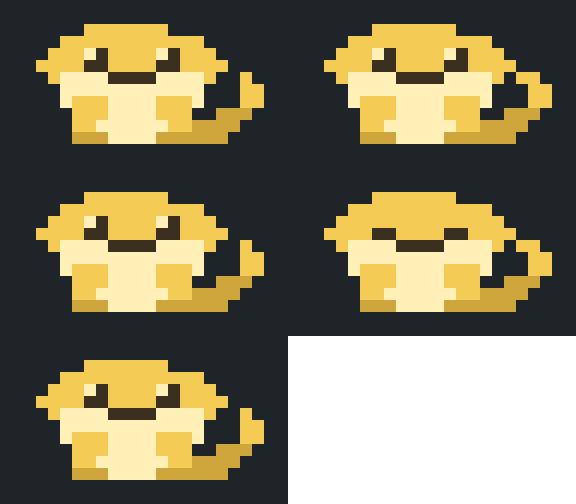
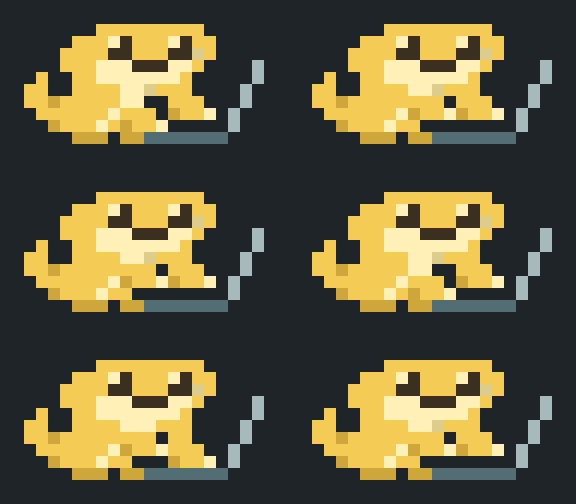
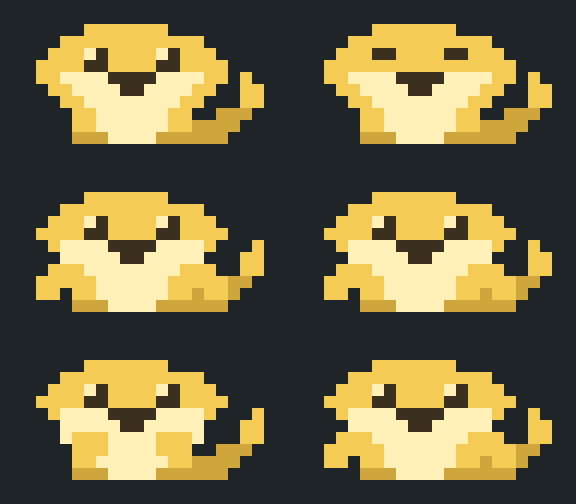
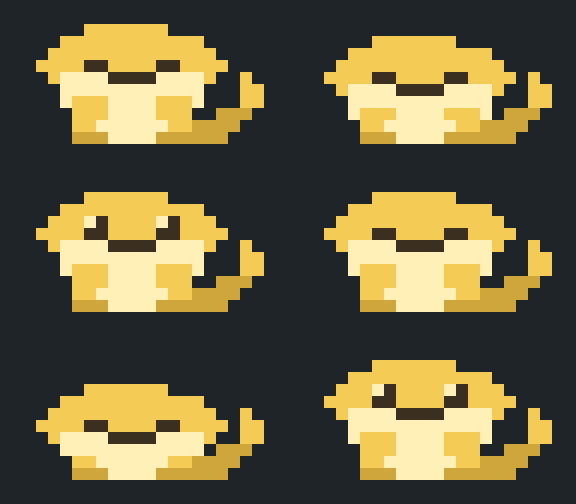
| Idle | Working | Done | Sleeping |
|---|---|---|---|
| |  |
|  |
|  |
|
This is Bun-chan (文ちゃん), the author's pet bearded dragon and a member of the family.
/dotpet turns it on and off and switches the size.editor/dotpet_editor.html in a browser, paint, export, and run one command to apply.The in-app messages and the editor UI are in Japanese.
Requirements: Claude Code, and Node.js 18 or later for the editor's apply command.
Clone this repository.
Start Claude Code with the folder as a plugin:
claude --plugin-dir /path/to/claude-dotpet
--plugin-dir loads the plugin for that session only. To load it in every session, place the folder inside a directory listed in the CLAUDE_CODE_PLUGIN_DIRS environment variable. That variable worked on 2.1.288 but does not appear in claude --help, so treat it as subject to change.
| Command | Effect |
|---|---|
| /dotpet | Toggle on / off |
| /dotpet on, /dotpet off | Turn on / off (the choice is saved across sessions) |
| /dotpet big | Full body, 20 columns × 5 rows of half-block characters (20 × 10 dots) |
| /dotpet small | Full body, 10 columns × 3 rows of octant characters (20 × 12 dots) |
| /dotpet image | Experimental. Draws the pet as an image, 12 columns × 3 rows |
| /dotpet still | Experimental. One still image, no animation |
Notes:
small uses octant characters (U+1CD00 and up, "Symbols for Legacy Computing Supplement"). The terminal font must have these glyphs, for example Cascadia Code. Without them the pet shows as empty boxes.image and still need a terminal that supports the kitty graphics protocol. image was seen working in kitty and Ghostty; still has not been checked there. In other terminals a text fallback is shown; use big or small there.Two art files are included in art/pets/:
| File | Pet | License |
|---|---|---|
| sample-lizard.json | Green sample lizard (the default) | MIT |
| bun-chan.json | Bun-chan, shown in the GIFs above | CC BY-NC 4.0 |
Switch with the apply command, from the repository folder:
node editor/apply_art.js --force art/pets/bun-chan.json
node editor/apply_art.js --force art/pets/sample-lizard.json
--force is needed because these files are not exports from the editor and carry no base marker. The command replaces the current art, so export your own drawing first if you want to keep it (the previous files are also saved under backup/).
Open editor/dotpet_editor.html in a browser (Chrome was used during development).
Pick a size, a state and a frame, then paint.
← → move between frames. Hold the key to preview the motion.Shift + arrow keys shift the picture by one dot. The target can be one picture, one state, or one size.Press 「書き出す」 (export). The browser downloads dotpet_art_<timestamp>.json and the page shows a command.
Run that command in a terminal:
node "/path/to/claude-dotpet/editor/apply_art.js" ~/Downloads/dotpet_art_<timestamp>.json
The command path is taken from where the HTML file is, so it works from any directory. The download location is assumed to be ~/Downloads; adjust it if your browser saves elsewhere.
If the pet does not change in an open session, run /dotpet twice or restart the session.
The apply command validates the file, backs up the current files to backup/, rewrites art/dotpet_art.json and the four generated files (hooks/palette.ts, hooks/sit_art.ts, hooks/octant_art.ts, editor/dotpet_art.js), and then runs claude plugin validate and claude plugin test. If those checks fail, the files are restored from the backup. If the claude command is not found, the checks are skipped and a notice is printed.
| Option | Effect |
|---|---|
| --check <file> | Validate only; write nothing |
| --regen | Rebuild the generated files from art/dotpet_art.json |
| --force | Continue past the two safety stops below (their details are still printed) |
Exit codes: 0 success, 1 failure, 2 bad arguments.
dotpet_art*.json files that were never applied, the command stops and names them. Applied files are remembered in apply_ledger.json.--force overwrites the art with the given file, including any rollback it lists. There is no automatic merge.
art/dotpet_art.json holds:
palette: nine colors under the fixed keys A S M E P K B C V. The color values can be changed; keys cannot be added.big (20 × 10) and small (20 × 12), each with poses (the pictures, one string per row, one character per dot, space = transparent) and order (which picture each frame shows).Fixed in this version:
hooks/art.ts.small, every 2 × 4 block of dots may use at most two colors, and transparent counts as one. A terminal cell can only carry a foreground and a background color. The editor outlines offending blocks in red and refuses to export until they are fixed.node editor/test_apply_art.js
claude plugin validate .
claude plugin test .
art/pets/bun-chan.json and the GIFs in assets/): CC BY-NC 4.0. See LICENSE-ART.md. Credit the author when you reuse it; commercial use, such as selling goods with the artwork, is not permitted. Showing Bun-chan in your own terminal is fine, including on a computer you use for work.The first draft of the Bun-chan pixel art was made with an AI tool; the author then redrew it by hand in the editor.

Firstmate Calm for Claude Code: the sailboat working animation and conversation-only transcript presentation, sharing the per-home config/calm preference with the Pi Calm extension. Its hooks module may load through CLAUDE_CODE_ENABLE_FUNCTION_HOOKS or Claude Code's tengu_plugin_hooks_modules rollout flag, but the mod activates only when CLAUDE_CODE_ENABLE_FUNCTION_HOOKS is exactly 1 and is otherwise a complete no-op.

A Claude Code output style (Epistemic Ink) paired with a mod that draws the ```mermaid and ```math fences it writes as terminal figures, leaving anything transcript text can already draw as text.

A pixel Pokémon that lives above your Claude Code prompt and reacts to everything Claude does.