
alex2481kobe@alex2481kobe
alex2481kobe/claude-mods/tree/main/plugins/codex
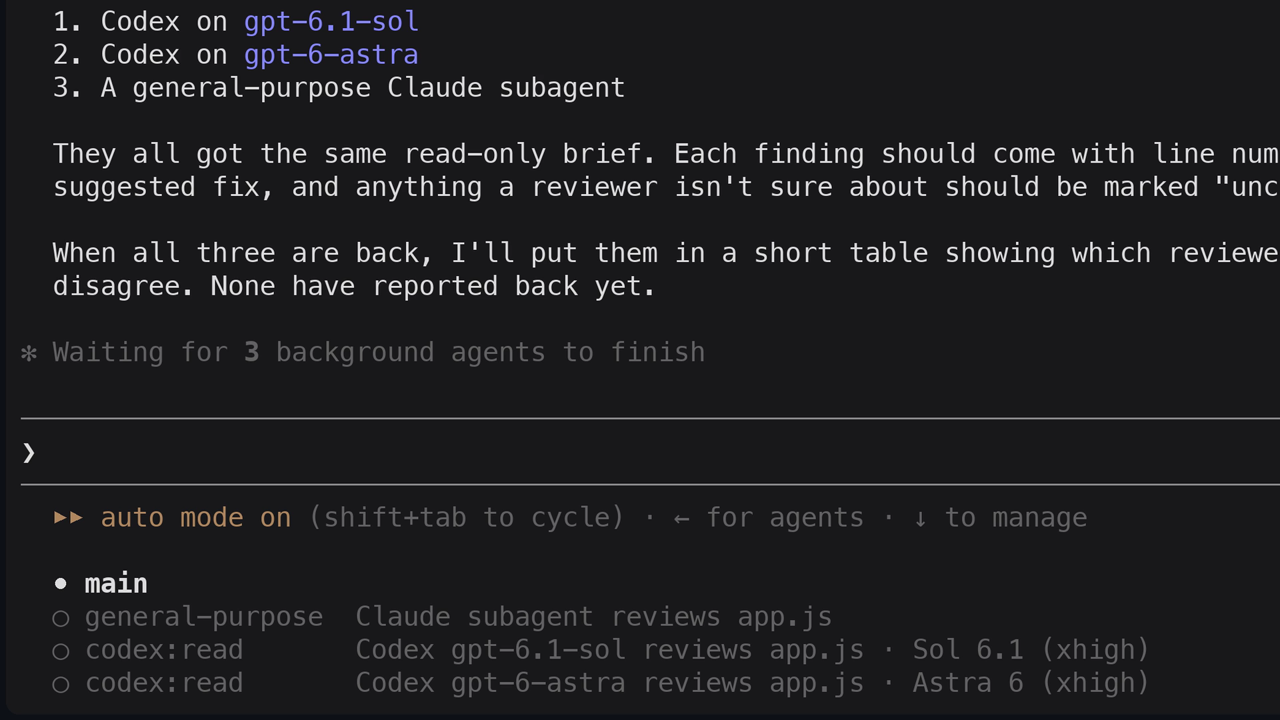
将 OpenAI Codex 作为原生的 Claude Code 子代理:Agent 工具启动一个,mod 驱动 codex app-server 代替它,中间没有模型
alex2481kobe/claude-mods/tree/main/plugins/codex
一个 Claude Code 插件,注册了三种 Codex 代理类型(codex:read, codex:write, codex:run),因此 Agent 工具将 OpenAI Codex 作为原生子代理启动。该 mod 驱动 codex app-server 代替 Claude 模型,在代理视图中实时显示 Codex 的步骤,支持消息、排队消息、批准/问题、通过提示符设置模型/工作量/沙盒/批准标志,以及视图中的 /codex-* 命令。需要 macOS/Linux 上的 Claude Code 和 mods,以及安装并登录了 codex app-server 的 Codex CLI。
请先查看作者 README 确认 marketplace 和插件名称;命令可能随仓库结构改变。
claude plugin marketplace add alex2481kobe/claude-mods
claude plugin install codex
OpenAI Codex as a native Claude Code subagent.
Claude starts Codex with the Agent tool, the same way it starts any other subagent, and Codex behaves like one:
· Sol 6.1 (xhigh)),
its running time and token count, and clears when it finishes; the count
is Codex's current context plus what it has written, the way Claude Code
counts a Claude subagent, not the session's running total· 1 queued)/codex-* commands change its model, effort, sandbox and
approvals for its next Codex turns and show its statusNo Claude model runs inside the agent: the mod drives codex app-server in its
place and shows what Codex does in the agent's view as it happens. (A small Claude
model stands in only if the mod itself fails, to report that failure.)
| Agent type | Shown as | Codex sandbox and approvals | Use it for |
| ------------- | ----------------------- | -------------------------------------- | ----------------------------------------------- |
| codex:read | Codex read-only | read-only, approvals off | second opinions, review, research, scoping |
| codex:write | Codex workspace-write | workspace-write, approvals off | bounded implementation in the working directory |
| codex:run | Codex | your Codex config, changed by flags | anything else Codex can be set up to do |
Claude Code with mods (tested on 2.1.287 and 2.1.288)
macOS or Linux (the mod talks to Codex through a named pipe)
The Codex CLI with codex app-server
(tested on 0.159), installed and logged in:
npm install -g @openai/codex
codex login
codex must be on the PATH Claude Code starts with.
/plugin marketplace add alex2481kobe/claude-mods
/plugin install codex@claude-mods
Ask Claude for it by name:
Have codex:read review the changes in src/auth and report anything risky.
Use codex:write to add input validation to parseConfig in src/config.ts.
Codex cannot see your conversation with Claude, so Claude passes it a self-contained prompt. Codex uses your own Codex login, model and config.
The Agent tool's own model option names Claude models, so Codex is set up in
the prompt instead. The prompt may open with Codex CLI flags, one per line,
spelled as codex exec --help spells them (model: gpt-6-astra,
--sandbox workspace-write, or a flag alone on its line). The mod passes them
to Codex and removes them from the task. Model: and Effort: may be written
in any case:
model: gpt-6-astra
effort: high
Review app.js for bugs and report back.
The agent types' descriptions list the models your Codex knows, so you can ask in plain words: "have Codex review this on gpt-6-astra and gpt-6.1-sol".
Only an exact option line is an option: a flag's name with one plain value (a
path, or a config key=value, may hold spaces), or a flag that takes no value
alone on its line. The first line that is not one starts the task, so a prompt
that opens with prose such as search: every call to fetch or color: change the header color is passed to Codex whole.
codex:read and codex:write take model, effort and the flags that leave
their sandbox alone; sandbox, approvals, add-dir and cd are refused there.
codex:run takes every flag that applies to a session the mod drives:
| Flag | What Codex gets |
| --------------------------------------------------------- | ------------------------------------------------------- |
| model, effort | model, model_reasoning_effort |
| sandbox (s) | sandbox_mode |
| ask-for-approval (a) | approval_policy |
| approve-for-me | the automatic reviewer, in workspace-write |
| dangerously-bypass-approvals-and-sandbox | danger-full-access with approvals off |
| add-dir | an extra writable root, beside your config's |
| search, local-provider, cd (C), image (i) | live web search, the model provider, the folder, images |
| config (c), enable, disable, strict-config | passed as given |
| ephemeral, output-schema | an unsaved session, a JSON Schema for the answer |
Everything left out comes from your Codex config. An option line for a flag
codex app-server has no use for (profile: fast, worktree, json, ...)
stops the run with the reason rather than being dropped.
When Codex asks for something, the agent hands the question back:
Codex asks to run:
  printf 'hi' > note.txt
in /path/to/project
Reason: requires approval by policy
Reply "approve", "approve for session", "decline", or "cancel" (decline and stop the turn).
Claude answers it itself or asks you, then sends the reply to the agent as a message, and Codex carries on in the same turn. Questions for the user and MCP servers' forms work the same way.
A question lives as long as the Codex that asked it. If that Codex is gone (it exited, the session was resumed, or the mod reloaded), a reply such as "approve" is not sent as a new task: the agent reports that the question has expired, and the task has to be sent again.
Who Codex asks is set by its config. With approvals_reviewer set to Codex's
automatic reviewer, Codex never asks: its reviewer decides, and the transcript
shows what it decided. To be asked instead, set approvals to come to you, in
your config or for one agent:
ask-for-approval: on-request
config: approvals_reviewer="user"
Create note.txt containing hi.
Open a codex agent's view (select it in the agent list, press Enter) and run
a command; the / menu there lists them. The reply shows above the prompt in
that view, and neither Codex nor Claude is sent it:
| Command | What it does |
| ------------------------------------------------------------ | ------------------------------------------------------------- |
| /codex-model <id> | the Codex model, from the agent's next Codex turn |
| /codex-effort <level> | the reasoning effort, from the next turn |
| /codex-sandbox <read-only\|workspace-write\|danger-full-access> | the sandbox, from the next turn |
| /codex-approvals <untrusted\|on-request\|never> | when Codex asks for approval, from the next turn |
| /codex-status | what Codex said the session ran with at its last turn, what changes next turn, the Codex session and its running token total |
| /codex-help | the list |
model     gpt-6-astra from the next Codex turn (now gpt-6-luna)
effort    low
sandbox   workspace-write
approvals on-request
session   01a0f9f0-0000-7000-8000-000000000000
tokens    141,551 in (127,488 cached), 296 out, running total
A setting is kept for that agent and goes with each of its later Codex turns,
and the header of each turn names the model and effort Codex reports for it.
Values follow the option rules above: codex:read and codex:write refuse
/codex-sandbox and /codex-approvals, since they pin their sandbox, and a
value that is not one plain word is refused. An unknown /codex- command, or
one without its value, answers with the list. Claude can send one to the
agent with SendMessage; then the reply is the agent's report, and a message
sent together with it goes to Codex on its own.
While a codex agent's view is open, the footer and the / menu list these
commands alone: Claude Code's own commands act on the main session, not on
the agent, so they are hidden there (typed in full, they still run). Elsewhere
the /codex- commands are hidden, and one typed in full says to open a codex
agent's view.
codex:* agent's loop asks its model for a response, the mod answers
instead: it starts codex app-server with the agent's flags as config
overrides, starts or resumes the Codex session in the session's working
directory with the settings its commands chose, shows Codex's messages and commands in the agent's view as they
happen (each is also appended as a notice, which is what refreshes the agent
list's activity line; the detailed transcript, ctrl+o, shows both), and
reports Codex's token usage on the agent's row: each turn hands Claude Code
the input of Codex's last request (its current context, cached tokens
apart) and the output the turn generated. Claude Code keeps the latest
input and adds up the outputs, as it does for a Claude subagent. The
running total, which counts every cached re-read of the session and soon
reaches millions, is in /codex-status.codex app-server
through a named pipe in a private temporary folder, which goes when the
process does. The mod writes only to that pipe, and never once the server
has gone.kill -9), the shell sees its parent gone within a second or
two and ends Codex and the folder.SubagentHandback tool in an interactive session, or as the
final text where that tool does not exist (headless, SDK). A handback you
interrupt (Esc in the agent's view) does not change that. A report that
never reached the caller (its handback interrupted, or failed for want of
the tool) is given again the next time the agent's loop runs, once: ahead
of the answer to a new message, or alone when there is none.codex: stopped before Codex finished.: what Codex said on the way is never handed back, and that line
is never given again as an undelivered report. (Claude Code's own notice
that the agent was stopped still quotes what the agent had shown so far.) A message counts as passed on once Codex
has taken it (its turn started, or its question answered), finished or not:
the next message resumes the same Codex session with that message alone,
and the stopped task is not sent again. Only a step cut off before Codex
took its messages (Esc, or the session moving host, while the session was
starting) passes nothing on, and the next time the agent's loop runs, those
messages are given to Codex again. The agent's options come from the prompt
it was spawned with, which the mod records at spawn, so a first task run
again keeps them however Claude Code places the messages sent since; the
task goes first, then those messages. Claude Code's interruption marker
([Request interrupted by user]) never reaches Codex. When the interruption is the session moving to the background
(the session list opening while the agent's first turn runs), Claude Code
2.1.287 continues the agent in a forked session whose conversation, as the
mod reads it, no longer holds the task, so the agent reports
codex: nothing new to send to Codex. and Claude has to send the task
again.turn/steer, for a
message Claude sends with SendMessage while Codex works), or as a new turn
of the same Codex session. Claude
Code places a message sent to a running agent twice, wrapped in its own
instructions and as typed; the mod counts it once and drops the wrapping, so
the same words sent twice are asked twice. A /codex- message is the mod's
own and never reaches Codex.model and cwd options are ignored: Codex uses your Codex
config, in the session's working directory.codex:run takes every flag Codex
accepts, dangerously-bypass-approvals-and-sandbox included. Codex's own
requirements (allowed_sandbox_modes, allowed_approval_policies) are the
place to forbid one; the mod has not been tested against them. In auto mode, Claude may note that its safety
check could not review the agent's output, since no Claude model wrote it.codex app-server takes no profiles: set those values with config: lines.codex:read and codex:write run with approvals off, so the sandbox is the
limit. Codex's workspace-write sandbox keeps .git read-only, so
codex:write cannot stage or commit (git add fails on .git/index.lock);
commit its work yourself, or use codex:run with approvals that let Codex
ask.ephemeral cannot take follow-ups: Codex does not
keep its session, so there is nothing to resume.codex: nothing new to send to Codex., and the
view shows codex: nothing to run. (Ending without a report would have
Claude Code tell Claude that no report came and to message the agent for
one.)~/.claude and is not affected; for a
--plugin-dir or a local marketplace, keep the folder outside those three./tasks) names the stand-in's model, Haiku, for a
codex agent; the agent's row and header show Codex's. The agent keeps a
Claude model so that a run the mod does not answer (the mod not loaded, or
the session resumed without it) reaches the stand-in, which reports that
Codex did not run, rather than failing on a Codex model id./ menu, background agents, messages and queued messages,
approvals, stop) and headless (claude -p). Linux should behave
the same; Windows is not supported (the mod needs sh and a named pipe).claude plugin validate plugins/codex
claude plugin test plugins/codex
claude --plugin-dir plugins/codex

将工作阶段作为 skill 使用的浏览器自动化:Playwright + RVF 认知容器 + ruvector 轨迹 + AgentDB 选择器记忆 + AIDefence PII/注入守门。作为 mod(ADR-445 模式):只收紧的工具守门、本地斜杠命令和控制台显示的状态文件。

为 Claude 提供 register_assumption 工具,并在提示列上方显示本回合的假设、决定和考虑过但未完成的事项。

通过 SSH RemoteForward 隧道,将 REMOTE 主机上的 Claude Code 会话上下文发布到 Mac 上的 localvoxtral。命令钩子运行随附的 POSIX-sh shim,通过 curl POST;远程主机只需 sh 和 curl,缺少任一项时会静默放行。