
KTCrisis@KTCrisis
KTCrisis/flux7-mods/tree/main/avatar7
KTCrisis/flux7-mods/tree/main/avatar7
avatar7 是 Claude Code function hooks 插件,在面板中渲染 64x64 的机器脸,根据工具调用结果以情绪改变颜色、加入故障效果和环境场景层,并通过 Piper/SAPI TTS 说出一句话。支持 15 多种 persona(SHODAN、HAL 9000、类似 GLaDOS、Ada 等)、/avatar、/avatar-talk、/avatar-ask、/avatar-chat、/avatar-mute、/avatar remote 指令、通过 Tailscale 远程语音的 relay、私人 persona 补充和自定义 avatar 创建。
请先查看作者 README 确认 marketplace 和插件名称;命令可能随仓库结构改变。
claude plugin marketplace add KTCrisis/flux7-mods
claude plugin install avatar7
A machine face in a Claude Code pane. It watches every tool call of the session, changes color with the outcome, and comments in one spoken line, in the voice and temper of the chosen avatar: SHODAN, HAL 9000, a GLaDOS-like lab AI, Ada, a benevolent brass automaton, Nova, a Miami night radio host, and ten more. A backdrop of its world fills the black around the face.
It is a mod: a plugin of function hooks that runs inside one Claude Code session. It sees the session's events at the source and nothing of other sessions.
avatar7                      # alias for: claude --plugin-dir ~/flux7-mods/avatar7
avatar7 --resume             # any claude flag passes through
| Command | Effect |
| --- | --- |
| /avatar | open the pane |
| /avatar <id> | switch avatar (shodan, hal, glados, ada, duck7, pod042, kaneda, commis, fox, adjutant, morte, pda, lain, tachikoma, nova), greet, remember the choice across sessions |
| /avatar-talk | ask the avatar what it thinks of the conversation; the talk button under the face (hotkey t while the pane has the focus) does the same |
| /avatar-ask <question> | ask the avatar on duty its opinion on the session: it reads the last 12 messages (600 characters each) and answers in two or three sentences; an answer ending on a question opens the answer field. The ask button (hotkey q) opens a field for the same |
| /avatar-chat <what you say> | talk to the avatar personally, about anything but the session: it answers from its own world and what it knows of you (see the private complement below), in two or three sentences, and remembers your last six exchanges, per persona. The chat button (hotkey h) opens a field that stays open for the conversation |
| avatars button (hotkey c) | lists every avatar by name above the controls; click one and it takes over, as /avatar <id> does |
| /avatar-mute | toggle the voice for this session; the mute / unmute button under the face (hotkey m) does the same |
| /avatar remote on\|off | send the voice to another machine instead of this one (see Remote voice) |
| vol - N + | buttons under the face: SAPI volume by steps of 10, 0 to 100, kept across sessions ($.store) |
The pane opens by itself at session start when the terminal is at least 144
columns wide; below that, /avatar seats it. It opens after the other mods
have started, so it is the pane shown, in the last tab (see Loading in the
root README). The plugin folder is watched:
saving a file reloads the mod in every session started with the alias.
It is deliberately not in the global CLAUDE_CODE_PLUGIN_DIRS: a plain
claude session has no avatar.
A session driven from elsewhere (Remote Control from a phone, ssh from another
PC) keeps its mods on the host: the pane and the voice stay there.
tools/relay.py carries them to a browser tab on http://<host>:8797/, which
installs on a phone's home screen and opens like an app.
What the page shows. The full-size portrait over the persona's scene,
tinted by the mood, with the mouth and frown frames where they exist; the line
typed as the voice is heard in that tab; the pane's controls (talk, ask,
answer, avatars, mute, events, visits, volume); at the bottom, which session
holds the relay (short id, folder, last prompt). Tap listen once: browsers
play nothing before a gesture.
float: the face and its subtitles in picture-in-picture over the other
apps. Android draws no HTML there, only media buttons: next track asks the
avatar to talk, play/pause mutes it.pixel: the faces the terminal draws (64x64, scaled up without smoothing)
under a CRT (scanlines, a rolling band, a vignette); remembered by the
browser. The terminal dropped its CRT at 64x64 half blocks; a phone has the
pixels to draw it thin.How a line travels.
<audio>
element is the fallback.A locked phone puts a silent page to sleep mid-line. From listen on, the
page loops a breath on the last bit (about -90 dBFS, inaudible; -60 was
heard) through an <audio> element, on purpose: that one takes the audio
focus, so Android keeps the page running as a player. Piper voices only: a
persona speaking through SAPI itself has no WAV to send.
Who holds the relay. One session at a time, named in the spool's owner
file; the others keep their voice on the host, and the page's buttons reach
the holder only. The voice follows where the user last typed: a prompt sent
through Remote Control, or typed in a session reached over ssh, takes the
relay; a prompt typed at the host's own terminal gives it back, and so does a
session that ends (the page then says nobody holds it). /avatar remote on
takes it and holds it whatever the next prompt's origin, a /clear included
(the relay follows the new session id); /avatar remote off gives it back.
A holder counts only while the relay's process lives: a relay that died
without cleaning up no longer swallows the voice. While nobody holds it the
page's presses are refused (409) rather than kept for later, and at most 16
wait at once.
In the code. hooks/mood.ts holds the face's state and its transitions
(react, hold, release, ask, answered, tick): a wait keeps the face, written
once. hooks/draw.ts draws the face from a View built once per frame (tint,
glitch, scanlines, the comm window's frame, the cutout over the scene; about
0.4 ms a frame at 64 px, measured in Node). hooks/voice.ts holds the Piper
and SAPI commands, hooks/hearing.ts the slash commands and the other mods'
announce and say. hooks/speech.ts holds what is said and when: the kinds of line, the
queue, the persona's text, and how a line is asked of the model (reads,
promptFor) and kept (lineFrom). hooks/line.ts holds the line under the face: its text, typing pace,
the voice's timing and the one speaking slot. hooks/relay.ts holds the relay's protocol (the page's
presses, the mirrored face), the shell that touches the spool, the state and
the decisions (who takes, who gives back); hooks/register.tsx keeps only its
few engine calls, in one section, since the engine follows $ into nothing
imported.
Running it. As a service, so it is ready before any session needs it:
tools/avatar7-relay.service (instructions inside). The page
(tools/relay.html) is read at each request, so editing it needs no restart;
relay.py reloads itself when the file changes (same PID, spool kept, a
version that does not compile is skipped). /avatar remote off only gives
the relay back, it does not stop it.
The relay binds to the machine's Tailscale address (tailscale ip -4);
without Tailscale, pass --host <address>. The page has no authentication and
its buttons act on the avatar only, never on mesh7 approvals: keep it on a
private network, never on a public interface. A session started over ssh dies
with the ssh connection; start the one the phone will use in a local
terminal, or in tmux.
The avatars address you by the user_name option, empty by default. Set it in
the config menu (/config, row "Your name"), or in ~/.claude/settings.json
under pluginConfigs for avatar7. Empty, they stay impersonal; HAL falls
back to Dave.
The personas in this repository know nothing about you. To give them more,
without publishing it, write a file per persona outside the repository:
~/.config/avatar7/personas/<id>.json. avatar7 merges it at load, on top of
personas/<id>/persona.json; a persona without one stays as published.
{
  "persona": "You know the user practises judo and builds agent governance.",
  "events": [
    { "story": "the user's judo bag sits by the door; a training night", "mood": "wait" },
    { "story": "a melody the user started three days ago is open again", "mood": "watch" }
  ],
  "asks": "judo and discipline",
  "nobody": "sensei"
}
| Field | Effect |
| --- | --- |
| persona | appended to the character's text: what it knows of you, how it treats you |
| events | added to its own scenes (moods: watch, wait, error, deny) |
| asks | added to the topics it asks you about |
| nobody | what it calls you when user_name is empty |
Every field is optional. The file is read when the persona comes on duty or
visits, so a switch (/avatar <id>) picks up an edit. Invalid JSON is
ignored, with a line in the session log. Keep the file out of any repository:
it is the place for what you would not publish.
--plugin-dir).powershell.exe from WSL2. Elsewhere
the call fails silently and the avatar only writes; /avatar-mute avoids
the attempt.tool.call ──► next(e) runs the tool ──► outcome ──► mood (color, glitch)
│
└──► (rate-limited) Haiku line
│
├──► line atom ──► typewriter text in the pane
└──► powershell.exe SAPI voice (WSL interop)
clock.every 66 ms ──► pixel() over face.rgb ──► Raster cells ──► $.ui.blit (15 fps)
hooks/register.tsx)| Hook | Role |
| --- | --- |
| session.start | registers /avatar, /avatar-talk, /avatar-ask, /avatar-chat and /avatar-mute, loads the stored avatar ($.store), starts the frame clock, opens the pane |
| command.run avatar | opens the pane, or loads another persona, stores it, queues its greeting (first in line, never over another voice) |
| command.run avatar-talk, the talk Button | raise a flag; the frame clock, which holds the session's $, reads the last 6 messages ($.session.messages(), 300 characters each) and asks Haiku for one line, outside the tool-call rate limits |
| command.run avatar-ask, the ask field | queue a consult, ranked with the poke and never stale; the clock reads the last 12 messages (600 characters each), asks Haiku for an opinion in two or three sentences (160 tokens), keeps every sentence, and opens the answer field when the opinion ends on a question; no stock line when the model gives none |
| command.run (any other) | a command listed in COMMANDS (clear, compact, fast, rewind, resume, brief, veille, document, galerie, mesh-approve, code-review, security-review, code7) queues a line with what it means; the rest pass in silence; adding one is one line |
| turn.complete | compares the model in use ($.session.model()) with the last turn's and queues a line when it changed: the /model picker, /config and Remote Control switch outside any command the mod sees |
| session.compact | an automatic compaction of the main conversation queues an amber line; a manual one was heard as /compact |
| command.run avatar-mute | flips the isMuted state |
| state.set | another mod's write to its own announce key is recorded in announcers, by plugin name; a write to its own say key queues a line at once (see below) |
| ui.toast | a toast from a recorded mod (next.origin.plugin) queues a line announcing it in that mod's mood, past the rate limits |
| tool.check | an ask verdict on a real call (a settings rule, or mesh7's hook answering ask for Bash) sets the waiting face; the line comes only if the prompt is still up after ~2 s, since auto mode may settle the ask alone |
| tool.call | lets the call run (await next(e)), classifies the outcome (denied, failed, succeeded) and queues a line; a success waits for silence, a refusal or a failure takes its place in the queue even while another line plays; a refusal, a failure or any call through mesh7 waits ~1.8 s in the queue, so mesh7-pane can replace it with what mesh7 decided; a wait (permission prompt, mesh7 hold) lets the face go after 15 minutes at most |
| ui.render Pane | draws the Raster and the line under it; a text fallback off the terminal |
avatar7 knows no mod by name. A mod that wants its toasts spoken publishes, at session start, one value under its own name, declared in its own contract:
// types/index.d.ts
export type Announce = { mood: 'watch' | 'error'; event: string }
declare module 'claude-code' {
  interface PluginState { 'my-mod': { announce: Announce } }
}

// hooks/register.ts, in session.start
await $.state.set({ plugin: 'my-mod', key: 'announce' }, { mood: 'watch', event: 'a build finished' })
mood is the face (watch calm, error amber), event what happened, in
words the line is written from; the toast text is added to it. avatar7 hears
the write and keeps it across its own reloads; the mod never imports avatar7,
and without it the value just sits unread. atelier-bell and usage-bell
do this. /avatar voices lists the mods heard so far.
A mod that wants a line without a toast writes its own say key instead,
each time it has something to say (its first say also takes it off the
toast readers, so a mod that moved from one to the other is not heard twice):
export type Say = { mood: 'watch' | 'error' | 'deny' | 'wait'; event: string; at: number }
await $.state.set({ plugin: 'my-mod', key: 'say' }, { mood: 'deny', event: 'the deploy was refused', at: Date.now() })
at makes the same event twice two writes. Three optional fields go with
it: tool, the call the line is about as Claude Code names it, whose own
waiting line the avatar then drops; hold, a call held for a human (the face
waits); release, that call decided. mesh7-pane says mesh7 going down
(error), an emergency stop (deny) and their end (watch); a refusal of
this session's calls with its rule; an MCP call held for a human, then the
human's decision. It reads them from mesh7's traces, not from message texts.
jukebox7 says each song as it starts, asked or chained, and the persona
introduces it the way a radio host would, over the intro while the music
steps back under the voice.
Every line, from a call, a toast, a say or a poke, goes through one queue of
four: a poke first, then deny, then error and wait, then watch, the
oldest first among equals. Full, the least urgent is dropped; a line that
waited more than ~20 s is dropped unspoken.
Now and then, every 20 to 40 minutes and only after a minute of quiet with
nothing queued, held or asked, the persona lives an event of its own: one
of its events, its face in that event's mood and a line written from the
story; or, when it has asks, a question to the user, philosophical from
its story or technical from the last messages of the conversation. A
question opens an answer field in the pane (ctrl+x tab, type, Enter); the
answer goes to the persona only, never to Claude, and it reacts in
character. Unanswered, the field closes after five minutes. These lines
take the last place in the queue; a question with no model answer is not
asked. /avatar event makes one happen now, /avatar events off stops
them (kept in $.store). Every persona has three stories and a bent.
One event in three is a visit: another persona drops in and the two trade
six lines, host first, about the work in the session or where their two
stories cross. Each speaks with its own voice, the face on screen follows
the speaker, and the line reads GLaDOS: …. A turn the model leaves empty
ends the visit; so does a turn that waited too long behind other lines.
A guest picked at random favours the host's friends (three times as
likely): GLaDOS drops in on HAL more than on the Commis.
/avatar duo glados brings one now, /avatar duo a guest at random.
The pane has two switches beside mute: events (key e) for all of a
persona's own events, visits (key v) for the visits alone, which leaves
the stories and questions on. Both are kept in $.store, and answer to
/avatar events on|off and /avatar visits on|off too.
| Outcome | Mood | Look |
| --- | --- | --- |
| success | watch | slight cyan pull, about 0.8 s |
| isError | error | amber pull, about 2 s |
| denied by a hook or permission, or a mesh7 refusal | deny | magenta pull, shifted rows, snow, about 2 s |
| held for a human: a mesh7 approval (said by mesh7-pane), or a permission prompt | wait | violet pull, slow breathing, until the decision; the pane shows waiting for a human: <tool> for a mesh7 hold |
avatar7 knows nothing of mesh7 itself: without mesh7-pane, a call mesh7 refuses reads as a failure, and a held one as a success.
personas/<id>/face.rgb is 64x64 raw RGB (3 bytes per pixel, row-major).fit() takes the pane body width (e.props.bodyColumns) and the surface height, and sample() averages the portrait blocks each output pixel covers (64 down to 16 pixels a side). The scanlines are drawn at the output size.pixel(x, y) reads the portrait and applies, in order: the mood tint by
luminance, the waiting breath, scanlines, a rolling bar, and the deny
glitch. The eye glow, blink and pulse are off for now: on several portraits
the ellipses missed the eyes and read as smudges.cells() packs two pixel rows per terminal row with the upper half block
▀ (foreground = top pixel, background = bottom pixel), base64 as
RasterProps expects.$.ui.blit every 66 ms, which repaints the mounted Raster
without a render pass.The black around the face holds each persona's backdrop and weather
(hooks/ambient.ts, ambient in persona.json): a margin either side of the
face and a band under the text, three more Rasters repainted every third
frame (5 a second), about 3 ms in all on a 160-column pane. Each cell is a
quadrant block (▖▗▘▝▚▞...): four pixels, two colors chosen as chafa does,
twice the face's horizontal resolution.
scene layer is a wide studio render baked by tools/bake_scene.py. It
rises behind the face to its middle, across the pane (cropped like a CSS
cover, sky first), and runs six rows past the text before fading out. The portrait's
dark background lets it through by degrees: cutout in persona.json
(default 12, on 0-255 luminance) is lowered for a face with dark hair.
Framed as a comm window: bright brackets at the corners, a faint line
along the edges, in the persona's color or the mood's. animate picks what moves in it: beacons (red lights
blink), neon (saturated signs flicker), windows (points of light go dark
and come back).rain, rise (bubbles, embers,
steam), wind, stars, bolt (rare, frequent on a refusal), pulse
(wires), grid (an outrun floor from where the scene fades out under the text,
horizon as a share of the scene's bottom row, down to the pane's bottom). Each takes
color, density, speed. Every pixel is a function of its place and
time through hashed noise; nothing is kept per drop.Image (real pixels) would be sharper but needs the kitty graphics protocol
(kitty, Ghostty); Windows Terminal shows only its alt text, hence the Raster.
loudnorm, -18 LUFS)
after its persona's filter; the user's volume applies after that, so a
persona's filter sets its timbre, not its level.3rd denial in a row), and a success after three
or more says first success after N failures in a row, at the 5 s pace.$.model.complete with haiku, the persona's persona text as system
prompt, the event as prompt (preceded by the first 200 characters of the
last prompt the user typed, at the terminal or through Remote Control, so
the call is judged against what was asked) and followed by the avatar's
last three lines, not to be reworded, 80 tokens, 15 s. If it fails, a line
is taken from fallback[mood].line atom (survives reloads), typed out two
characters per frame.setsid): the engine kills
a module's children when it reloads, and a line half spoken used to die
with it. The voice is held for the WAV's length plus 0.9 s for PowerShell
to start, then the next line may speak.turn.complete): a toast or a story later on is not judged against it.piper voice, sits outside the repo:
uv venv ~/.local/share/piper/.venv && uv pip install --python ~/.local/share/piper/.venv/bin/python piper-tts, then python -m piper.download_voices --download-dir ~/.local/share/piper/voices <name>.
A line takes one to two seconds to synthesize on the CPU, no GPU, no account.~/.local/share/piper/custom/<avatar id>.onnx (with its .onnx.json, and
an optional <id>.fx filter): it wins over the persona's, and stays out of
the repo.powershell.exe with the text on
stdin in UTF-8, the persona's voice and rate.| Where | Key | Lifetime |
| --- | --- | --- |
| $.state | avatar7.line, isMuted, volume, avatar, color, station, isVoicing (jukebox7 ducks on it), announcers | the session, across reloads |
| $.store | avatar, volume, events, visits | across sessions |
| module variables | frame, mood, loaded face and persona | one load |
An avatar is a folder personas/<id>/:
personas/<id>/
  portrait.png        the studio render (kept as the source)
  face.rgb            baked by tools/bake.py, what the mod draws
  face-preview.png    the same grid x8, to read coordinates on
  persona.json        name, voice, features, temper
POST http://localhost:8700/keyframe, 1024x1024. What survives a 64x64
reduction is contrast and a large central subject, so the prompt asks for:
The shipped portraits (model krea2_turbo_fp8_scaled.safetensors, seed
random unless given; the actual seed is in the PNG metadata). Morte and
GLaDOS are edits of a still from their game (Boogu Edit, mode: edit), not
renders from a prompt:
| id | style | prompt |
| --- | --- | --- |
| shodan | cyber-futur 1995 | frontal symmetric portrait of a cold artificial intelligence goddess, female machine face made of glowing wireframe mesh and circuit plates, piercing luminous eyes staring straight at the viewer, thick cables and wires flowing from the head like hair, face centered and filling the frame, pure black background, high contrast, green and cyan glow, 1994 cyberspace computer graphics |
| hal | libre | extreme close-up of a single glowing red camera lens eye set in a brushed aluminium panel, deep red glass iris with a bright yellow-white pinpoint center, concentric reflections, perfectly symmetric, centered and filling the frame, 1968 science fiction spaceship computer, pure black surroundings, high contrast |
| glados | edit, seed 2011 | Boogu Edit (mode: edit) of a Portal 2 still of GLaDOS: "keep this exact white robotic head with its single glowing yellow eye, turn the head so the eye faces the viewer straight on, centered and filling the frame, replace the whole background with pure black" |
| ada | decopunk (Belle Époque futur) | frontal symmetric portrait of a benevolent automaton woman, face of polished brass and ivory porcelain, gentle kind luminous amber eyes, serene soft smile, ornate brass filigree and whiplash curves framing the head like a halo, face centered and filling the frame, warm golden light, dark background, high contrast |
| duck7 | none, seed 11 | cartoon mascot portrait of a cheeky mallard duck head facing the viewer, 1990s animated series style, bold thick black outlines, flat cel shading, big round expressive white eyes with black pupils and a mischievous half-lidded look, wide orange-yellow bill with a smug grin, glossy emerald green head, small tilted golden crown, symmetric, head centered and filling the frame, pure black background, high contrast, vivid saturated colors |
| pod042 | none, seed 42 | frontal symmetric view of a small floating support robot pod, boxy grey metal casing with rounded edges, a single horizontal glowing slit eye in the center, two small mechanical arms folded at its sides, minimalist post-apocalyptic android design, centered and filling the frame, pure black background, high contrast, soft white and pale yellow glow, 2017 video game concept art |
| kaneda | none, seed 1988 | frontal portrait of a cocky teenage biker gang leader, spiky brown hair, smirking confidently straight at the viewer, red leather biker jacket with a white pill capsule emblem on the chest, neon red city lights behind, 1988 japanese anime cel animation style, bold outlines, face centered and filling the frame, dark background, high contrast, saturated red |
| commis | none, seed 1770 | frontal symmetric portrait of a weary 18th century ship log clerk, powdered wig, round brass spectacles, quill pen behind the ear, 1990s animated series cartoon style, bold thick black outlines, flat cel shading, warm candlelight colors, face centered and filling the frame, pure black background, high contrast |
| fox | none, seed 1994 | frontal portrait of a cocky anthropomorphic fox fighter pilot, orange and white fur, sharp green eyes looking straight at the viewer with a confident smirk, a radio headset with a small microphone over the muzzle, green flight jacket collar with a white scarf, starfield and a blue cockpit glow behind, 1990s video game box art style, bold outlines, head centered and filling the frame, dark background, high contrast |
| adjutant | none, seed 1999 | frontal symmetric portrait of a military android adjutant, bald pale female face with panel seams, glowing pale blue eyes, thick cables plugged into the skull, 1990s science fiction comic book style, heavy ink outlines, flat colors, cold cyan monitor light, face centered and filling the frame, pure black background, high contrast |
| morte | edit, seed 2009 | Boogu Edit (mode: edit) of a Planescape: Torment still of Morte: "keep this exact floating skull with its bulging eyes and open toothy jaw, turn it to face the viewer straight on, centered and filling the frame, replace the whole background with pure black, keep the painted 1999 game art style", then a second edit of that (seed 2009) setting it in the dim Planescape Mortuary: stone vaults, purple and green planar haze, a distant candle |
| pda | none, seed 2018 | frontal symmetric view of a rugged handheld survival PDA device floating in dark deep ocean water, a round glowing screen in the center showing a single luminous cyan signal ring like an eye, concentric rings, small status lights on a scratched white and orange casing, faint bubbles and bioluminescent particles around, device centered and filling the frame, pure black abyssal background, high contrast, cold cyan and teal glow, 2018 underwater survival video game interface |
| lain | libre, seed 1998 | frontal portrait of a quiet teenage girl with a short brown bob haircut, one long lock of hair on her left side held by a small X shaped clip, large pale grey eyes staring straight at the viewer, pale skin lit by the faint glow of an old CRT monitor, tangled cables and telephone wires blurred in the darkness behind, late 1990s anime cel animation style, melancholic and distant, face centered and filling the frame, black background, high contrast, cold blue glow with a touch of red |
| nova | libre, seed 1986 | frontal portrait of a late-night radio DJ woman, 1980s japanese anime cel animation style, bold black outlines, flat cel shading, voluminous dark curly hair, retro headphones around her neck, aviator sunglasses pushed up on her head, calm half-lidded confident eyes looking straight at the viewer, a faint knowing smile, magenta and cyan neon rim light, face centered and filling the frame, pure black background, high contrast, saturated colors |
| tachikoma | libre, seed 2002 | frontal view of a small cobalt blue spider-like AI think-tank robot facing the viewer, a round bulbous abdomen pod behind, three large round glowing optical sensors clustered on its front like curious eyes, two small manipulator arms, glossy rounded armor, childlike curious pose, late 1990s anime mecha cel style, robot centered and filling the frame, black background, high contrast, cyan and white glow |
A render takes about 25 to 50 s on Krea 2 turbo.
mkdir personas/<id>
cp ~/ComfyUI/output/kf_000NN_.png personas/<id>/portrait.png
~/py_env/bin/python tools/bake.py <id> --box LEFT TOP RIGHT BOTTOM
--box crops the 1024x1024 original before the reduction; keep it square and
tight around the face (the shipped boxes are in the table below). The tool
boosts contrast by 1.25, reduces with Lanczos to 64x64, and writes
face.rgb and face-preview.png. Look at the preview: if the features are
mush, crop tighter or re-render with more contrast.
| id | box |
| --- | --- |
| shodan, ada | 112 100 912 900 |
| hal | 150 150 874 874 |
| duck7 | none (full frame) |
| pod042 | 64 20 960 916 |
| kaneda | 180 40 860 720 |
| commis | 64 40 960 936 |
| glados | 70 105 430 465 (on the 504x480 edit) |
| fox | 112 60 912 860 |
| adjutant | 80 20 944 884 |
| morte | -20 10 236 266 (on the 216x360 edit; outside the image is black) |
| pda | 130 120 890 880 |
| lain | 140 60 880 800 |
| tachikoma | 112 160 912 960 |
| nova | 80 40 944 904 |
A wide render for the band under the text (1536x576, Krea 2, the prompt ends
with "wide flat horizontal panoramic composition, the scene fills the lower
two thirds, dark empty sky above, no people, no text"), saved as
personas/<id>/scene.png, then:
python3 tools/bake_scene.py <id> # --sharpen 120 by default, 0 for none
writes scene.rgb (512x192) and scene-preview.png; name it in ambient:
{"kind": "scene", "color": "...", "file": "scene.rgb", "width": 512, "height": 192, "animate": [...]}.
A persona may have two more faces, drawn instead of the portrait: talk
(mouth open), alternated with the portrait at an uneven pace while the voice
is heard, and deny (a frown), worn on a refusal or a failure. Make each
with flux7-studio's edit mode from the persona's render, asking to keep the
same face, hair, light and framing and to change only the mouth or the
brows, then:
cp ~/ComfyUI/output/kf_000NN_.png personas/<id>/portrait-talk.png
~/py_env/bin/python tools/bake.py <id> --box ... --frame talk
--frame shifts the edit onto portrait.png before cropping (edits drift by
a few pixels, sometimes much more, which would make the face jitter), with
the same box: the shift is the peak of the cross-correlation of the two
images' edges, within --reach pixels (40 by default; GLaDOS needed 200).
Only a few personas are animated: Lain, duck7, Kaneda, the Tachikoma and
the PDA. The others keep a single face.
~/py_env/bin/python tools/bake_hd.py <id> # or --all
A persona may carry its own HD picture, portrait-hd.png, with its square
crop as "hdBox" in hd.json: at 384 px a realistic face holds where it
turns to mush at 64. The Commis (Krea 2, seed 1770, the commis prompt made
photorealistic on pure black) and the Adjutant (its first, realistic render)
have one; the half blocks keep the drawn portraits.
Where the terminal draws pictures for the Image element, the band of the
face and the band under the text are real images instead of half blocks, the
same field as the half blocks (the scene from the face's middle down past the
text, the weather over it), the scene made finer by the grain, the weather
kept on its own grid and looped over 12 pictures. In the face's band: the portrait at 384 px cut out
over the scene at 768 px, tinted, glitched, scanlined and framed as below,
drawn in art pixels of /avatar pixel 1|2|3|6 output pixels (3 by default:
twice the half blocks' grid; 6 is their grid, 1 the full bake)
(hooks/hd.ts). It needs kitty's Unicode placeholders, so kitty and Ghostty
only; WezTerm and Windows Terminal keep the half blocks, and so does
AVATAR7_HD=0. The tool writes face-hd.rgb (and the talk/deny frames,
aligned as bake.py --frame aligns them) and scene-hd.rgb, derived and kept
out of git, and hd.json, tracked: the box from the table above and the
baked sizes. A persona without a box in hd.json gets one recovered from its
face.rgb. The picture is blitted only when it changes (mood, mouth, a new
tear every four frames on a refusal, six tears in turn). Each picture is
written once to /dev/shm/avatar7-hd/ and kitty reads the file itself: a
change sends a path, not a megabyte, so the face does not blink out while one
arrives. Files a day old are removed at session start.
Read the eyes and the mouth on face-preview.png and divide by 8 (the preview
is the grid enlarged x8):
eyes: a list of { x, y, rx, ry }, center and radii in grid pixels. Two
almonds for a face (rx 3 to 4, ry 1), one disc for a lens (rx = ry = 4).mouth: { x, y, half }, the line of the lips and its half width, which
marks a face; or null for a lens or a slit.Both are kept for an eye effect to come; nothing draws them today (the glow, blink and pulse were dropped, like the wind and the auras before them).
persona.json)| Field | Meaning |
| --- | --- |
| name | pane title |
| voice | an installed SAPI voice: Microsoft Hortense Desktop (fr), Microsoft David Desktop, Microsoft Zira Desktop (en) |
| rate | SAPI rate, -10 to 10 |
| pitch | optional: SAPI pitch, -10 to 10; set, the voice goes through the SAPI COM object, which takes it as XML (duck7: 10) |
| piper | optional: { "voice": "en_GB-alan-medium", "lengthScale": 0.95, "fx": "…" }, a Piper neural voice run on the CPU in WSL, its WAV played by Windows; fx is an ffmpeg audio filter (GLaDOS's metal, SHODAN's glitch, duck7's pitch). speaker picks one voice in a multi-speaker model by its id in the model's speaker_id_map (Lain is VCTK speaker p240, id 86, in en_GB-vctk-medium). Every persona names one; SAPI speaks when Piper or the model is missing |
| color | color of the line under the face |
| station | optional: artists this persona would put on; avatar7 publishes them in its station state and jukebox7's a plays them |
| greeting | spoken on /avatar <id> |
| nobody | optional: the name used for {, user} when user_name is empty |
| persona | system prompt of the line; the mod appends the rules every persona keeps: answer in English even to French, never flattering, no quotes, no emoji, no em dash (STYLE) |
| fallback | lines per mood (idle, watch, deny, error, wait) when the model gives none; without wait, a held call takes a watch line |
| events | optional: moments of the persona's own story, { "story": "…", "mood": "error" }, lived now and then (see below) |
| asks | optional: the bent of the questions it puts to the user, "truth, duty and error, …" |
| friends | optional: avatar ids it gets on with, or against, ["glados", "shodan"]: three times as likely to visit it |
Any text field may name the user with a placeholder: {, user} becomes
, <name> (the braces hold any text around the word user), using the
user_name option, else nobody, else nothing at all. Bonjour{ user}.
reads Bonjour Marc. or Bonjour..
Writing persona, what works:
STYLE: English, even to a French
prompt), to match the voices (a French text in an English voice is
unintelligible);STYLE already forbids (vulgar, emotional).Ada's text is the model for a kind avatar: warm but precise, no flattery, explains a refusal rather than mocking it.
Add the id to AVATARS in hooks/register.tsx, then:
claude plugin validate .
git add personas/<id> hooks/register.tsx
git commit -m "feat(avatar7): add <id>"
In a session started with the alias, the save reloads the mod; /avatar <id>
shows it.
The pane shows how to approve a held call and never approves it: the mod
runs in the governed agent's session, which can edit it (see
docs/decisions/2026-10-03-mesh7-pane-read-only.md).
A mesh7 in supervisor mode blocks the call inside next(e); the waiting
face does not show then.
Only three Windows voices are installed; every avatar speaks English (the French voice mangled English tool names), whatever language the user types. A local neural voice (piper) would change the rendition; not done.
Eye and mouth coordinates are read by eye on the preview.
Each spoken line is one Haiku call; the rate limits above bound the cost.
The avatars pay homage to machines other people imagined; the names and a few lines belong to their works. The portraits are renders from a prompt, except Morte's and GLaDOS's, edited from stills of their games.

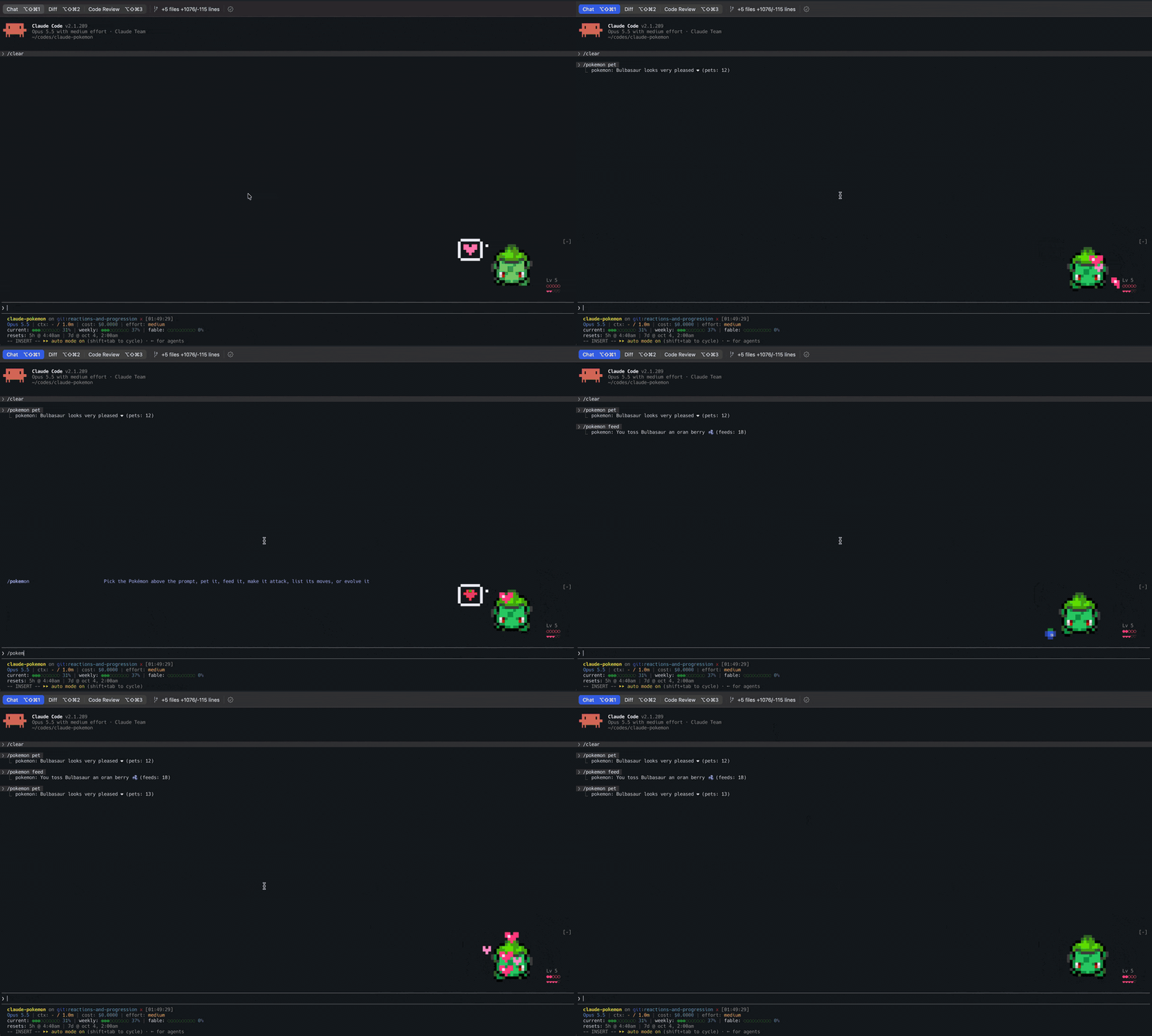
一个像素宝可梦住在你的 Claude Code 提示符上方,对 Claude 所做的一切做出反应。

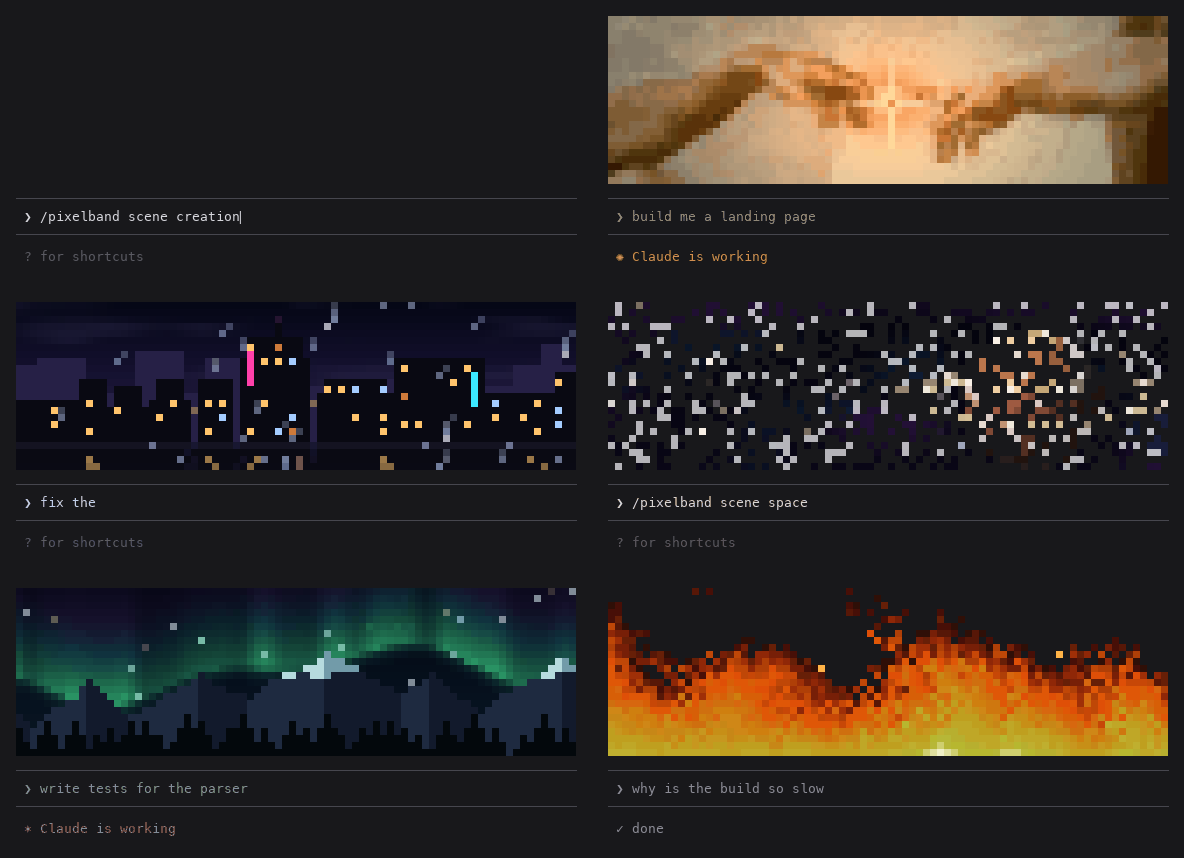
Animated pixel art above your Claude Code prompt that reacts while Claude works: seven scenes, or your own image or GIF. Zero tokens.

在同一个 TUI 中重绘 Claude Code 的助手回复、工具行和回合页脚,提供彩色命令、代码卡片、差异卡片、无边框表格和子代理横幅。