Digital-Threads@Digital-Threads
Digital-Threads/aimux/tree/master/mod
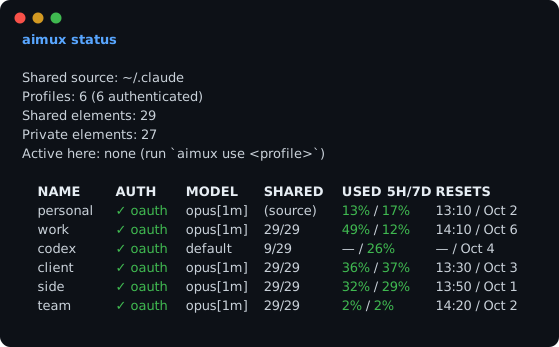
各 aimux サブスクリプションの 5 時間および週間使用量をプロンプト上に表示し、現在の枠が尽きる前に警告して、Enter 1 回で先へ進める
Digital-Threads/aimux/tree/master/mod




複数の Claude Code / Codex / Gemini サブスクリプションを横に並べて実行できます。skills、agents、memory、settings は 1 つの共有された頭脳として使い、ログインは分離したまま、各サブスクリプションのリアルタイムの 5h/7d 制限を 1 つの画面で確認できます。

個人用、仕事用、クライアント用など、複数の Claude Code サブスクリプションを別々の ~/.claude-* ディレクトリで使っているとします。シンボリックリンクを手作業で管理し、設定を複製し、切り替えには bash 関数を使うことになります。
aimux は、tmux が端末を扱うのと同じ考え方で AI CLI の設定を扱います。共有する頭脳 1 つと、分離されたセッションを複数用意します。
npm install -g @digital-threads/aimux
~/.claude と追加ディレクトリ(~/.claude-work など)がある場合npm install -g aimux
aimux init # auto-detects all ~/.claude* dirs
aimux status # verify profiles, auth, symlinks
aimux run w # launch work profile (prefix matching)
~/.claude しかない場合(サブスクリプション 1 つ)npm install -g aimux
aimux init # creates config with main profile
aimux profile add work # add a new profile
aimux auth login work # OAuth for the new account
aimux profile update w -m 'opus[1m]'
aimux run w
aimux profile add myapi --api
# Configure API endpoint (leave blank to use default):
#   Base URL:                          https://api.your-provider.com/v1
#   Auth token:                        [hidden]
#   Default model [claude-sonnet-5-5]:
#   Opus model    [claude-opus-5-5]:
#   Sonnet model  [claude-sonnet-5-5]:
#   Haiku model   [claude-haiku-4-5]:
# ✓ Credentials saved to ~/.aimux/profiles/myapi/.env (chmod 600)
aimux run myapi
宣言的な代替方法(.env ファイルまたは env: ブロック)を使うパワーユーザーや CI については、プロファイルごとの環境変数を参照してください。
# Install Claude CLI first, then:
claude auth login       # creates ~/.claude
npm install -g @digital-threads/aimux
aimux init
aimux profile add work
aimux auth login work
aimux run               # interactive picker (↑↓ + Enter)
aimux run w             # prefix match → work
aimux run o -m claude-sonnet-5-5  # one-time model override
aimux run w --resume    # flags pass through to Claude CLI
aimux run --auto        # launch whichever subscription has the most headroom left
aimux status            # dashboard
aimux usage             # token usage by profile for the last 7 days
aimux usage --all       # all known transcript usage

# Set a default model per profile. Prefer a family alias: `opus[1m]` always means the
# newest Opus, so a new release is picked up without touching aimux. A full id such
# as `claude-opus-5-5` pins that exact version until you change it. Quote names with
# brackets, or the shell will try to expand them.
aimux profile update w -m 'opus[1m]'
aimux profile update w -m claude-opus-5-5   # pin one version
aimux profile update w --unset-model        # let the CLI choose its own default

# Set a fallback model, tried automatically when the primary is overloaded/unavailable
aimux profile update w --fallback-model claude-sonnet-5-5
aimux profile update w --unset-fallback-model   # remove it
aimux use)aimux run は一度きりのセッションを起動します。nvm use や pyenv shell のように profile を
有効化して、通常の claude / codex で使いたい場合は、最初に shell integration を有効にします。
# add to ~/.zshrc or ~/.bashrc (fish: ~/.config/fish/config.fish)
eval "$(aimux shell-init)"
次のように実行します。
aimux use work     # activate 'work' in this shell (persistent until you switch)
claude             # runs under 'work', on its model — no `aimux run` needed
codex              # same; the CLI adapter sets CODEX_HOME for you
aimux use api      # switch profiles — stale ANTHROPIC_*/tokens are cleaned up
aimux use          # no name → interactive picker
各 shell は独立しているため、別々のターミナルで異なる active profile を同時に使えます。切り替えで
環境変数が現在の shell に export されるだけで、グローバル状態は変わりません。aimux run は一度きりの
起動にも引き続き使え、shell でどの profile が active でも、指定した profile を必ず実行します。
aimux split)aimux split # one tmux pane per logged-in claude subscription, in this directory
aimux split work client # just these two
各ペインでは完全な aimux run <profile> が実行され、ペインの境界に profile が表示されます。
実行に失敗したペインは、エラーを表示したまま残ります。ウィンドウを閉じると、通常のターミナル
と同じようにペインが終了します。会話は保存され、aimux run <profile> --resume で再開できます。
tmux 内では tmux を入れ子にせず新しいウィンドウを開くので、そのウィンドウは残しても閉じても構いません。
tmux が必要です(sudo apt install tmux または brew install tmux)。
トランスクリプトは共有されるため、別のサブスクリプションでセッションを続けられます。変わるのは
ログインだけです。aimux run で開始した claude セッションが、そのウィンドウを使い切って停止すると、
aimux は残りの余裕が最も大きい場所で続けるかどうかを尋ねます。
⚠ work hit its 5-hour limit (resets 23:10).
Continue this session on personal (5h 10%, 7d 16%)? [Y/n]
Enter を押すと同じセッションがそこで再開し、開始時の flags も引き継ぎます。aimux はセッション自身の
トランスクリプトから制限到達を読み取るため、通常の終了では何も消費しません。他のサブスクリプションを
確認するのは、実際に制限へ到達したときだけです。aimux split のペイン内でも動作します。
aimux run で開始した claude セッション、または aimux split のペインで開始したセッションでは、
プロンプト上のバンドにすべてのサブスクリプションが表示され、現在のセッションのものが先頭になります。

/exit がすでにプロンプトに入っています。Enter を押せば、確認なしで会話をそのサブスクリプションへ移します。/aimux は全体の表と、各枠のリセット時刻を表示します。これは Claude Code mod(Claude Code 2.1.287 以降)で、aimux が起動したセッションにだけ読み込まれます。
AIMUX_NO_MOD=1 で無効にできます。同じ数値は aimux status --json としてスクリプトから利用できます。
| Command | Description |
|---------|-------------|
| aimux init | Claude ディレクトリを自動検出し、設定を作成して profile を移行 |
| aimux init --source <path> | 明示した source directory で初期化 |
| aimux status | TUI ダッシュボード。profiles、認証、リアルタイムの 5h/7d 制限使用量とリセット時刻(claude + codex)、いずれかが設定された場合の auto-mode ルール、シンボリックリンクの状態を表示します。--watch [s] は画面を維持して制限を再読します。--json はスクリプト向けに出力し、--max-age <s> は最近の読み取りを再利用します |
| aimux status --no-limits | レート制限プローブを行わない同じダッシュボード(オフライン/高速) |
| aimux usage | profile ごとの token 使用量(Claude トランスクリプト + codex rollouts)を表示。aimux 外で開始したセッションも含みます |
| aimux usage --profile work --since 24h | 1 つの profile の直近の期間における使用量を表示 |
| aimux run [profile] | 正しい環境とモデルで AI CLI を起動 |
| aimux run | インタラクティブな選択。履歴から最後に使った profile をあらかじめ選択 |
| aimux run w | 前方一致。曖昧でなければ work を起動 |
| aimux run work -m claude-sonnet-5-5 | モデルを上書きして起動 |
| aimux run --auto | 全サブスクリプションのリアルタイム制限を調べ、余裕が最も大きいものを起動(同じ CLI 内に留まる) |
| aimux split [profiles...] | 複数のサブスクリプションを横に並べ、各 1 ペインで開く(既定:ログイン済みのすべての claude サブスクリプション) |
| aimux use [profile] | 現在の shell を profile に切り替える(永続)。以後は通常の claude/codex がそれを使います。rc に eval "$(aimux shell-init)" が必要 |
| aimux shell-init | aimux use を有効にする shell 関数を出力(~/.zshrc/~/.bashrc/fish config に追加) |
| aimux agents | 複数 profile の agent ビュー。すべての profile にまたがる claude のバックグラウンドセッションを 1 つの TUI で表示・管理 |
| aimux profile add <name> | シンボリックリンク付きの新しい profile を作成 |
| aimux profile add <name> --api | サードパーティ API profile を作成(endpoint + token の対話式プロンプト) |
| aimux profile add <name> --cli codex | 別の AI CLI(例:Codex)用 profile を作成 |
| aimux handoff <sessionId> --to <profile> | summary handoff で別の profile/CLI の下にセッションを引き継ぐ |
| aimux profile update <name> | model/cli 設定を更新 |
| aimux profile update <name> --fallback-model <model> | primary が過負荷または利用不可のときに使う fallback model を設定 |
| aimux profile update <name> --unset-model | 既定モデルを削除し、CLI 自身の(最新の)既定値を使わせる |
| aimux profile update <name> --unset-fallback-model | fallback model を削除 |
| aimux profile update <name> -e KEY=VALUE | profile の .env ファイルに環境変数を設定 |
| aimux profile update <name> --unset-env KEY | profile の .env ファイルから環境変数を削除 |
| aimux profile list | すべての profile を一覧表示(aimux status と同じ表。--no-limits はプローブを省略) |
| aimux profile remove <name> | profile を削除して後処理 |
| aimux profile clone <src> <name> | private ファイル付きで profile を複製 |
| aimux rebuild [profile] | シンボリックリンクを同期し、ローカルの共有ファイルの衝突を表示 |
| aimux doctor | ヘルスチェック。壊れたシンボリックリンク、欠落した共有エントリ、衝突を確認 |
| aimux auth login <profile> | profile の OAuth フローを起動 |
| aimux auth status | profile ごとの認証ファイル状態を表示 |
| aimux setup-shell | shell 補完(bash/zsh/fish)を自動インストール |
| aimux migrate isolate | 1 回限りの移行。profile ごとの jobs/、daemon/、projects/ のシンボリックリンクを実体のある private ディレクトリに変え、各 profile が独自の supervisor とセッションを持てるようにします。安全で、データは削除されません。--dry-run を付けるとプレビューできます。 |
すべての profile コマンドは前方一致に対応しています。aimux run w → work、aimux profile update o → own。
~/.claude/          ← source of truth (your main profile)
  agents/
  skills/
  commands/
  memory/
  settings.json
  .credentials.json  ← private, stays here

~/.aimux/
  config.yaml        ← aimux config
  profiles/
    work/
      agents/ → ~/.claude/agents      ← symlink (shared)
      skills/ → ~/.claude/skills      ← symlink (shared)
      memory/ → ~/.
まず作者の README で marketplace とプラグイン名を確認してください。コマンドはリポジトリの構成によって変わる場合があります。
claude plugin marketplace add Digital-Threads/aimux
claude plugin install aimux
Run multiple Claude Code / Codex / Gemini subscriptions side by side: one shared brain — skills, agents, memory, settings — separate logins, and every subscription's live 5h/7d limits in a single view.
You have multiple Claude Code subscriptions (personal, work, client) each in separate ~/.claude-* directories. You maintain symlinks manually, duplicate settings, and juggle bash functions to switch between them.
aimux treats your AI CLI configs like tmux treats terminals: one shared brain, multiple isolated sessions.
npm install -g @digital-threads/aimux
~/.claude + extra directories (~/.claude-work, etc.)npm install -g aimux
aimux init # auto-detects all ~/.claude* dirs
aimux status # verify profiles, auth, symlinks
aimux run w # launch work profile (prefix matching)
~/.claude (one subscription)npm install -g aimux
aimux init # creates config with main profile
aimux profile add work # add a new profile
aimux auth login work # OAuth for the new account
aimux profile update w -m 'opus[1m]'
aimux run w
aimux profile add myapi --api
# Configure API endpoint (leave blank to use default):
#   Base URL:                          https://api.your-provider.com/v1
#   Auth token:                        [hidden]
#   Default model [claude-sonnet-5-5]:
#   Opus model    [claude-opus-5-5]:
#   Sonnet model  [claude-sonnet-5-5]:
#   Haiku model   [claude-haiku-4-5]:
# ✓ Credentials saved to ~/.aimux/profiles/myapi/.env (chmod 600)
aimux run myapi
See Per-profile environment variables for the declarative alternative (.env file / env: block) used by power users and CI.
# Install Claude CLI first, then:
claude auth login       # creates ~/.claude
npm install -g @digital-threads/aimux
aimux init
aimux profile add work
aimux auth login work
aimux run               # interactive picker (↑↓ + Enter)
aimux run w             # prefix match → work
aimux run o -m claude-sonnet-5-5  # one-time model override
aimux run w --resume    # flags pass through to Claude CLI
aimux run --auto        # launch whichever subscription has the most headroom left
aimux status            # dashboard
aimux usage             # token usage by profile for the last 7 days
aimux usage --all       # all known transcript usage

# Set a default model per profile. Prefer a family alias: `opus[1m]` always means the
# newest Opus, so a new release is picked up without touching aimux. A full id such
# as `claude-opus-5-5` pins that exact version until you change it. Quote names with
# brackets, or the shell will try to expand them.
aimux profile update w -m 'opus[1m]'
aimux profile update w -m claude-opus-5-5   # pin one version
aimux profile update w --unset-model        # let the CLI choose its own default

# Set a fallback model, tried automatically when the primary is overloaded/unavailable
aimux profile update w --fallback-model claude-sonnet-5-5
aimux profile update w --unset-fallback-model   # remove it
aimux use)aimux run launches a one-off session. If you'd rather activate a profile so
plain claude / codex use it — like nvm use or pyenv shell — enable the
shell integration once:
# add to ~/.zshrc or ~/.bashrc (fish: ~/.config/fish/config.fish)
eval "$(aimux shell-init)"
Then:
aimux use work     # activate 'work' in this shell (persistent until you switch)
claude             # runs under 'work', on its model — no `aimux run` needed
codex              # same; the CLI adapter sets CODEX_HOME for you
aimux use api      # switch profiles — stale ANTHROPIC_*/tokens are cleaned up
aimux use          # no name → interactive picker
Each shell is independent, so different terminals can hold different active
profiles at once. The switch only exports env vars into the current shell — it
never changes global state. aimux run still works for one-off launches, and it
always runs the profile you name, whichever one the shell has active.
aimux split)aimux split # one tmux pane per logged-in claude subscription, in this directory
aimux split work client # just these two
Each pane runs a full aimux run <profile>, labelled with its profile on the pane
border; a pane whose run fails stays open with its error. Closing the window ends the
panes, as in any terminal — the conversations are saved, and aimux run <profile> --resume picks one up again. Inside tmux it opens a new window instead of nesting
tmux, and that window is yours to keep or close. Needs tmux (sudo apt install tmux,
or brew install tmux).
Transcripts are shared, so a session can carry on under another subscription — only
the login changes. When a claude session started with aimux run stops because its
window is spent, aimux offers to continue it where there is the most room left:
⚠ work hit its 5-hour limit (resets 23:10).
Continue this session on personal (5h 10%, 7d 16%)? [Y/n]
Press Enter and the same session resumes there, with the flags you started it with.
aimux reads the hit from the session's own transcript, so an ordinary exit costs
nothing; the other subscriptions are only checked when a limit was actually reached. It
works inside aimux split panes too.
A claude session started with aimux run — or in an aimux split pane — shows every
subscription in a band above the prompt, the one it runs on first:
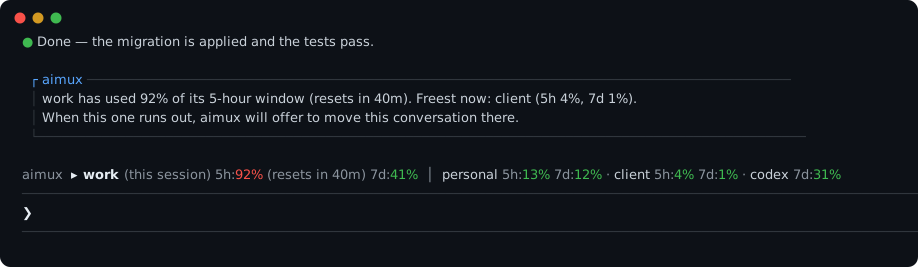
/exit is already in the prompt:
press Enter and aimux carries the conversation over to that subscription without
asking again./aimux prints the whole table, each window with its reset time.It is a Claude Code mod (Claude Code 2.1.287 or newer), loaded only into the sessions
aimux starts; AIMUX_NO_MOD=1 turns it off. The same figures are available to scripts
as aimux status --json.
| Command | Description |
|---------|-------------|
| aimux init | Auto-detect Claude dirs, create config, migrate profiles |
| aimux init --source <path> | Initialize with explicit source directory |
| aimux status | TUI dashboard — profiles, auth, live 5h/7d limit usage and reset times (claude + codex), auto-mode rules when any are set, symlink health. --watch [s] keeps it on screen and re-reads the limits; --json prints them for scripts; --max-age <s> reuses a reading that recent |
| aimux status --no-limits | Same dashboard without the rate-limit probe (offline / faster) |
| aimux usage | Show token usage by profile (Claude transcripts + codex rollouts), including sessions started outside aimux |
| aimux usage --profile work --since 24h | Show usage for one profile over a recent window |
| aimux run [profile] | Launch AI CLI with correct env and model |
| aimux run | Interactive picker — history pre-selects last used profile |
| aimux run w | Prefix matching — launches work if unambiguous |
| aimux run work -m claude-sonnet-5-5 | Launch with model override |
| aimux run --auto | Probe every subscription's live limits and launch the one with the most headroom (stays within the same CLI) |
| aimux split [profiles...] | Open several subscriptions side by side, one tmux pane each (default: every logged-in claude subscription) |
| aimux use [profile] | Switch the current shell to a profile (persistent) — plain claude/codex then use it. Requires eval "$(aimux shell-init)" in your rc |
| aimux shell-init | Print the shell function that enables aimux use (add to ~/.zshrc/~/.bashrc/fish config) |
| aimux agents | Multi-profile agent view — see and manage claude background sessions across all profiles in one TUI |
| aimux profile add <name> | Create new profile with symlinks |
| aimux profile add <name> --api | Create a 3rd-party API profile (interactive endpoint + token prompt) |
| aimux profile add <name> --cli codex | Create a profile for another AI CLI (e.g. Codex) |
| aimux handoff <sessionId> --to <profile> | Continue a session under another profile/CLI via summary handoff |
| aimux profile update <name> | Update model/cli settings |
| aimux profile update <name> --fallback-model <model> | Set a fallback model, used when the primary is overloaded/unavailable |
| aimux profile update <name> --unset-model | Remove the default model, so the CLI uses its own (newest) default |
| aimux profile update <name> --unset-fallback-model | Remove the fallback model |
| aimux profile update <name> -e KEY=VALUE | Set an env var in the profile .env file |
| aimux profile update <name> --unset-env KEY | Remove an env var from the profile .env file |
| aimux profile list | List all profiles (same table as aimux status; --no-limits skips the probe) |
| aimux profile remove <name> | Remove profile and clean up |
| aimux profile clone <src> <name> | Clone profile with private files |
| aimux rebuild [profile] | Sync symlinks and surface local shared-file conflicts |
| aimux doctor | Health check — broken symlinks, missing shared entries, conflicts |
| aimux auth login <profile> | Launch OAuth flow for a profile |
| aimux auth status | Show auth file status per profile |
| aimux setup-shell | Auto-install shell completions (bash/zsh/fish) |
| aimux migrate isolate | One-time migration: convert per-profile jobs/, daemon/, projects/ symlinks into real private dirs so each profile gets its own supervisor and sessions. Safe — no data is deleted. Add --dry-run to preview. |
All profile commands support prefix matching: aimux run w → work, aimux profile update o → own.
~/.claude/          ← source of truth (your main profile)
  agents/
  skills/
  commands/
  memory/
  settings.json
  .credentials.json  ← private, stays here

~/.aimux/
  config.yaml        ← aimux config
  profiles/
    work/
      agents/ → ~/.claude/agents      ← symlink (shared)
      skills/ → ~/.claude/skills      ← symlink (shared)
      memory/ → ~/.claude/memory      ← symlink (shared)
      plugins/                        ← real dir (shared content, per-profile metadata)
        marketplaces/ → ~/.claude/plugins/marketplaces   ← symlink (shared)
        cache/        → ~/.claude/plugins/cache           ← symlink (shared)
        known_marketplaces.json       ← real file (paths point inside this profile)
        installed_plugins.json        ← real file (paths point inside this profile)
      .credentials.json               ← real file (private)
      .claude.json                    ← real file (private)
    own/
      ...same pattern...
When you run aimux run work, it sets CLAUDE_CONFIG_DIR=~/.aimux/profiles/work and launches the CLI. Claude sees a complete config directory — shared content via symlinks, private auth locally.
Plugins are shared too, but Claude validates that a marketplace's installLocation
lives inside the active config directory. So each profile gets a real plugins/
directory: the heavy content (marketplaces/, cache/) is symlinked to the shared
~/.claude/plugins, while known_marketplaces.json and installed_plugins.json are
real, path-rewritten copies. ~/.claude stays the source of truth — install or update
plugins from your main profile (or with CLAUDE_CONFIG_DIR=~/.claude claude plugin …)
and every profile picks them up on its next run. A plugin installed from inside a
profile is merged back into the shared source automatically.
aimux isn't claude-only. A profile's cli field selects which AI CLI it runs, so you
can keep claude, Codex, and Gemini subscriptions side by side — same shared brain,
isolated auth — and even hand a live conversation from one to the other when a limit hits.
aimux profile add codework --cli codex   # a Codex profile
aimux profile add gem --cli gemini       # a Gemini profile (~/.gemini)
aimux auth login codework                # runs `codex login` under an isolated CODEX_HOME
aimux run codework                        # launches Codex with the right model flag
aimux agents                              # claude + codex sessions in one view (CLI-badged)
CLAUDE_CONFIG_DIR /
CODEX_HOME / GEMINI_CLI_HOME), so subscriptions never collide.shared_sources maps each CLI to its source
(claude → ~/.claude, codex → ~/.codex); the legacy shared_source stays as the
claude alias.private; Codex shares a
knowledge allowlist (skills, rules, memories) and keeps auth.json /
config.toml / sessions/ private; Gemini shares GEMINI.md / skills / commands
/ extensions / memories and keeps auth + settings.json + history private.GEMINI_CLI_HOME at the profile's parent and the profile dir IS gemini's .gemini.
Gemini resumes by per-project index (-r latest), not by session id, so cross-Gemini
native resume isn't wired into the session list yet.Hit a subscription limit mid-session? Continue it under another CLI:
aimux handoff <sessionId> --to codework
The two CLIs' transcripts are mutually unreadable, so this is a summary handoff, not
a native resume: aimux reads the source transcript, summarizes it with the target
profile (self-contained — the target CLI does the summarizing), then launches the target
seeded with that summary. Same-CLI continuation (claude↔claude, codex↔codex) still uses
native resume (aimux run <profile> --resume <id>). Note: the conversation context
carries over, not the model — the target continues with its own model.
Many providers expose an Anthropic-compatible endpoint, so they run on the claude CLI
itself — just a different base URL + token. A provider profile is therefore a claude
profile: it shares the full claude brain (skills, plugins, settings, memory, transcripts)
and you can even --resume a claude session under it natively (same CLI, same model swap).
One command, prompts only for the token:
aimux profile add ds --provider deepseek   # fills base URL + model mapping
aimux run ds
Built-in presets: deepseek, kimi, glm, qwen, minimax, mimo. Base URLs are verified;
model names drift — update with aimux profile update <name> -e ANTHROPIC_MODEL=….
For anything else (local models via Ollama/LM Studio, a proxy, Bedrock/Vertex), use the
generic aimux profile add <name> --api and point ANTHROPIC_BASE_URL at it (see below).
Costs shown by aimux usage are list-price estimates (Claude, codex/gpt-5, and the
Anthropic-compatible providers) and will drift as prices change.
Some Claude Code modes (3rd-party proxies, self-hosted gateways, Bedrock, Vertex) are activated by environment variables rather than OAuth. aimux injects per-profile env into the spawned claude process (and into aimux auth login <profile>) from two sources, merged in this order:
<profile>/.env — a dotenv file inside the profile directory. Best for secrets. Written with chmod 600 when aimux creates it; aimux run warns if it becomes group/other-readable.env: block under the profile in config.yaml — best for non-secret toggles you want versioned. Overrides .env on key conflict.The fastest way to set up an API profile is the interactive prompt:
aimux profile add myapi --api      # prompts for Base URL, hidden token, models
aimux profile update myapi -e ANTHROPIC_MODEL=claude-opus-5-5   # edit later
…which writes something like:
# ~/.aimux/profiles/myapi/.env — do not commit
ANTHROPIC_BASE_URL=https://api.your-provider.com/v1
ANTHROPIC_AUTH_TOKEN=sk-your-token...
ANTHROPIC_MODEL=claude-sonnet-5-5
ANTHROPIC_DEFAULT_OPUS_MODEL=claude-opus-5-5
ANTHROPIC_DEFAULT_SONNET_MODEL=claude-sonnet-5-5
ANTHROPIC_DEFAULT_HAIKU_MODEL=claude-haiku-4-5
The .env parser supports KEY=value, export KEY=value, comments, and single/double-quoted values (with \n/\t escapes inside double quotes). It does not do ${VAR} interpolation or multi-line values — it's a secrets loader, not a full dotenv-expand. .env is always private (never symlinked to the shared source).
# ~/.aimux/config.yaml
version: 1
shared_source: /home/user/.claude

profiles:
  main:
    cli: claude
    path: /home/user/.claude
    is_source: true
  work:
    cli: claude
    model: opus[1m]            # follows the newest Opus
    path: /home/user/.aimux/profiles/work
  myapi:
    cli: claude
    model: claude-sonnet-5-5
    path: /home/user/.aimux/profiles/myapi   # secrets live in this dir's .env
    # Optional non-secret env injected into the spawned CLI (overrides .env).
    # env:
    #   ANTHROPIC_DEFAULT_OPUS_MODEL: claude-opus-5-5

private:
  - .credentials.json
  - .env                  # API credentials — never symlinked, never committed
  - .claude.json
  - policy-limits.json
  - mcp-needs-auth-cache.json
  - remote-settings.json
  - settings.local.json
  - stats-cache.json
  - statsig
  - telemetry
  - state                 # MCP protocol verdicts, per install
  - session-env           # per-session environment
  - backups               # copies of the private .claude.json
  - remote                # Remote Control daemon + its binaries
  - security              # Agent SDK venv and logs
  - shell-snapshots
  - cache                 # fetched model catalog, per account
The defaults above are always applied — listing extra entries adds to them. Claude
Code keeps growing new runtime directories, so if aimux doctor reports a conflict
on one, add it here and run aimux rebuild.
MIT

Ruflo メモリ基盤のプラグイン。AgentDB コントローラーブリッジ(15 個の agentdb_* MCP ツール)、RuVector ONNX 埋め込み(RaBitQ 32x 量子化を含む 10 個の embeddings_* ツール)、WASM HNSW パターンルーター(3 個の ruvllm_hnsw_* ツール)を提供します。mod(ADR-445)として、プロンプトへの安全な任意リコール、秘密をメモリから遠ざける書き込みガード、/agentdb、コンソールが表示するステータスファイルを備えます。

pbir CLI に従うレポートペインで Claude が読み取り、変更する内容を表示しながら、インタラクティブな Power BI レポートの作成、整形、最適化、レビューを行います。

プロンプトの上、ステータス行、トーストに未読 AMP メッセージを表示し、アイドル状態の Claude Code セッションを起こして読ませます。Claude Code 2.1.287 以降が必要です。