
kaiwutech-TW@kaiwutech-TW
kaiwutech-TW/flightwake/tree/main/mods/flightwake
flightwake 的 Claude Code mod,提供狀態注入、提示列、工作階段飛行紀錄、TRAPS 觸發警告與角色守衛五項功能,需要 Claude Code 2.1.287+ 並開啟資料夾信任。
kaiwutech-TW/flightwake/tree/main/mods/flightwake
flightwake 是一套輕量的工作紀錄框架,透過 .flightwake/ 目錄下的 STATE、DECISIONS、TRAPS 與 records 檔案,讓跨工作階段的 AI 代理能安全接手。其中的 --mod 選項會安裝 flightwake-mod 到 .claude/skills/flightwake-mod/,包含 5 個可個別開關的功能:工作階段開始時的狀態注入、提示上方的資訊列、工作階段飛行紀錄、TRAPS 觸發警告,以及預設關閉的角色守衛。安裝需要 Claude Code 2.1.287+、接受資料夾信任提示,並在 repo 根目錄啟動工作階段;mod 不會寫入使用者紀錄。
請先查看作者 README,確認 marketplace 與外掛名稱;指令可能隨儲存庫結構而變動。
claude plugin marketplace add kaiwutech-TW/flightwake
claude plugin install flightwake-mod
Records are the contrail your work naturally leaves behind — not a flight plan you must file before takeoff.

An ultra-lightweight work-recording framework for strong AI coding agents (Claude Fable 5 generation and beyond). Zero runtime dependencies, pure Markdown, everything lives in git.
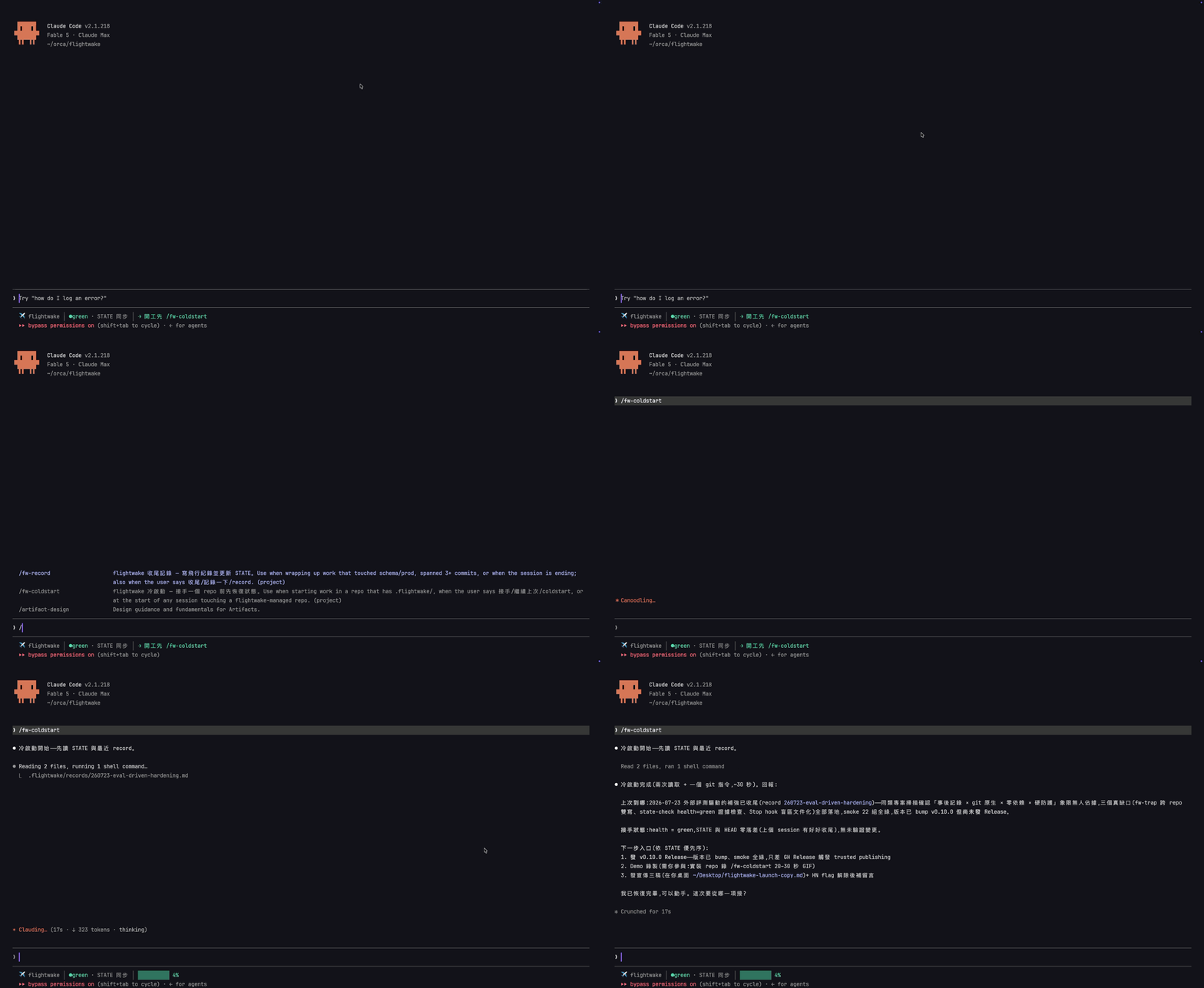
A real cold start on this very repo (recorded live, zh-TW install): one command, two file reads, and a fresh session reports exactly where the last one left off.
cd your-repo
npx flightwake setup                # guided install: a few questions, shows every path it will write, installs after you confirm
setup needs a terminal. It checks git first (offering git init if the directory isn't a repo — default No, run only after the final confirmation), then asks language, agents (the detected ones if the folder already has CLAUDE.md / AGENTS.md / GEMINI.md; otherwise it asks which tools you use — pick one or more, nothing preselected), optional add-ons (each default No: the bottom gauge, the Claude Code mod, roles, Orca collaboration; the mod question is only asked when Claude Code is picked) and repo type (code / notes), lists every path it will write, and asks Proceed? [Y/n] — Enter installs; n, EOF or Ctrl-C writes nothing. If flightwake is already installed it only offers an in-place upgrade (update). It installs through the same path as init, then runs doctor and prints next steps. Flags you pass on the command line answer their question; --private is flag-only and is never asked.
Non-interactive form — npx flightwake init [flags] (a bare npx flightwake does the same) never asks anything: use it for automation, agents, CI, and when you already know what you want:
npx flightwake init --statusline    # English (default) + the bottom gauge
npx flightwake init --statusline --agents=claude,codex,gemini   # all three agents at once (Claude Code + Codex + Gemini CLI)
npx flightwake update               # upgrade an existing install in place (keeps your options: lang/statusline/private)
Pick your language (non-interactive form; setup asks it for you) — installed templates, skills, and all CLI/gauge output follow it. There is no
auto-detection: a terminal's LANG and the OS locale routinely disagree, and a confident wrong guess is
worse than a stated default. Copy the line you want:
| Language | Fresh install | Already installed in another language |
|---|---|---|
| English | npx flightwake init --statusline | npx flightwake init --lang=en --force --statusline |
| 繁體中文 | npx flightwake init --lang=zh-TW --statusline | npx flightwake init --lang=zh-TW --force --statusline |
| 简体中文 | npx flightwake init --lang=zh-CN --statusline | npx flightwake init --lang=zh-CN --force --statusline |
| 日本語 | npx flightwake init --lang=ja --statusline | npx flightwake init --lang=ja --force --statusline |
Switching languages is safe: --force replaces only framework-owned files (templates, skills, hooks, the
marker block). Your STATE / DECISIONS / TRAPS / records are never touched — they stay in whatever language you
wrote them. Drop --statusline from any line if you don't want the gauge. Add --agents=claude,codex,gemini (any subset) to install for those agents explicitly — without it, init installs for whichever instruction files already exist (CLAUDE.md / AGENTS.md / GEMINI.md).
Don't hand-translate the installed files. The marker records which language you installed, so the next
update refreshes them from that language's source and your edits disappear. Rerun init with --lang instead;
if you already did hand-edit, init/update will now name each file it overwrote.
init creates .flightwake/ (templates + Stop hook), copies 4 skills into .claude/skills/, merges the Stop hook into .claude/settings.json, and appends the trigger-obligation table (wrapped in <!-- flightwake:begin/end --> markers) to detected agent instruction files (CLAUDE.md / AGENTS.md / GEMINI.md — whichever exist; if none, it creates AGENTS.md; --agents=claude,codex,gemini selects explicitly). Each detected platform gets the same skills and hook in its own dialect: Codex and Gemini CLI read the skills from .agents/skills/fw-*, the STATE check goes into .codex/hooks.json (Stop) or .gemini/settings.json (AfterAgent), and the table says $fw-coldstart to Codex, /fw-coldstart to Claude Code, and the bare skill name to Gemini. Codex asks you to trust the repo hook once on first run. Pure file copying, zero runtime dependencies (Node ≥18 used only at install time and by the hooks). User data (STATE/DECISIONS/TRAPS) is never overwritten; --force only updates framework-owned files. update re-detects what you installed and refreshes it from the latest version.
/fw-coldstart — it notices STATE is still the unfilled template and writes the first STATE from the repo itself (health is never guessed green: it is yellow until something was actually verified)git add .flightwake .claude CLAUDE.md && git commitYou (and the model) only need to remember one thing: start work with /fw-coldstart; the model triggers every other obligation itself — the obligation table is already in the instruction file, and strong models both read it and honor it. A typical session:
You:   /fw-coldstart
Model: (reads STATE + the latest record, ~1 minute)
       "Last session got to X, health green, next entry point is Y.
        Unverified changes: none. Pick up from Y?"
You:   Yes, go
Model: (starts working directly. Makes a decision that closes off options →
        one line appended to DECISIONS; hits a non-obvious trap → /fw-trap)
You:   Wrap up
Model: (/fw-record: writes the flight record, updates STATE, runs the
        sensitive-info self-check)
Forgot to wrap up? When STATE lags ≥3 commits, the Stop hook blocks once before the session ends to remind you (it also nags when STATE claims health=green but the latest record carries no test evidence); --ci brings the same gate to other agents and human collaborators. Honest edges of the net: the lag counts human commits only — bot commits (dependabot[bot], renovate[bot], …) are excluded, because a dependency bump never makes STATE wrong and the bot's own PR could never satisfy the gate. A session that commits nothing (research, ops work) or a squash/rebase flow slips under it — the net catches forgetting; it doesn't replace the session-end obligation. For multi-session construction, say "handoff" before stopping so the model runs /fw-handoff.
Whether STATE's health is honest (green/yellow/red). The framework has a single quality metric: how long it takes a fresh session to reach a safe takeover after /fw-coldstart — if that takes more than 5 minutes, your records are degrading. Everything else — record count, format compliance — doesn't matter.
When that light comes on, you don't do the maintenance yourself. Say: "this cold start took X minutes — diagnose what's slow and compact." The model comes back with a diagnosis (STATE too long? last session never wrapped up? stale TRAPS/DECISIONS entries?) and an item-by-item plan — which entries to mark superseded and why, which to merge — and you approve with one word. Facts work better than pressure: "over 5 minutes means the next session will fumble the takeover" is a prompt the model can reason about; "this is serious!" is not.
This repo dogfoods its own framework: .flightwake/ contains the real STATE, DECISIONS, and records — every step from the gap list to the open-source launch is recorded there. That's exactly what will grow in your repo after installing.
New to working with a strong model? docs/workflow.md is a stage map of what you do and what to say to the model at each point — beginner main line, advanced folds for Claude Code veterans. (繁體中文版:workflow.zh-TW.md)
Using more than one model on the same repo? docs/multi-agent.md shows how Claude Code, Codex, and Gemini CLI share one .flightwake/ — what init installs for each, how to invoke the skills in each tool, and the wrap-up → commit → cold-start loop that makes the handover identical whichever model wrote last. (繁體中文版:multi-agent.zh-TW.md)
Running a team of agents (a project manager, a tech lead, a coder, a reviewer)? docs/roles.md covers flightwake roles (opt-in, v0.14.0+): the agent recommends a set of roles for your project, you preview and customize them, and each role is written into the instruction file its agent re-reads at every session start — so nobody forgets their job after /clear, across repos if your team spans several. (繁體中文:roles.zh-TW.md · 简体中文:roles.zh-CN.md · 日本語:roles.ja.md)
A Fable 5-class model doesn't need to be taught how to do the work — but there are four things no model can do however strong it gets, because they are structural and don't disappear as models improve:
So flightwake supplements persistence and discipline, not intelligence. Its ancestor in spirit is GSD: GSD is navigation (turn-by-turn guidance for every step); flightwake is a dashcam + warning lights + road signs — strong models drive themselves, so the framework only does three things:
records/, DECISIONS.md, TRAPS.md)STATE.md and takes over safely within 2 minutesThe origin was a real three-day session (2026-07-15~17: two repos, 19 commits, 4 cron jobs, 2 deep bug fixes — no upfront planning, zero derailment). It proved a strong model needs no navigation — but everything it left behind to make the next session possible (SUMMARY/CONTEXT/memory files) was improvised on the spot. flightwake turns that improvisation into an installable convention.
GSD is stage-driven (research→plan→execute→verify gates); flightwake is trigger-driven (events create obligations):
| Trigger event | Obligation | Tool |
|---|---|---|
| Starting to touch a repo | Read STATE + the latest record first | /fw-coldstart |
| Making a decision that closes off other options | One line into DECISIONS (append-only, with the why) | write directly |
| Hitting a non-obvious trap | One entry into TRAPS | /fw-trap |
| Touching schema / touching prod / ~3+ commits | Wrap up with a record | /fw-record |
| Work will span sessions | Write handoff/CONTEXT before stopping (not before starting) | /fw-handoff |
| Session about to close | Update STATE's position and next-step entry point | part of /fw-record |
Escalation rule (the opposite of GSD): by default everything is quick — just start working; only "construction spanning multiple sessions" escalates to a phase (one CONTEXT file; plan decomposition is left to the model's in-the-moment judgment).
your-repo/
├── .flightwake/
│   ├── STATE.md             # where we are now, next-step entry (always short, always current)
│   ├── DECISIONS.md         # append-only decision log (one line per decision, with the why)
│   ├── TRAPS.md             # trap registry (OKF-style frontmatter entries)
│   ├── TEMPLATE-record.md   # flight-record template
│   ├── hooks/state-check.mjs  # Stop hook: reminds you to wrap up when STATE lags ≥3 commits
│   └── records/             # flight records (one per meaningful wrap-up)
├── .claude/skills/fw-*/     # the four skills (Claude Code)
├── .claude/settings.json    # init merges the Stop hook config here
├── .agents/skills/fw-*/     # the same four skills for Codex / Gemini CLI (only when AGENTS.md / GEMINI.md is detected)
├── .codex/hooks.json        # Codex Stop hook (only when AGENTS.md is detected)
└── .gemini/settings.json    # Gemini CLI AfterAgent hook (only when GEMINI.md is detected)
The skills and hooks are convenience sugar per platform — the same four skills and the same check script, installed where Claude Code, Codex, and Gemini CLI each look for them; .flightwake/ itself is plain Markdown in git, so every agent (and every human) reads and writes the same state. Any other agent that reads the instruction file can follow the same trigger obligations by hand. Coexists with an existing GSD .planning/ (old records become historical archives).
--private keeps records local-only, out of git: every write is registered in .git/info/exclude (purely local — no trace left in the repo), the hook goes into .claude/settings.local.json, and the obligation table goes into CLAUDE.local.md (git-tracked instruction files are never touched). The cost: records aren't shared with the repo, and a fresh clone needs init --private again — "in git, shared with the repo" is flightwake's default and reason to exist; --private is the escape hatch for personal use inside someone else's repo.
doctor (npx flightwake doctor) is a read-only, no-network check of the install structure: git and git root, Node ≥18, .flightwake/, STATE (unfilled template fields are a warning), latest_record, marker blocks and their version/lang/profile consistency, skills, hook registration (valid JSON, exact command, correct event — Stop for Claude Code/Codex, AfterAgent for Gemini CLI — no duplicates, script exists), that --private excludes are actually in effect, and the status of optional add-ons. Each line is ok / warning / fail; exit code 1 on any failure. It verifies structure only, not that hooks fire at runtime (whether Codex trusts the hook path can't be checked — doctor prints a hint instead). Writes nothing.
--profile=code|notes (default code) picks the obligation table. notes is for repos that aren't code (writing, research, notes): it drops "tests green + typecheck clean", "prod verification evidence", and the schema/prod wrap-up trigger, and keeps cold start, decisions, traps, handoff, the ≥3-commit wrap-up, confirming destructive operations, and an honest STATE at session end. The same files are installed. The profile is stored in the marker (profile=notes); update keeps it, and update --profile=code switches back.
--orca (opt-in; also a setup question, offered only when Orca is detected) adds a marked block to each active platform's instruction file: use visible Orca tabs — not hidden background runs — for cross-agent discussion and review, plus a one-writer review protocol (the agent that was asked to review writes no record and doesn't touch STATE; the asker records the conclusions it adopts). uninstall removes it; update refreshes it only where installed.
--mod (opt-in; also a setup question, asked only when Claude Code is among the agents) installs the flightwake-mod Claude Code mod into .claude/skills/flightwake-mod/: five features (state injection at session start, a band above the prompt, a session flight log, a TRAPS tripwire, and an off-by-default role guard), each with its own switch. It needs Claude Code 2.1.287+, an accepted folder trust prompt and a session started at the repo root; it never writes your records. Without Claude Code among the agents, init --mod prints a note and skips it; an existing folder is skipped unless --force. update refreshes it only where installed; uninstall removes the files it shipped and keeps (and lists) anything you added in that folder. Details: docs/mod.md.
--git-init makes init create the git repo when the directory isn't one — explicit flag only; without it, init stops and tells you. Both init and setup check that git is installed first and print per-platform install hints if not.
uninstall reverses init's fixed write scope: removes the skills' and the framework's own files (only what it shipped — anything you added inside a skill folder, or a directory where a shipped file was, is kept and listed), extracts flightwake's Stop hook from settings (your other hooks stay untouched), and strips the marker blocks from instruction files and .git/info/exclude (files created by flightwake are deleted once emptied). .flightwake/ is user data and is kept by default; only uninstall --purge deletes it too.
Monorepo policy: one install per repo, at the git root. Work is session-shaped — a session routinely spans multiple packages, and records follow the session; per-subdirectory installs would shred one stretch of work into fragmented records and turn "which STATE do I read?" into a new cold-start ambiguity. Running init in a subdirectory stops and points you to the root. Submodules have their own .git and count as independent repos. If a high-traffic multi-team monorepo sees false positives from the CI staleness check, tune --threshold first.
Wrap up your current milestone first, then:
npx flightwake init — coexists with .planning/; nothing is deleted.planning/ for the current state and initialize .flightwake/STATE.md with /fw-record — unfinished items go into the next-step entries. From now on .planning/ is a historical archive; don't update it."npx flightwake init --statusline puts a persistent gauge at the bottom of Claude Code:
✈️ flightwake │ ●green · STATE 2c behind │ ▓▓░░░░░░░░ 23%
Health color (the one thing you watch), STATE staleness (same rev-list logic as the Stop hook — but as a live gauge instead of an exit-time reminder), and context usage. The gauge also tells you the next command for the current state — session just started → → 開工先 /fw-coldstart; STATE ≥3 commits behind → → /fw-record; context running hot → → /fw-record → /clear → /fw-coldstart; all healthy → silence. It never overwrites an existing statusline (a single-value setting), and repo-level config takes precedence over user-level, so it coexists with tools that set a global one.
Note: a plain npx flightwake init does not install the gauge — it's opt-in. Already ran init without it? Running npx flightwake init --statusline again just adds the gauge (everything else is skipped as already installed); the bar appears in the next Claude Code session.
The gauge also tells you when a newer flightwake exists (→ v0.9.1 available: npx flightwake update) — shown only when nothing more urgent is up. The check is an anonymous GET to the npm registry at most once per 24h, cached in the OS temp dir, always in a background process (rendering never waits on the network). Opt out with FLIGHTWAKE_NO_UPDATE_CHECK=1.
The hook fires only inside Claude Code, Codex, and Gemini CLI sessions; to extend the "STATE must not lag" discipline to other agents and human collaborators, run the same script in CI — it fails when STATE lags HEAD by ≥3 commits (tunable via --threshold=N):
# .github/workflows/flightwake.yml (example; pin actions to SHAs per your repo's conventions)
name: flightwake
on: [push, pull_request]
permissions:
  contents: read
jobs:
  state-fresh:
    runs-on: ubuntu-latest
    steps:
      - uses: actions/checkout@v7
        with:
          fetch-depth: 0 # rev-list needs full history to count the lag
      - uses: actions/setup-node@v7
        with:
          node-version: 24
      - run: node .flightwake/hooks/state-check.mjs --ci
flightwake will not write a workflow into your repo — .github/workflows/ is permission-sensitive and outside the "fixed write scope" promise; copy the example yourself.
Claude Code memory: persistent memory has the same shape as flightwake (frontmatter + [[links]]) but lives on a different layer — memory is single-machine, single-person; flightwake's files go into git and travel with the repo to teammates, CI, and any agent. Repo facts (traps, decisions, state) go to flightwake; personal preferences and cross-project habits go to memory. Never write the same fact in both places — with one deliberate exception: a trap that isn't repo-specific (platform/language layer) lives in both, because the repo's registry must stay self-contained while your other repos need the warning too (one copy per scope is division of labor, not duplication).
Google OKF: OKF manages the knowledge layer (system facts: schemas, metric definitions, code mappings); flightwake manages the process layer (what happened, why, where we are now). flightwake's knowledge-shaped artifacts adopt OKF conventions (YAML frontmatter + [[links]]) — naturally compatible on the shared "plain Markdown + frontmatter" substrate.
git (no shell) for read-only queries.init only touches .flightwake/, .claude/skills/fw-*, .claude/settings.json, the marker blocks inside agent instruction files (including the Orca block, only when you opted in), ~/.flightwake/registry.json (init/update write it; uninstall removes this repo's entry), .claude/skills/fw-roles / .agents/skills/fw-roles (only when you opted into roles), .claude/skills/flightwake-mod/ (only when you opted into the mod; uninstall removes the shipped files and keeps anything you added there, and with --private it is added to the exclude block), and — when Codex / Gemini CLI is detected — .agents/skills/fw-*, .codex/hooks.json, .gemini/settings.json; with --private it instead touches .claude/settings.local.json, CLAUDE.local.md, and the marker block in .git/info/exclude (the Codex/Gemini files are written only while untracked, and excluded). uninstall reverses the same scope. Nothing is ever written through a symlink or outside the repo: the install is checked first, and if any required path would be refused it stops before writing anything and names the path (exit 1). Files are replaced via a temp file + rename, never overwritten in place; uninstall and the roles commands follow the same rules. --private refuses up front if privacy can't take effect (something it must exclude is already tracked, or .git/info/exclude can't be written). doctor writes nothing — when the mod is installed it also runs claude --version (read-only). The one exception to "only copies files" is git init: it runs only after you confirm it in setup's final summary, or when you pass --git-init..flightwake/hooks/state-check.mjs is a file in your repo — anyone who can commit can change it, same trust level as all repo-local config; Claude Code asks for confirmation when loading it, and Codex records a trust hash per hook definition and re-asks whenever it changes.npm audit signatures.🚧 v0.x — actively dogfooded; conventions may still evolve (append-only files carry a superseded lifecycle, and read-side tolerance keeps old installs working).

了解快取的 /loop worker 與 CronCreate 背景自動化。ruflo 系列每個週期性工作都使用的基礎外掛。

作為 Claude Code mod 的 claude-reflect:每個簡短提示都會進行模型檢查,找出可重複使用的修正(任何語言皆可);提示列上方的橫條讓你按一次就將它們儲存到 CLAUDE.md。


Claude Code 裡的早期 crit:在面板中評論對話、差異或檔案,把審查送給 Claude,並在線程中閱讀 Claude 的回覆。