
vmallela0@vmallela0
vmallela0/cc-buddy
帶回 /buddy:那個曾在你寫程式時陪著你的微小生物,再次出現在提示列上方。它會準確還原 ~/.claude.json 中的夥伴(物種、稀有度、帽子和屬性都相同),為新帳戶孵化一顆蛋,透過提交和通過測試升級,隨著你交付工作解鎖 49 個夥伴的陣容,免費回應 Claude 的工作,在你叫它名字時用 Haiku 寫的一行話回答,並顯示在桌面和行動裝置的面板中。需要 CLAUDE_CODE_ENABLE_FUNCTION_HOOKS=1。
vmallela0/cc-buddy
帶回 /buddy:那個曾在你寫程式時陪著你的微小生物,再次出現在提示列上方。它會準確還原 ~/.claude.json 中的夥伴(物種、稀有度、帽子和屬性都相同),為新帳戶孵化一顆蛋,透過提交和通過測試升級,隨著你交付工作解鎖 49 個夥伴的陣容,免費回應 Claude 的工作,在你叫它名字時用 Haiku 寫的一行話回答,並顯示在桌面和行動裝置的面板中。需要 CLAUDE_CODE_ENABLE_FUNCTION_HOOKS=1。
請先查看作者 README,確認 marketplace 與外掛名稱;指令可能隨儲存庫結構而變動。
claude plugin marketplace add vmallela0/cc-buddy
claude plugin install cc-buddy
/buddy is back. The small terminal creature Claude Code hatched for people in April 2026 (and removed in 2.1.97), drawn above the prompt again and brought up to date, as a plugin built on Claude Code's function hooks.
              Noodle  rare ghost ★★★  lv 2 · » focused              [ next ]
   .----.                                                            [ hide ]
  / ×  × \    ╭──────────────────────────────────────────────╮
  |      |    │ sent 2 off. i will keep their seats warm.    │
  ~`~``~`~    ╰──────────────────────────────────────────────╯
This is an unofficial fan project. It isn't made or endorsed by Anthropic.
Your buddy comes back as it was. If you hatched one in April, it's still listed in ~/.claude.json. cc-buddy reads it and redraws the same creature: same name and personality, and the same species, rarity, eyes, hat and stats. The body is derived from your account id exactly the way the original did it (wyhash of the id plus friend-2026-401, fed to Mulberry32). A test suite pins this down so it can't drift.
New here? You get an egg. Run /buddy and it hatches: a short animation, then Haiku writes its name and personality once, the way the original did. The body still comes from your account id.
It stays yours. You keep one buddy, and it grows:
» focused while Claude works, ↑ proud after a green run or a commit, ! worried after three failures in a row, z sleepy after twenty quiet minutes, and ♥ happy after a pet. Every mood shows as a symbol and a word, never color alone.A collection you earn. A roster of 49 more buddies (two of them legendary), seeded from your account id, opens one at a time: one new buddy per 25 commits. /buddy roster shows what's open and how far the next one is. If you used an earlier version that rotated through the roster, you keep everyone you already met.
It reacts, cheaply. When Claude edits a file, runs a command, passes or fails tests, commits or finishes a turn, your buddy says something in its own voice. Those lines come from a pool built per buddy from its species and stats, so they cost no tokens.
Talk to it. Mention your buddy by name in a prompt and it answers in its bubble. A pool line shows up right away, then Haiku writes a proper reply in character and swaps it in. Claude gets a note that the buddy is a separate watcher and should stay out of the way, so it doesn't answer for it.
It notices agents. When Claude sends out two or more subagents, the buddy counts them out and tells you when they're all back.
It fits your screen. It shows the full sprite when there's room and a single line when the terminal is short or narrow. On the desktop app and mobile, where there's no band above the prompt, it sits in a pane instead.
"CLAUDE_CODE_ENABLE_FUNCTION_HOOKS": "1" under env in ~/.claude/settings.json.claude -p.claude plugin marketplace add vmallela0/cc-buddy
claude plugin install cc-buddy@cc-buddy
Or from a clone, for one session: claude --plugin-dir /path/to/cc-buddy
| command | what it does |
|---|---|
| /buddy | hatch the egg the first time; after that, hide or show for this session |
| /buddy pet | two and a half seconds of floating hearts (or click the buddy) |
| /buddy card | the stat card: stats, level and XP, mood, commits, unlocks, model use |
| /buddy mute, /buddy unmute | silence the speech bubbles, remembered |
| /buddy talk model, /buddy talk canned | Haiku for replies and the hatch (default), or no tokens at all |
| /buddy roster | unlocked buddies with their levels, and how far the next unlock is |
| /buddy next, /buddy prev, /buddy <name> | switch among the unlocked |
| /buddy rotate, /buddy pin | a different unlocked buddy each session, or stay with this one (default) |
| /buddy compact, /buddy full, /buddy auto | one line, the sprite, or pick by terminal size (default) |
| /buddy still, /buddy move | turn animation off (no wiggle, blink or floating hearts) or back on |
| /buddy pane, /buddy band | move it into a pane, or back above the prompt |
| /buddy on, /buddy off | show or hide, remembered |
| /buddy help | this list |
ctrl+x ctrl+a collapses the band above the prompt, buddy included.
Only two things ever reach a model, both through Claude Code's own client, and both stop with /buddy talk canned:
The first time either happens you get a notice saying so. /buddy card shows how many calls were made and roughly how many tokens they used.
Everything else stays local:
~/.claude.json once, for your account id and the original companion. It never writes to that file.bun test # bones, art, voice, soul parsing, progress
bun run typecheck # needs .claude/types, see below
claude plugin validate . # what the module hooks and calls
claude --plugin-dir . --debug # hot reloads on save
Run /plugin-types once in a Claude Code session in this folder to write .claude/types/claude-code.d.ts, which tsconfig.json includes. CI runs the tests only, since those types come from your local Claude Code.
To see the egg without touching your own buddy, point the plugin at a stand-in config and give it a fresh store by renaming the plugin in a copy:
echo '{"oauthAccount":{"accountUuid":"any-id-you-like"}}' > /tmp/fake.json
CC_BUDDY_CLAUDE_JSON=/tmp/fake.json claude --plugin-dir /path/to/renamed-copy
Layout:
hooks/register.tsx is the hooks module: session start, /buddy, reactions, the band and the pane.hooks/boards/buddy.tsx is the surface module that draws and animates the buddy.hooks/buddy/engine.ts holds the derivation, art, card and roster.hooks/buddy/voice.ts builds each buddy's lines.hooks/buddy/progress.ts holds XP, levels, moods and unlocks.Species art and the derivation follow the community port at 1270011/claude-buddy, trimmed to the original eighteen species so existing buddies keep their bodies. Some write-ups describe hats as gated by rarity. The shipped code never gated them, so this plugin doesn't either.
MIT

Claude Code 的 Firstmate Calm:帆船工作動畫和僅顯示對話的轉錄呈現,並與 Pi Calm 擴充功能共用每個 home 的 config/calm 偏好。它的 hooks 模組可能透過 CLAUDE_CODE_ENABLE_FUNCTION_HOOKS 或 Claude Code 的 tengu_plugin_hooks_modules rollout flag 載入,但只有當 CLAUDE_CODE_ENABLE_FUNCTION_HOOKS 恰好是 1 時 mod 才會啟用,否則完全不執行任何操作。

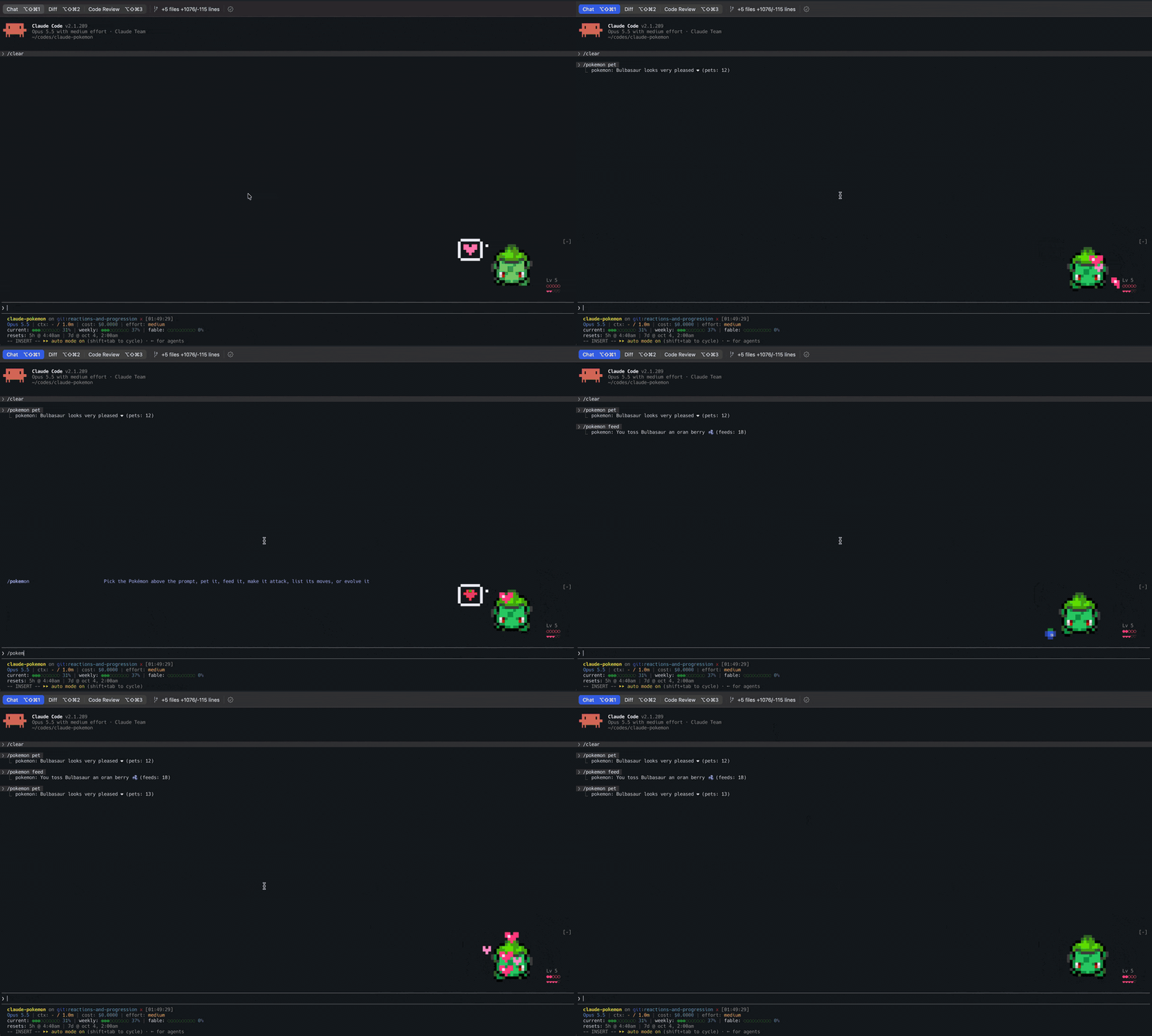
一個像素寶可夢住在你的 Claude Code 提示列上方,對 Claude 所做的一切做出反應。

Claude Code 輸出樣式(Epistemic Ink)搭配一個 mod,會把它寫出的 ```mermaid 和 ```math 圍欄繪製成終端機圖形;轉錄文字本來就能呈現的內容則維持文字。