jongwony@jongwony
jongwony/cc-plugin/tree/main/ink-figure
Claude Code 출력 스타일(Epistemic Ink)과 그 스타일이 작성한 ```mermaid 및 ```math fence를 터미널 도형으로 그리는 mod를 결합합니다. transcript 텍스트로 이미 그릴 수 있는 내용은 텍스트로 남깁니다.
jongwony/cc-plugin/tree/main/ink-figure
Ink-figure는 두 가지를 묶습니다. 출력 스타일 Epistemic Ink는 단계 제목, 게이트 및 인사이트로 답변 형식을 만들고, 답변에 그림이 필요하면 mermaid 또는 math fence를 작성합니다. figure mod는 이 fence를 터미널 transcript에 그립니다. 플로차트, 시퀀스·클래스·상태·ER 다이어그램은 계산된 상자 그림이 되고, 단일 시리즈 mermaid xychart는 축 차트가 됩니다. TeX math fence는 포함된 MathJax를 통해 이미지가 됩니다. 하나의 ui.render hook이 한 번의 처리로 AssistantMessage의 모든 fence를 읽습니다. 이 mod에는 Claude Code v2.1.287+와 인터랙티브 터미널이 필요합니다. 그리기 문법 밖에 있거나 터미널에 너무 넓거나 크기 제한을 넘거나 파싱할 수 없는 내용은 작성된 fence 그대로 남습니다. claude plugin marketplace add jongwony/cc-plugin 및 claude plugin install ink-figure@cc-plugin로 설치한 다음 /reload-plugins를 실행하세요.
먼저 작성자의 README에서 marketplace와 플러그인 이름을 확인하세요. 저장소 구조에 따라 명령어가 달라질 수 있습니다.
claude plugin marketplace add jongwony/cc-plugin
claude plugin install ink-figure
A Claude Code output style and a mod that draws the figures it writes.
↻ line, a departure that recurs
against the same clause of an extension the user maintains.In every reply while the style is active, not only during a protocol run, it
reaches for a fence wherever one fits. When the reader's task is taking in
relations at once — a graph, a flow, states, a sequence, classes, entities — it
writes a ```mermaid fence; for measured values over an ordered axis, an
xychart line chart (one series in whole units, the unit in the title, its scale
stated); for a two-dimensional formula, a ```math fence. It keeps a picture
small enough to hold (about 12 nodes, 24 at most), never draws box art by hand,
and names a focal node in the prose beside the fence, since node styling draws
nothing. The mod then draws the fence:
| Fence | Drawn as | What it is for |
|---|---|---|
| ```mermaid flowchart/graph, sequence, class, state, ER | box art | a computed diagram layout |
| ```mermaid xychart with a line series | an axis chart | a trend a sparkline cannot carry |
| ```math (TeX) | an image | 2-D structure: fractions, matrices, stacked scripts |
Everything text can write stays text: bar charts, tables and shaded matrices
(block characters, a stated scale, the harness's table columns), and flat
expressions such as a + b = c or O(n log n). Every other mermaid kind keeps
its fence.
One ui.render hook on AssistantMessage reads every fence in one pass, so a
reply holding several figures draws whole.
The mod needs Claude Code v2.1.287 or later (mods on by default) and the
interactive terminal. On any other surface, and for a fence that does not
parse, is not a drawn kind, holds a statement outside the drawn grammar or is
wider than the terminal, the fence is left as written. The Desktop app draws ```math
itself and shows other fences as code.
Where the fence is not drawn, it shows as written — the mermaid or TeX source, readable as it is; the style accepts that rather than fall back to hand-drawn art. The mod draws such fences under any output style, not only this one.
claude plugin marketplace add jongwony/cc-plugin
claude plugin install ink-figure@cc-plugin
Then /reload-plugins in a running session. The mod draws as soon as the plugin
is enabled; the style takes effect once it is picked — /output-style in a
session, or in settings.json:
{ "outputStyle": "ink-figure:Epistemic Ink" }
Standard mermaid source, within the grammar below. A top-down flowchart or state
diagram (a flowchart header with no direction is top-down, as in mermaid) is laid
out left to right when no word of the drawing is lost and it fits the terminal or
is no wider than the top-down layout; a flowchart written BT or LR keeps its
direction. Spacing is compact: three columns between boxes and one cell inside
them, left and right. A row that holds nothing but spaces and vertical lines running
straight through it is taken out, so a box stands three rows tall and a vertical line
keeps only the rows where it turns or ends; a line chart keeps every row, since its
height is the measured scale.
The renderer reads more of mermaid than it draws faithfully, so a fence is drawn only when every statement is one of these forms; any other statement leaves the whole fence as written. Each form has a test showing its drawing keeps its labels, arrows and direction, and the drawing must still show every label whole.
| Kind | Drawn forms |
|---|---|
| flowchart | header LR, TD, TB, BT or none; nodes A, A[text], A(text), A{text} (text quoted or not); one A --> B per line, optionally -->\|word\|; one edge per pair of nodes; style, classDef, class, click, linkStyle, accTitle:, accDescr: |
| state | direction LR or TB; A --> B between states or [*], optionally : text; state "text" as A; A : text; one transition per pair of states |
| sequence | participant A, participant A as text; A->>B: text, A-->>B: text, a self-message included |
| class | class A, class A { … }, A : member: Type name, name, name(), name() Type, each with an optional + - # ~, a name once per class; <\|--, *--, o--, -->, ..>, ..\|>, optionally : text, as chains (no class above two others or below two, no cycle) |
| ER | A ‹card›--‹card› B : label (-- or ..); A { type name … }; each entity in at most one relationship |
| xychart | upright xychart/xychart-beta; title "text"; x-axis [a, b, …]; y-axis min --> max in integers; one line [ … ] of integers |
A diagram that would stay top to bottom (a BT flowchart, a top-down one the
sideways layout does not take, a state diagram with direction TB) is drawn only
as one unlabelled chain: at one row between boxes a label or a branch draws over
the box borders.
Outside the grammar, among others: subgraphs, composite states and every edge to
them; graph RL; other edge shapes, chained edges and &; an edge label with a
space; notes; sequence blocks (alt, opt, loop, …), activations, actor,
autonumber, <br/> and arrows other than ->>/-->>; class methods with
parameters, overloads, undirected relations, multiplicities, generics,
annotations, namespaces and fan-outs; ER aliases, attribute keys and comments; a
chart's axis titles, fractional values, bars, second series and horizontal; and
a drawing whose title or category names would be cut or run together.
```mermaid
graph LR
  A[request] --> B[cache]
  B --> C[resp]
```
┌─────────┐   ┌───────┐   ┌──────┐
│         │   │       │   │      │
│ request ├──►│ cache ├──►│ resp │
│         │   │       │   │      │
└─────────┘   └───────┘   └──────┘
Labels are measured in screen cells, so Hangul and other double-width labels line
up inside the boxes. The drawing here uses ASCII labels because a web page's
monospace font does not give a Hangul character exactly two columns; in the
terminal, where it does, Hangul labels such as 서울 요청 line up the same way.
Borders and junctions are drawn cyan, arrows yellow, lines dim, through element styles.
A mermaid xychart (or xychart-beta) that holds one line series of integers
is drawn on a y-axis with ticks and grid dots, its categories under the x-axis,
the line in magenta. A value off its y-axis, or a series with more or fewer values
than the categories, keeps its fence.
```mermaid
xychart-beta
  title "Latency"
  x-axis [mon, tue, wed, thu, fri]
  y-axis 0 --> 120
  line [20, 35, 80, 60, 110]
```
The line is drawn as steps between the categories, on a plot at least 60 columns wide and 20 rows tall.
A ```math fence holds TeX (the base and ams packages) and is drawn as an
image. Use it only where the structure is two-dimensional — a fraction, a matrix,
a sum with stacked limits; a flat expression stays in the text.
```math
\frac{a+b}{c} = \sqrt{x^2 + y^2}
```
light* theme, light on a
dark* theme. With auto, which follows the terminal, the ink is a middle
grey that reads on either.\boxed) and array rules (|, \hline) are drawn as lines.
Malformed TeX, an unknown macro, a dashed rule, \text holding a character
the math font lacks (Hangul, for one; Latin \text{if } draws), or a line
break \\ or \newline that MathJax draws as a space (anywhere but a table
row: equation included) keeps the fence, as does a formula wider than the
terminal, one drawn with a colour, a background, hidden parts or a stroked
outline, any \pmb (each nesting doubles the work), any
\DeclareMathOperator (a chain of operators built from earlier ones grows the
same way; \operatorname draws), or any alignat or alignedat (its
column count is allocated as written; aligned draws).
Each fence is read on its own: an operator one fence declares does not
reach the next. A single $$…$$ or \[…\] wrapper around the whole fence is
ignored; a fence holding two display formulas keeps its fence.AssistantMessage is the finest site a mod can draw in, so a reply holding a
figure is redrawn as Markdown pieces around it. A piece over 10,000
characters, or one carrying escape codes another mod wrote into the reply,
makes the whole reply fall back to Claude Code's own drawing, and so does a
link reference or footnote definition ([1]: …, its destination on the same
line or the next), which the pieces would lose.- ~~~, > ```) is not drawn, and every fence inside it is its
text.𝐀, 🌡) or a control character such as a tab keeps its fence: the
terminal draws those in another number of cells than the layout can count.Diagrams and charts: beautiful-mermaid
1.1.3 (MIT, hooks/vendor/LICENSE), bundled into hooks/vendor/mermaid-ascii.js
with the patches in scripts/patches.mjs:
The kind table, the left-to-right flip and the role colouring are adapted from
claude-mermaid (Gal Elmalah, MIT,
hooks/vendor/LICENSE-claude-mermaid).
Math: MathJax 3.2.2 (Apache-2.0,
hooks/vendor/LICENSE-mathjax) turns TeX into SVG outlines, bundled into
hooks/vendor/math/; hooks/math.ts fills the outlines into pixels. The mod
runtime has no WebAssembly and no eval, and reads no module file over
1 MiB, so the bundle is split into chunks under that size.
hooks/vendor/mermaid-ascii.js and hooks/vendor/math/*.js are generated;
rebuild them after changing scripts/patches.mjs, scripts/math-entry.mjs or a
pinned renderer version (Node 22+). The build fails when a patch's anchor or
target file has moved upstream, or a file would exceed 1 MiB.
cd ink-figure && npm install && npm run build:vendor
claude plugin test

Claude Code용 Firstmate Calm입니다. 범선 작업 애니메이션과 대화만 보여 주는 트랜스크립트 표시를 제공하며 Pi Calm 확장과 home별 config/calm 설정을 공유합니다. hooks 모듈은 CLAUDE_CODE_ENABLE_FUNCTION_HOOKS 또는 Claude Code의 tengu_plugin_hooks_modules rollout flag를 통해 로드될 수 있지만, CLAUDE_CODE_ENABLE_FUNCTION_HOOKS가 정확히 1일 때만 mod가 활성화되고 그 밖에는 완전한 no-op입니다.

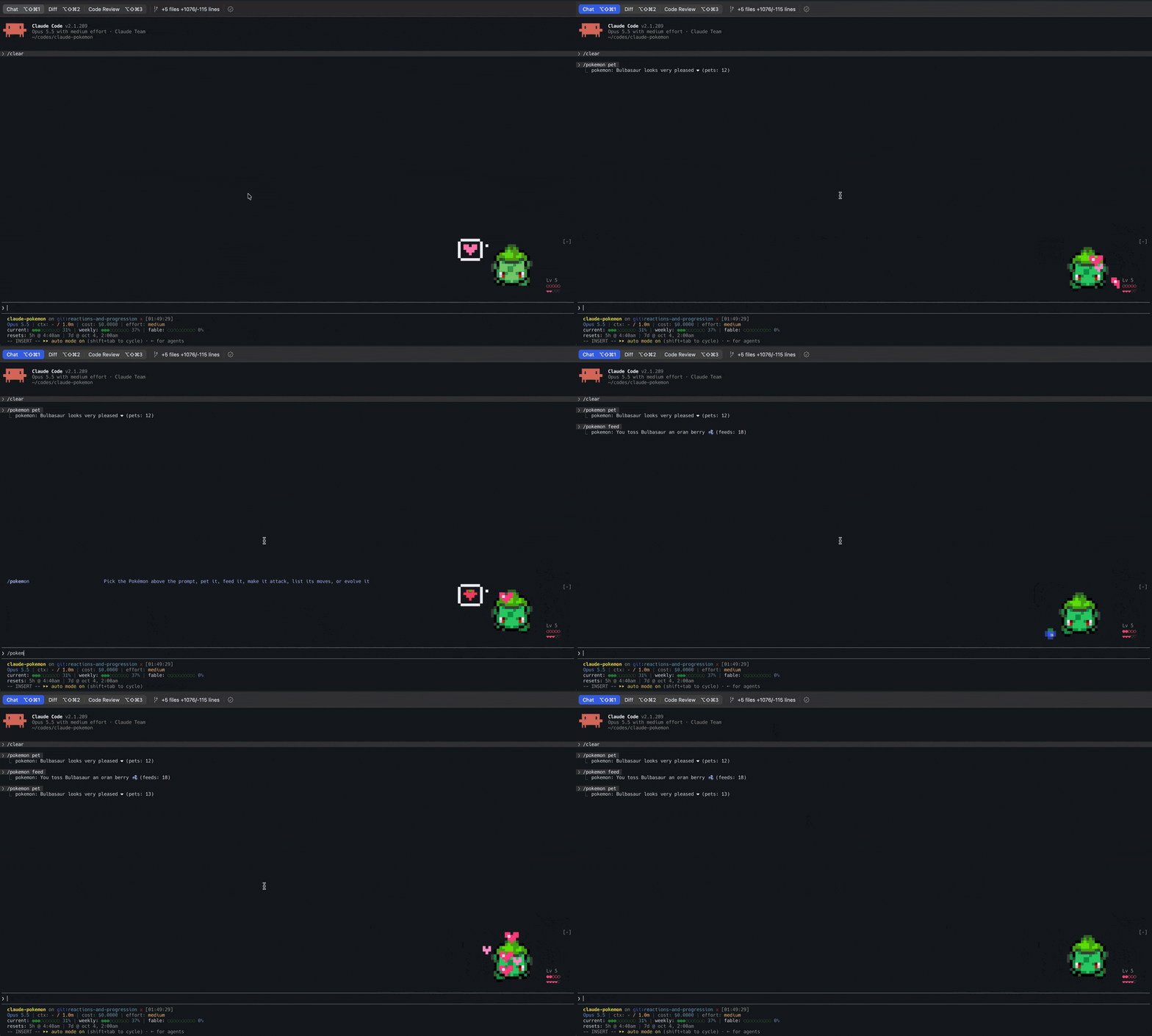
Claude Code 프롬프트 위에 사는 픽셀 포켓몬입니다. Claude가 하는 모든 것에 반응합니다.

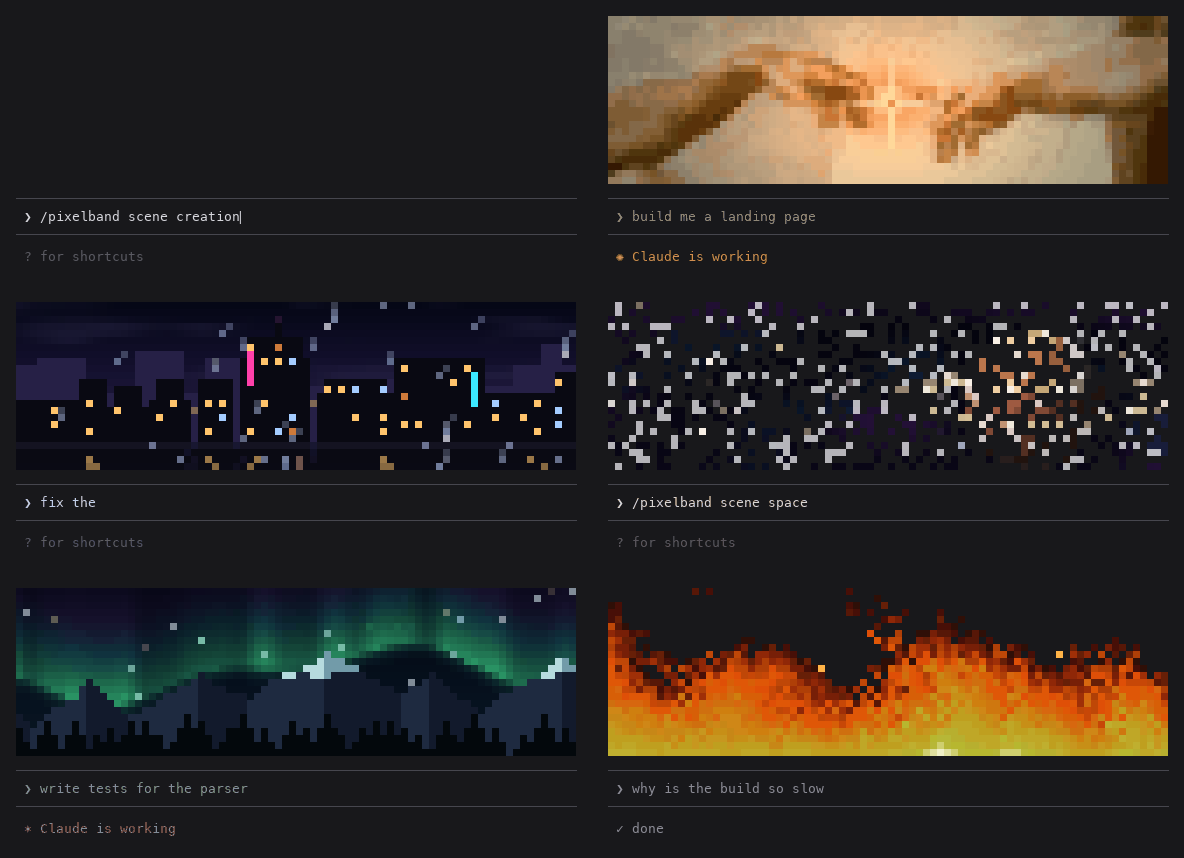
Claude가 작업하는 동안 반응하는 애니메이션 픽셀 아트를 Claude Code 프롬프트 위에 표시합니다. 일곱 장면 또는 자신의 이미지/GIF를 사용할 수 있으며 token을 쓰지 않습니다.