
manfye@manfye
manfye/cc-dino
function hooks로 프롬프트 위에서 오프라인 공룡 게임을 실행하는 Claude Code 플러그인입니다. 대화형 터미널과 function hooks 활성화가 필요합니다.
manfye/cc-dino
오픈 소스 Claude Code mod입니다. hooks 모듈이 /dino를 등록하고 ui.render에서 프롬프트 위에 게임 배너를 그리며 turn.complete에서 일시 중지하고 최고 점수를 플러그인 저장소에 기록합니다. Claude Code 2.1.269+, CLAUDE_CODE_ENABLE_FUNCTION_HOOKS=1, 대화형 터미널이 필요합니다. claude plugin marketplace add manfye/cc-dino와 claude plugin install cc-dino@cc-dino로 설치한 뒤 /dino를 실행하고 보드를 클릭해 게임에 키보드를 넘깁니다. 조작은 점프(space/up/w/Enter/click), 타이밍에 맞춘 숙이기(down/s), 일시정지(p), 재시작(r), Esc로 키보드를 프롬프트에 돌려주기입니다. 게임에는 선인장 무리, 200점부터 나타나는 익룡, 2.4 cells/frame으로 제한된 속도 조정, 700점마다 오는 밤, 지속되는 최고 점수가 있습니다. 구현 메모에는 반 행 비트맵 스프라이트, 33 ms 프레임 시계, 프레임 속도와 무관한 튜닝, h 바인딩과 모듈 문자열 리터럴에 관한 surface-module 주의사항이 설명되어 있습니다. MIT 라이선스입니다.
먼저 작성자의 README에서 marketplace와 플러그인 이름을 확인하세요. 저장소 구조에 따라 명령어가 달라질 수 있습니다.
claude plugin marketplace add manfye/cc-dino
claude plugin install cc-dino
The offline dinosaur, above the Claude Code prompt.
Run /dino, click the board, and jump cacti while Claude works on your request. When Claude
finishes the turn the run pauses and the status line says so, so you never miss a reply. Playing
costs no tokens: the plugin answers every key and click itself, without asking the model.
A clone of the genre, not affiliated with or endorsed by Google.
CLAUDE_CODE_ENABLE_FUNCTION_HOOKS=1 set. Function hooks
are in early access and the API can change between releases.claude -p, the desktop app or mobile.Turn function hooks on. Add this to ~/.claude/settings.json (create the file if it does not
exist, or merge the env key into what is there). Without it the plugin installs fine but does
nothing.
{
  "env": {
    "CLAUDE_CODE_ENABLE_FUNCTION_HOOKS": "1"
  }
}
This also loads the hooks module of any other installed plugin that ships one. For a single
session instead, prefix the command: CLAUDE_CODE_ENABLE_FUNCTION_HOOKS=1 claude.
Install from GitHub. The repo is its own marketplace:
claude plugin marketplace add manfye/cc-dino
claude plugin install cc-dino@cc-dino
Start claude — an interactive session, not claude -p — and run /dino.
Click the board, then press space. The click is what gives the game the keyboard; until then your keys go to the prompt. Esc gives the keyboard back.
To remove it:
claude plugin uninstall cc-dino
claude plugin marketplace remove cc-dino
To try it without installing, or to hack on it, clone and load it for one session:
git clone https://github.com/manfye/cc-dino
cd cc-dino
claude --plugin-dir .
The repo's own .claude/settings.json sets the variable for sessions started inside the folder.
| | |
|---|---|
| space, ↑, w, Enter, or a click | jump — and start the next run after a crash |
| ↓, s | duck, for about 0.6s (a terminal reports no key release, so a duck is timed) |
| p | pause |
| r | start again |
| Esc | give the keyboard back to the prompt |
/dino stop or the close button closes the board. /dino reset clears the best score.
It is a mod: a plugin whose behaviour is a hooks module of TypeScript running inside Claude
Code's process, rather than shell commands in settings.json.
hooks/register.tsx is the hooks module. It registers /dino on session.start, answers it on
command.run, draws the band on ui.render for AbovePrompt, pauses the run on turn.complete,
and keeps the best score in $.store — taking a finished run's score off ui.message.hooks/boards/dino.tsx is a surface module, mounted as a Client element. It runs on the
drawing thread with its own 33 ms frame clock, keyboard and mouse, and posts a finished run's score
back to the hooks module.hooks/games/dino.ts is the rules — gravity, spawning, collision — as pure functions over a plain
state object, so they can be simulated without a terminal.The dino is drawn from a bitmap of half-rows, not from characters: a terminal row holding the
sprite's upper half is ▀, its lower half ▄, both █. So the sprite moves in half cells, and a
jump draws 11 distinct positions where whole cells would give 6.
The bitmap is five columns by four half-rows, which is about square once the terminal's 2:1 cell is accounted for — the room a tyrannosaur's silhouette needs:
  hr3   . . . # #        snout                 ▄█▀
  hr2   . . # # .        head and neck       ▀▀█▄
  hr1   # # # . .        tail and body
  hr0   . . # # .        legs
The two leg frames differ in hr0 alone, so the run cycle is a foot lifting rather than the whole
body bobbing. The hit box covers the three columns of body, head and legs; the tail overhangs two
cells further left and is not hittable, since a tail that ends a run is a hit the player cannot read
off the sprite. The frame clock runs at 33 ms for
the other half of it. The game constants are per-frame and therefore tied to FRAME_MS — at twice
the frame rate a velocity halves and an acceleration quarters — so hooks/games/dino.ts derives the
obstacle gap from the jump's airtime rather than from a hand-tuned cell count, and the tuning
survives a change of frame rate.
The hit test rounds the dino's feet to the nearest cell instead of flooring them, so the half cell the board can draw but the test cannot see is an error in the player's favour.
The other half of smoothness is not clipping: the region holds two border rows, the sky, the ground and the status line, and a board that asks for more than that loses the top of every jump.
Two things that will bite you if you write one of these:
h in a surface module: every JSX tag compiles to a call of h.module= on a Client must be a string literal — the engine reads the path off the source,
not off the running value.claude plugin validate . # manifest, hooks, and the $ calls each module makes
CLAUDE_CODE_ENABLE_FUNCTION_HOOKS=1 claude -p "/plugin-types" # writes .claude/types/claude-code.d.ts
npm i -D typescript && ./node_modules/.bin/tsc -p tsconfig.json
.claude/types/claude-code.d.ts is the real API reference; it is regenerated per release and is not
checked in.
MIT

Claude가 작업하는 동안 패널에서 실행되는 Snake이며 끝나면 일시 중지됩니다. opt-in이므로 /snake를 입력하기 전에는 열리지 않습니다.

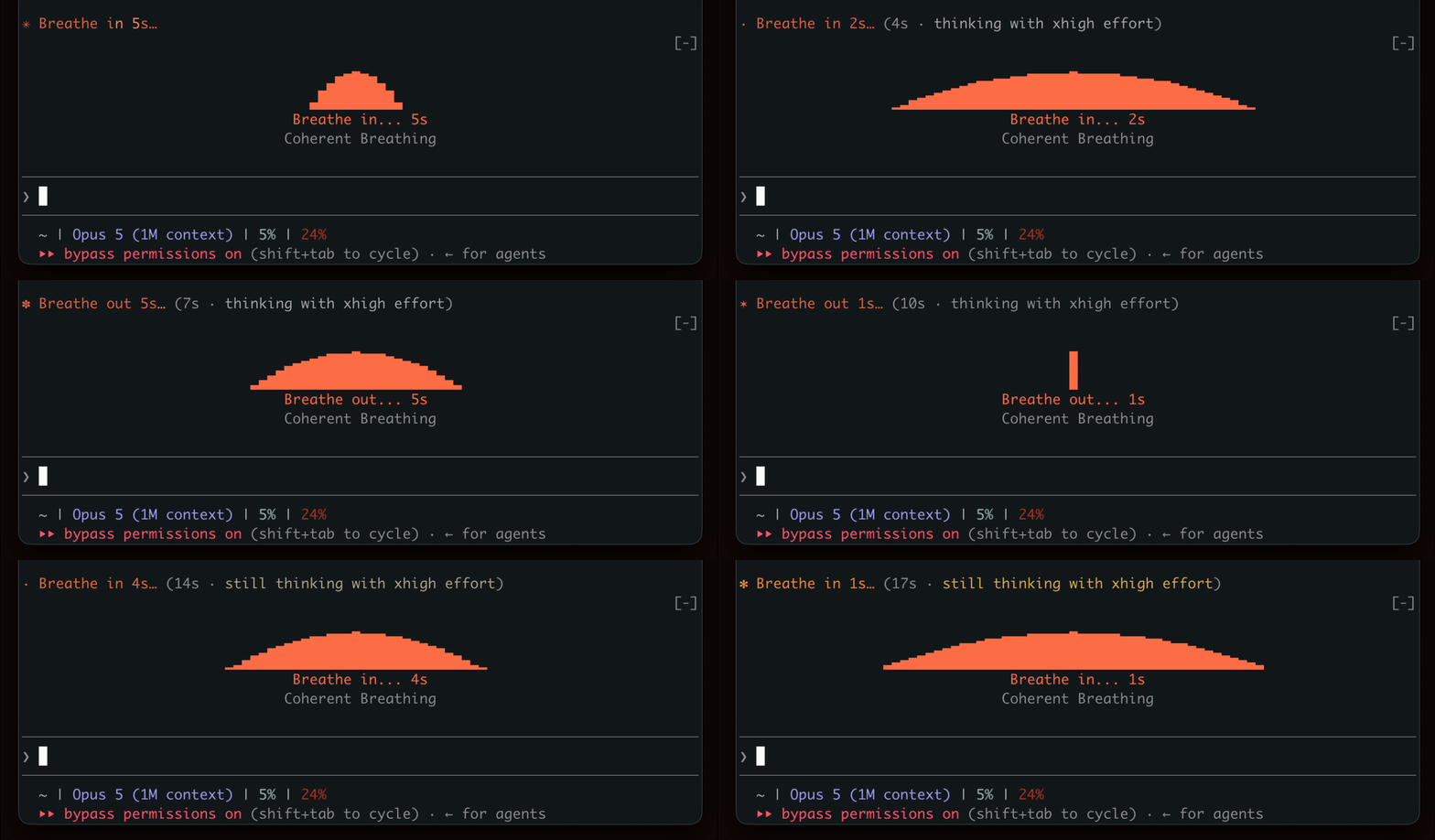
세대를 기다리며 호흡의 리듬을 보여주며 잠시의 휴식을 독려한다.

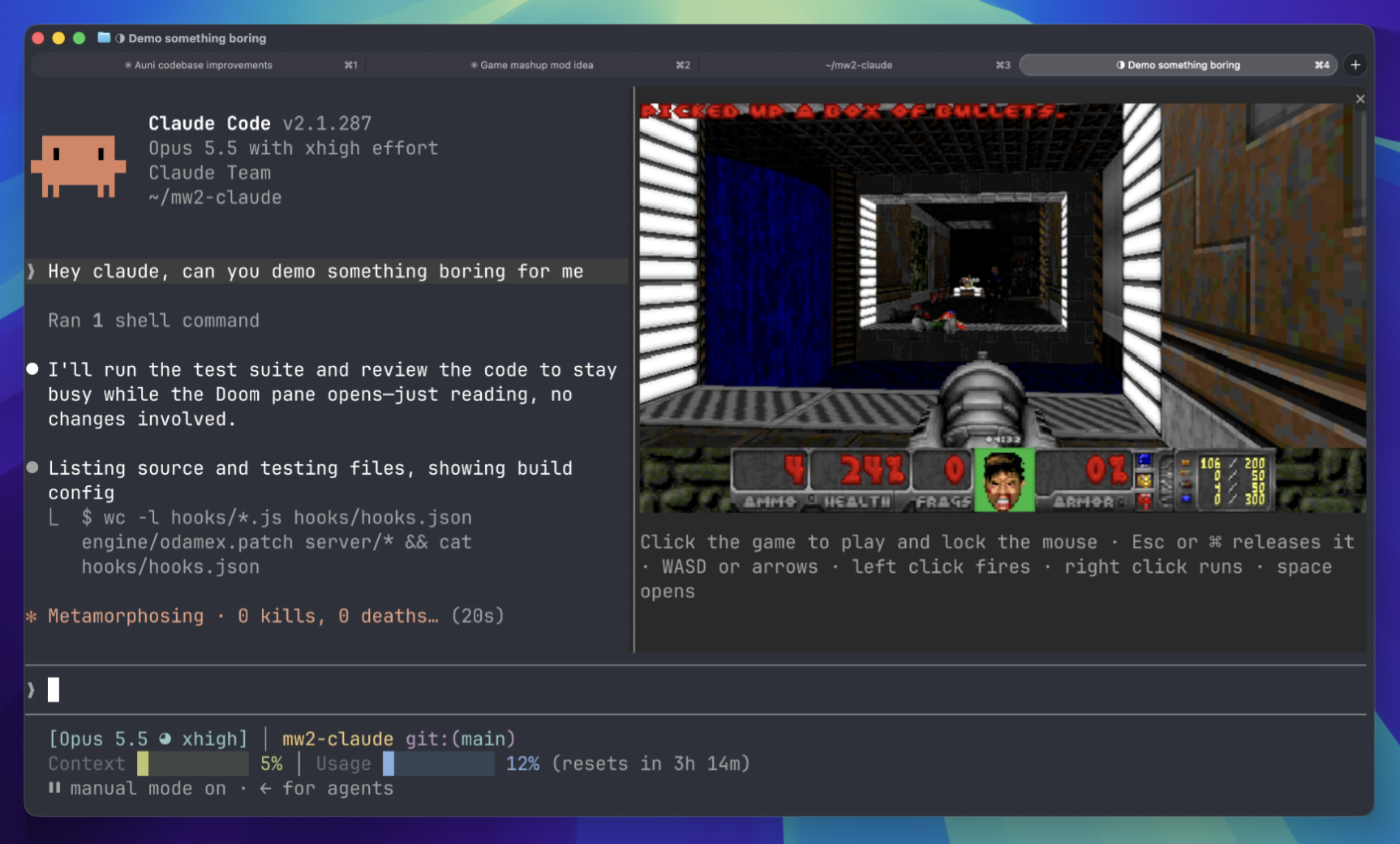
기다리는 동안 터미널 패널에서 Doom 경기를 플레이하세요. 게임 구성 요소를 다운로드하고 서버에 연결해야 합니다.
 ▶ ♫
▶ ♫