
ruihe774@ruihe774
ruihe774/cc-micro-compaction
A Claude Code plugin that adds `/compact micro`, a manual compaction mode which locally elides Read tool results (including images and PDFs) and strips thinking blocks while keeping the rest of the transcript intact.
ruihe774/cc-micro-compaction
micro-compaction registers exactly one hook on the session.compact event with a trigger: 'manual' filter. When you run /compact micro, the hook rewrites the message list in memory instead of asking a model to summarize: successful Read tool results are replaced with short placeholders (covering text, images and PDFs), thinking-only messages are dropped, and everything else—prompts, replies, tool calls and non-Read tool output—is preserved. Other /compact invocations, with or without instructions, pass through unchanged to Claude Code's normal model-written summary, as do automatic and plugin-driven triggers.
Installation is through the official Anthropic plugin directory (claude plugin marketplace add anthropic-plugin-directory then claude plugin install micro-compaction@anthropic-plugin-directory), and requires Claude Code v2.1.287 or later. The plugin makes no model calls, no network requests and no shell commands, reads no files, and stores or transmits no data; it only edits the in-memory message list and writes one debug log line with counts of elided reads and dropped thinking blocks. Core logic is a pure function microCompact(messages) in hooks/elide.ts with unit tests, and elision is idempotent so repeated runs are safe.
まず作者の README で marketplace とプラグイン名を確認してください。コマンドはリポジトリの構成によって変わる場合があります。
claude plugin marketplace add ruihe774/cc-micro-compaction
claude plugin install micro-compaction
A Claude Mod that adds micro-compaction as /compact micro. Instead of asking a model to summarize your whole conversation, it trims the two bulkiest and cheapest-to-recover parts of the transcript and leaves everything else exactly as it was.
When you run /compact micro, the plugin rewrites the conversation transcript locally:
Read tool result is replaced with a short placeholder such as [file contents elided by compaction: <path>, N lines. Read it again if needed.] (or lines A-B for partial reads). Images and PDFs get one too ([image elided by compaction: <path>, WxH. …], [PDF elided …], [PDF pages elided …, pages N]), since their image and document blocks are usually the largest results in a conversation. Claude can read the file again on its own whenever it needs the contents.Some results are deliberately left alone: errored reads, text results already shorter than their placeholder ("unchanged since last read" stubs, tiny files), and earlier placeholders. Running /compact micro repeatedly is safe, because elision is idempotent.
/compact micro./compact, with or without instructions (/compact keep the plan), is passed through unchanged to Claude Code's normal model-written summary.Requires Claude Code v2.1.287 or later.
Install it from the official Anthropic plugin directory. In case you haven't added this marketplace yet, add it first, and refresh it to get the latest listing:
claude plugin marketplace add anthropic-plugin-directory
claude plugin marketplace update anthropic-plugin-directory
claude plugin install micro-compaction@anthropic-plugin-directory
If you prefer using the TUI, inside a session, use /plugin marketplace add, /plugin marketplace update and /plugin install with the same arguments.
To update to a newer release later:
claude plugin marketplace update anthropic-plugin-directory
claude plugin update micro-compaction@anthropic-plugin-directory
To try a local checkout while developing, load it directly instead:
claude --plugin-dir /path/to/micro-compaction
Then run /compact micro. Plain /compact keeps working as usual.
bashOutputMaxChars in your Claude Code config. Micro-compaction leaves Bash output alone, but long output is spilled to a file that Claude then reads with Read, and that read can be elided. The default threshold is 30000 characters; a lower one (for example 10000) spills more output to files, so more of it can be stripped./compact (the default) is a better fit, as is /clear. Micro-compaction keeps everything except file reads and thinking, so it can't discard irrelevant discussion.Read tool for file contents. Only Read results are elided. Output from cat in Bash, or from other tools such as MCP tools, web fetches and searches, is kept as is./compact for a summary, or rely on automatic compaction, which always uses the normal summary.The plugin registers exactly one hook, on the session.compact event, with the filter trigger: 'manual'. session.compact is also the name of the call that Claude Code makes to compact a conversation, so this hook sees the conversation's message list for every manual /compact. It changes the call only when the instructions are exactly micro (ignoring surrounding whitespace and case): then it returns a rewritten list (file reads elided, thinking dropped) in place of core's model-written summary. For any other /compact, with or without instructions, it calls next with the call unchanged, so Claude Code compacts as usual. Other triggers (automatic, plugin, precompute) never reach the hook because of its trigger: 'manual' filter. The plugin never makes the session.compact call itself, and it hooks no other event.
session.compact hook, written in TypeScript (hooks/register.ts and hooks/elide.ts), inside Claude Code.The core logic is the pure function microCompact(messages) in hooks/elide.ts, covered by unit tests in tests/elide.test.ts.
claude plugin validate .
claude plugin test

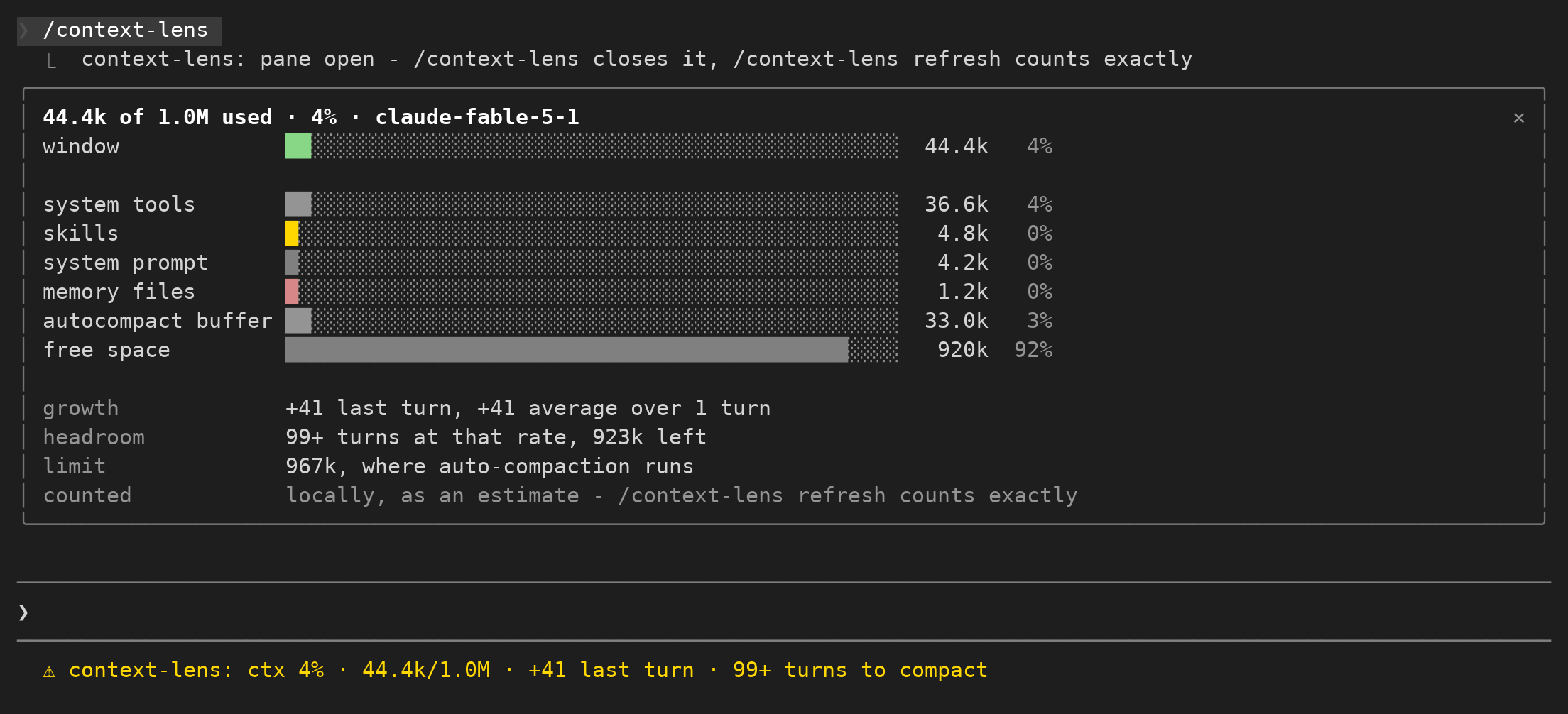
コンテキストウィンドウの使用量と各ターンの増加を表示し、整理のタイミングを判断できます。
コンテキストウィンドウを脳として描画。ツール呼び出しで対応する脳領域が光り、使用量が増えるほど混み合い、compact 時には睡眠のような整理を表現します。


Claude が考えている間に、入力ボックスの上に小さなカードを表示する Claude Code モッド。毎日 Hacker News と GitHub のトレンドリポジトリから概念を 1 つ選び、あなたに出題します。