drewpayment@drewpayment
drewpayment/jev-route
TypeSafe の意思決定モデル Jev を使い、各ターンを対応可能な最安の Claude モデルへルーティングする Claude Code プラグインです。/route で切り替えます。
drewpayment/jev-route
各ターンを対応可能な最安の Claude モデルへルーティングする Claude Code プラグインです。プロンプトを実行する前に、TypeSafe の意思決定モデル Jev へ、プロンプトに必要なモデル能力(fast、balanced、powerful)と、不注意な回答のリスクを問い合わせます。その後、そのターンのすべての API リクエストでモデルを書き換えます。単純なプロンプトは Haiku、日常のコーディングは Sonnet、難しい仕事やリスクの高い仕事は Opus に送ります。ターン全体で一つのモデルを共有するため、プロンプトキャッシュも維持されます。
早期アクセスの hooks-module プラグインです。Claude Code 2.1.259+、CLAUDE_CODE_ENABLE_FUNCTION_HOOKS=1 フラグ、TypeSafe または Vercel AI Gateway のキーが必要です。プロンプト本文(秘密情報を削除し、最大 20k 文字)は、判定のため設定済みプロバイダーへ送信されます。
まず作者の README で marketplace とプラグイン名を確認してください。コマンドはリポジトリの構成によって変わる場合があります。
claude plugin marketplace add drewpayment/jev-route
claude plugin install jev-route
A Claude Code plugin that routes each turn to the cheapest capable Claude model.
Before a prompt runs, it asks Jev, TypeSafe's decision model, how much model
capability the prompt needs (fast, balanced or powerful) and how risky a
careless answer would be, then rewrites the model for every API request of that
turn. Trivial prompts go to Haiku, everyday coding stays on Sonnet, hard or risky
work moves up to Opus, and the whole turn shares one model so the prompt cache is
kept. Between turns it is cache-aware too: a routed model is only left when the
thresholds say so, effort is never changed on a model that is kept, and once the
conversation is large, downgrades stop (a cold cache write on a cheaper model costs
more than the turn saves). Toggle it any time with /route. Nothing is
installed beside the plugin itself: no shell hooks, no MCP server, no npm
dependencies.
Early access. jev-route is a hooks module plugin, an early-access Claude Code feature. The plugin API may change between releases; see Early-access caveats.
Claude Code 2.1.259 or later (claude --version). Developed and verified
against 2.1.283 and 2.1.284.
The early-access flag CLAUDE_CODE_ENABLE_FUNCTION_HOOKS=1 in Claude Code's
environment. Without it the plugin installs but never loads. The env block of
~/.claude/settings.json is the easiest place; see Quick start.
A Jev key from one of two providers. Both speak the same TypeSafe wire format; the plugin only changes the base URL.
provider=typesafe), orprovider=gateway).Without a key the plugin can still route with Claude Code's built-in classifier
(fallback_classifier), which never leaves the machine but has no risk signal.
# 1. Register the marketplace (this repository) and install the plugin
claude plugin marketplace add drewpayment/jev-route
claude plugin install jev-route@drewpayment

# 2. Turn on hooks modules (early access). Add to the "env" block of
#    ~/.claude/settings.json, keeping any keys already there:
#    { "env": { "CLAUDE_CODE_ENABLE_FUNCTION_HOOKS": "1" } }

# 3. Configure the provider and key, either non-interactively at install time...
claude plugin install jev-route@drewpayment --config provider=gateway --config jev_api_key=YOUR_KEY
#    ...or inside Claude Code with the configure form (enter the key LAST, then Save):
#    /plugin configure jev-route

# 4. Restart Claude Code, then check
#    /route status
/route status should show enabled: yes, API key: present (...), source: jev
and no last error line. The first eligible prompt you send sets the status line to
something like route: fast claude-haiku-4-5 0.97.
Prefer to let Claude do it? Start Claude Code and paste this prompt. It never asks Claude to print the key back.
Set up the jev-route plugin for me. Follow these steps in order and confirm each
one before moving on.

1. Register the marketplace and install the plugin by running, in a shell:
     claude plugin marketplace add drewpayment/jev-route
     claude plugin install jev-route@drewpayment
   If either command reports the marketplace or plugin already exists, that is fine.

2. Enable hooks modules. Read ~/.claude/settings.json (create it as {} if missing).
   Add "CLAUDE_CODE_ENABLE_FUNCTION_HOOKS": "1" inside its top-level "env" object,
   creating "env" if it does not exist. Preserve every other key and value in the
   file exactly as they are; do not remove or reorder anything else. Show me the
   resulting "env" block, but mask the values of any key that looks like a secret.

3. Ask me which Jev provider I use: "typesafe" (TypeSafe API key) or "gateway"
   (Vercel AI Gateway key). Then ask me to paste the key. Treat the key as a secret:
   never repeat it, never print it in a summary, never write it to any file, and
   never put it in a commit. Offer me two ways to store it and do the one I pick:
     a) Non-interactive: run
          claude plugin install jev-route@drewpayment --config provider=<provider> --config jev_api_key=<key>
        substituting my answers. Do not echo the command back with the key in it.
     b) Interactive: tell me to run /plugin configure jev-route in Claude Code,
        set "Jev provider" to my answer, and enter the "Jev API key" as the LAST
        field before pressing Save (the form sometimes drops a sensitive value
        that is not the last one entered).

4. Tell me to fully restart Claude Code (the flag from step 2 and the newly
   installed plugin only take effect on a fresh start), then to run /route status.

5. Ask me to paste the output of /route status. Verify it shows "enabled: yes",
   "API key: present", "source: jev" and that there is no "last error" line. If the
   key is missing, tell me to re-enter it with /plugin configure jev-route (key
   last) or to put it as JEV_API_KEY in the "env" block of ~/.claude/settings.json.
   If "source" is "builtin", the key was not picked up. If there is a "last error",
   explain it using the Troubleshooting section of
   https://github.com/drewpayment/jev-route#troubleshooting.
Claude Code prompts for the options when the plugin is enabled. To change them
later run /plugin configure jev-route, or pass --config KEY=VALUE to
claude plugin install.
| provider | key | base URL (derived) |
|------------|---------------------------|------------------------------------------|
| typesafe | TypeSafe API key | https://api.typesafe.ai |
| gateway | Vercel AI Gateway key | https://ai-gateway.vercel.sh/typesafe |
| custom | whatever your proxy wants | you must set jev_base_url |
jev_api_key is marked sensitive, so Claude Code masks it on input and keeps it
in secure storage rather than settings.json. When it is empty the plugin falls
back to the env block of your settings, trying JEV_API_KEY, then
AI_GATEWAY_API_KEY, then TYPESAFE_API_KEY. That is plaintext in
settings.json, so prefer the configure form when it works. /route status
reports which source the key came from and never prints it.
All options:
| key | default | meaning |
|------------------------|-----------------------------|----------------------------------------------------------------------|
| provider | typesafe | typesafe, gateway or custom |
| jev_api_key | | API key (sensitive) |
| jev_base_url | "" | override / custom endpoint; empty derives from provider. Must be https (http only for localhost/127.0.0.1); anything else is refused and shown as a config error |
| jev_model | jev-latest | Jev model id sent in the request |
| model_fast | claude-haiku-4-5 | model for the fast tier |
| model_balanced | claude-sonnet-5-5 | model for the balanced tier |
| model_powerful | claude-opus-5-5 | model for the powerful tier |
| upgrade_confidence | 0.3 | min confidence to move to a more capable tier than the current one |
| downgrade_confidence | 0.6 | min confidence to move to a cheaper tier than the current one |
| switch_lock_tokens | 50000 | context size (tokens) from which downgrades are blocked; risky still moves up; 0 disables the lock |
| timeout_ms | 800 | hard budget (50..5000) for the whole Jev call: fetch, body and parse; on timeout the session model is kept |
| route_effort | true | when a turn is moved to another model, pin that model's effort too (balanced=medium, powerful=high; never sent to haiku). Never touches the effort of a kept model |
| fallback_classifier | true | with no key, use Claude Code's built-in small-model classifier |
| log_decisions | false | toast each decision (tier, confidence, risky, latency) and, when the turn completes, its context size and cache hit rate |
The model fields take full model ids or the aliases haiku / sonnet / opus.
Current ids at the time of writing: claude-haiku-4-5, claude-sonnet-5-5,
claude-opus-5-5, claude-fable-5-1. The model_balanced default is
claude-sonnet-5-5 (Sonnet 5.5). A model your
policy does not allow is refused by the engine with a warning and the request keeps
its own model.
/route commands/route toggle routing on/off (persists across sessions)
/route on
/route off stop new decisions; a turn already running keeps its rewrite
/route status enabled, provider, base URL (userinfo redacted), key present and
its source, model map, thresholds, switch lock, config error,
context size of the last request, last decision and its cache
usage, last error
/route setup how to set the options and the env flag
tier
(fast / balanced / powerful, with a confidence) and a risky score, under
one hard deadline (timeout_ms). The prompt itself is always passed through
untouched. Any error or timeout means no decision: the session model runs.haiku < sonnet < opus < fable). Upgrade when
confidence >= upgrade_confidence, downgrade when
confidence >= downgrade_confidence, risky >= 0.7 always goes to powerful,
otherwise stay. Coming back from a routed model to the session model is a move
like any other and pays the same threshold, so one strong grade cannot flap the
conversation between two caches.switch_lock_tokens, downgrades are blocked and the status line says
(locked); upgrades and risky still move up. The context size comes from the
usage of each request; until one has been seen the lock is off.fable session: nothing is changed. A [1m] session carries [1m] onto
targets that have a 1M window; Haiku has none (200k), so on a [1m] session it
is only used while the context is known to be under 150k tokens, else the turn
takes the next tier up. Subagent turns are never rewritten.last, shown by /route status and sent
to Jev as previous_tier so "yes", "continue", "now fix the tests" stay on the
tier that did the work. The decision also anchors the next turn's hysteresis
(step 2) as long as the session model has not been changed in between.Fallback: with no key and fallback_classifier on, Claude Code's built-in
classifier picks the tier from the same redacted text (confidence 1.0, no risk
signal); /route status shows source: builtin.
route: <tier> <model> <confidence>[ (kept)| (locked)], for example
route: fast claude-haiku-4-5 0.97, or
route: balanced claude-sonnet-5-5 0.41 (kept) when the session model runs the
turn untouched, or route: balanced claude-sonnet-5-5 0.92 (locked) when a cheaper
tier was asked for but the context is past switch_lock_tokens. It is set when the
decision settles on the first request of the turn. route: on means routing is enabled but there is no
decision for this turn (Jev failed, timed out, or the prompt was not graded).
route: off when disabled.
The key does not stick. The configure form does not reliably persist a
sensitive value unless it is the last field entered before Save. Re-open
/plugin configure jev-route, enter the key last, Save. If it still does not
stick, put it in the env block of ~/.claude/settings.json as JEV_API_KEY
(or AI_GATEWAY_API_KEY / TYPESAFE_API_KEY) and restart. /route status names
the source it used (from userConfig or from settings env JEV_API_KEY).
Status line says route: on but never shows a decision. Routing is enabled
but Jev returned nothing. Run /route status and read last error:
jev: unauthorized (bad API key) means the key is wrong or for the other
provider, jev: rate limited / jev: overloaded are transient, timeout after 800ms means raise timeout_ms or check the network, jev: unparseable response
usually means jev_base_url points at something that is not a Jev endpoint, and
no timer available means the engine exposed no clock (report it).
turn.step: model X is not allowed by policy. Your organisation's model
policy refuses that id; the request keeps its own model. Set model_fast /
model_balanced / model_powerful to ids your policy allows.
Model id not available. The defaults are claude-haiku-4-5, claude-sonnet-5-5 and
claude-opus-5-5. If your account does not have one of them, set that tier to an id
your /model picker lists, or to the alias haiku / sonnet / opus.
"hooks modules are not turned on for installed plugins in this process".
CLAUDE_CODE_ENABLE_FUNCTION_HOOKS=1 is not in the environment. Add it to the
env block of ~/.claude/settings.json (or export it in your shell) and fully
restart Claude Code.
Configured it once, but a session started with --plugin-dir (or the installed
copy) ignores it. A session-loaded plugin has the id jev-route@inline; the
marketplace install is jev-route@drewpayment. Claude Code stores pluginConfigs
and the secure-storage key per id, so each needs its own configuration. Configure
whichever one you actually run, or use the settings env fallback, which both
read.
/route status shows config error. jev_base_url was refused: it must be
https:// (plain http:// only for localhost / 127.0.0.1), no trailing slash
needed.
When routing is on, the text of each eligible prompt (secrets redacted, up to
20k chars) is sent to the provider you configured (TypeSafe directly, Vercel AI
Gateway, or your custom endpoint) to be graded. Nothing else from the session is
sent: no files, no tool output, no previous messages, only the prompt and the
previous turn's tier label. Anything that looks like a credential is replaced with
[REDACTED] first: sk-…, AKIA…, ghp_…, AIza…, sk_live_…, PEM private
keys, JWTs, user:pass@ in URLs, password|secret|token|api_key = value
assignments and Bearer <token>. Run /route off or unset the key to stop sending
prompts; the built-in fallback keeps everything inside Claude Code.
claude plugin marketplace update drewpayment
claude plugin update jev-route@drewpayment
Then restart Claude Code. A new copy is only fetched when the plugin's version
changes; see CHANGELOG.md.
git clone https://github.com/drewpayment/jev-route ~/dev/jev-route
cd ~/dev/jev-route
bun test tests                                          # pure modules + register.ts under a mocked 'claude-code'
claude plugin validate . --strict                       # marketplace + the plugin.json it points at
claude plugin validate .claude-plugin/plugin.json --strict   # plugin manifest + static scan of the hooks module
claude --plugin-dir .                                   # load the checkout in place (id jev-route@inline)
Inside a session started with --plugin-dir, /plugin-types writes the engine's
full .d.ts so tsc --noEmit typechecks hooks/register.ts against the real
Register type, and /reload-plugins reloads after edits. See
docs/CONTRIBUTING.md for the rules the engine enforces on
the module, and docs/DESIGN.md / docs/ENGINE-API.md
for how it works.
claude-code module API can change. The
plugin reads a few engine shapes defensively (the options argument of
register, the $.http.fetch result, $.store signatures).timeout_ms, max 5 s). The built-in fallback
runs under the same budget.log_decisions uses toasts, and the engine drops toasts within 2 s of the
previous one./route status shows the last error.MIT © 2026 Drew Payment

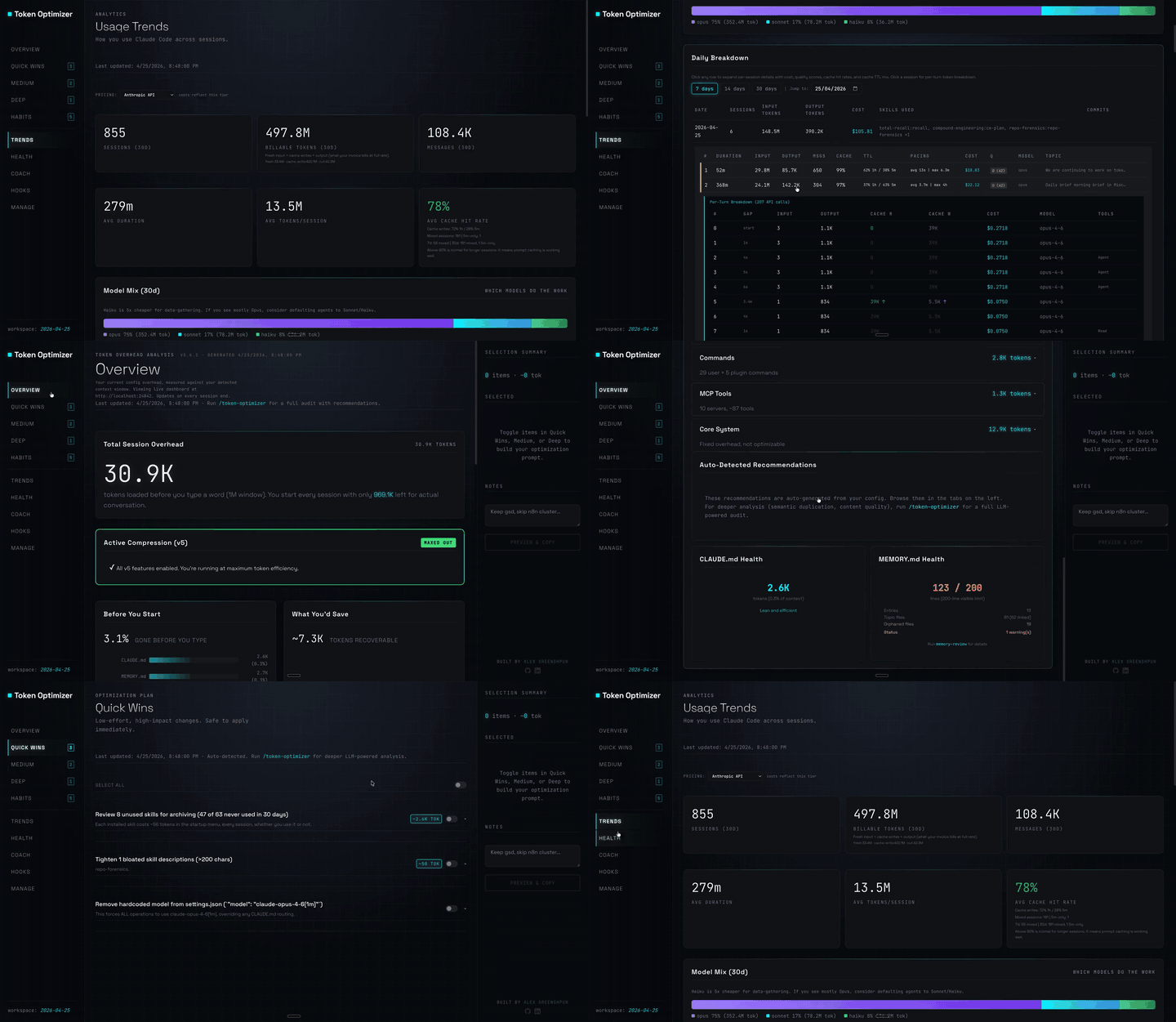
ツール出力を圧縮し、コンパクション前にチェックポイントを作成し、コンテキスト品質を採点して、ローカルダッシュボードに token/コスト削減を表示する Claude Code プラグインです。hooks と localhost デーモンも含みます。

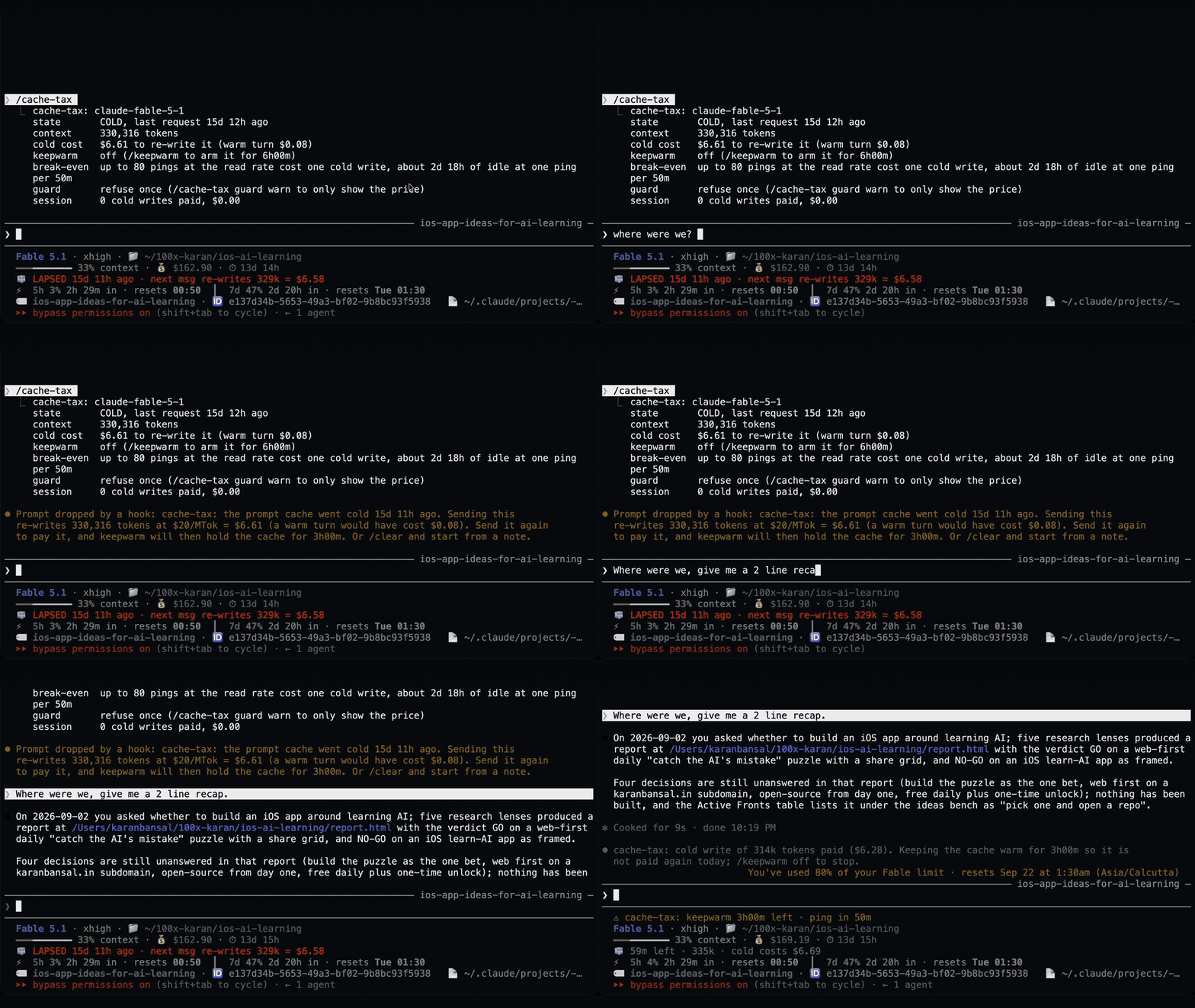
無操作のセッションのプロンプトキャッシュをサイレントな ping で温め、キャッシュが温かいうちに大きなセッションを 1 回だけ圧縮する Claude Code mod です。
休憩中も 1 時間のプロンプトキャッシュを温め、冷えた状態での送信を推定書き換えコストとともに一度止める Claude Code mod。ウォームアップはモデル要求を使い、トークンを消費します。Claude Code 2.1.287+ が必要です。